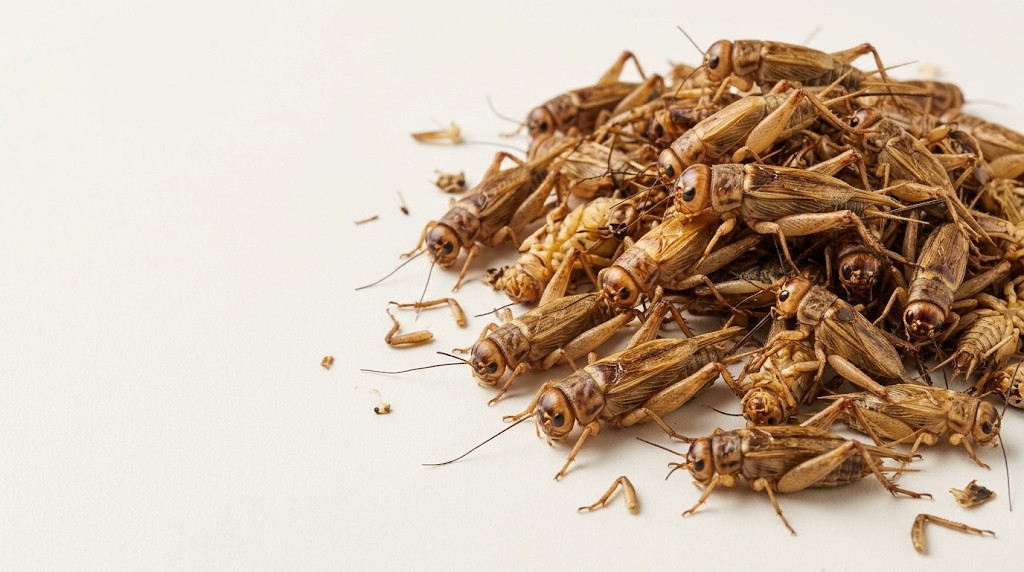

Buying bulk dried crickets requires more than comparing price and protein claims. Commercial buyers need to confirm species, whole-product grade, body condition, detached legs and wings, moisture, cleanliness, batch testing, and packaging. These factors influence how the product looks, handles, stores, and performs in repacking or further processing.
Two suppliers may both quote “whole dried crickets” while offering visibly different products. One grade may prioritize recognizable bodies and retail presentation. Another may allow more detached appendages and fragments for ingredient or farm use. Drying method, sorting, package size, and transport pressure can also affect the condition that reaches the buyer.
This guide explains how distributors, importers, wholesalers, resellers, pet-product businesses, farms, and feed-related companies can compare offers and write a clearer RFQ.
Key Takeaways
- Confirm cricket species and commercial form before comparing suppliers.
- Define intactness realistically: a recognizable whole body does not always mean every leg, wing, and antenna remains attached.
- Compare representative samples for color, odor, breakage, detached parts, fines, and foreign matter.
- Review moisture and other required parameters through batch-specific information rather than appearance alone.
- Match packaging, unit weight, and grade to resale, direct-use, or processing requirements.
1. Define the Intended Commercial Use
The right grade depends on what the buyer will do with the product. A distributor repacking crickets into transparent pouches may require a strong visual presentation and a high proportion of recognizable bodies. A farm or processor may accept more detached legs or natural variation when cleanliness, moisture, testing, and delivered cost meet its operational requirements.
Clarify whether the crickets will be:
- resold as a visible whole product;
- repacked under a private label;
- supplied to pet, bird, reptile, or specialist-feed channels;
- used directly in an appropriate farm feeding program;
- ground or blended by the buyer;
- distributed as a dried animal-origin raw material.
Separate essential requirements from appearance preferences. Product identity, cleanliness, and required batch results may be mandatory. A narrow size range or unusually high appendage retention may be a premium presentation preference.
Buyers can review the available wholesale dried crickets before requesting a grade-specific sample or quotation.
2. Confirm Cricket Species and Product Identity
“Crickets” describes a broad product category, not one universal commercial item. Species can differ in body size, color, wing development, and natural appearance. Commonly discussed commercial species include Acheta domesticus and Gryllus bimaculatus, but the offered supply should be confirmed rather than assumed.
Ask for:
- common and scientific name where available;
- production or source information;
- life stage or general size range;
- whole, broken, or mixed commercial form;
- drying method;
- batch or lot identification;
- whether the sample represents the quoted grade.
Do not set acceptance criteria using photographs of an unrelated species. A darker, larger cricket is not automatically overprocessed, and a lighter, smaller cricket is not automatically higher quality. Species and maturity need to be understood before appearance is compared.
Importers should also verify whether the offered species and intended use are accepted in the destination market. Supplier identification supports this review but does not replace the importer’s compliance responsibility.
3. What “Whole Dried Crickets” Should Mean
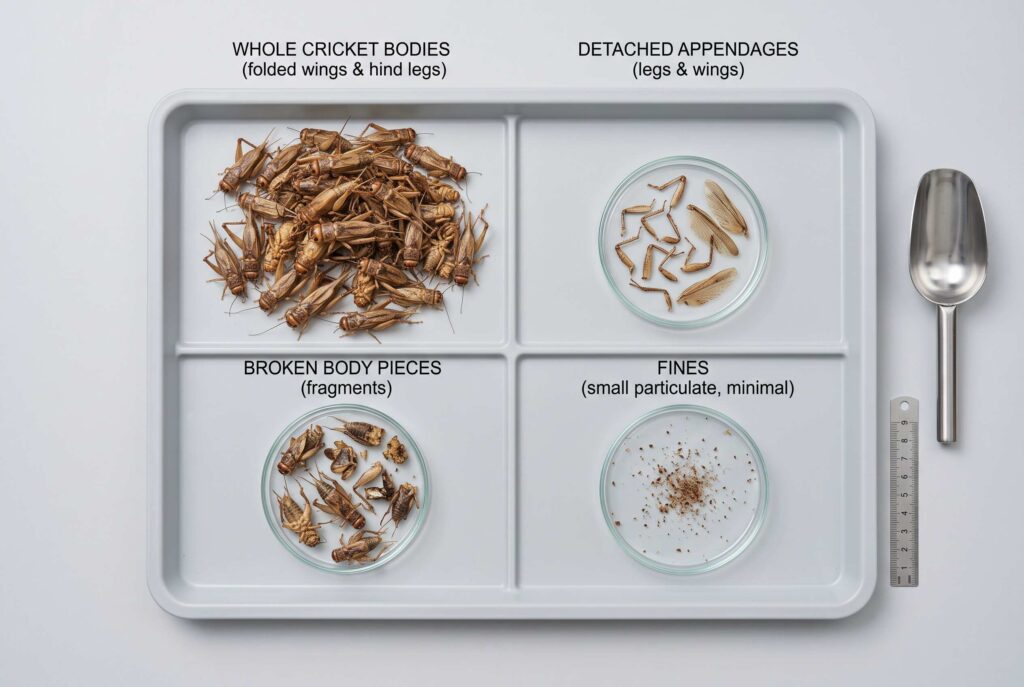
Crickets have delicate legs, wings, and antennae. Some detachment during drying, sorting, packing, and transport is normal. A requirement stating “100% fully intact crickets with every leg attached” may be commercially unrealistic for bulk international shipment.
A practical grade can distinguish:
- Recognizable whole body: head, thorax, and abdomen remain substantially connected.
- Whole body with detached appendages: main body is intact, but some legs, wings, or antennae are separate.
- Broken body: the main body is incomplete or divided.
- Fragments: smaller body or appendage pieces.
- Fines: very small particles accumulating at the bottom of the pack.
The buyer and supplier should agree on which categories matter. For many repacking applications, a recognizable body shape is more important than complete antenna retention. For ingredient use, the acceptable fragment level may be broader.
Define the sample weight, separation method, and tolerance. Otherwise, “mostly whole” can mean different things to each party.
4. Legs, Wings, and Antennae Require Separate Attention
Detached appendages are one of the most visible issues in bulk dried crickets. They affect presentation, package-bottom residue, and perceived grade even when the main bodies remain intact.
Inspect:
- How many bodies retain the major legs;
- whether wings remain aligned or are heavily separated;
- detached legs and wings collected at the bottom;
- excessive antenna and fine-particle accumulation;
- whether fragments are evenly distributed or concentrated in certain packs.
Do not automatically classify all detached legs as foreign matter. They belong to the cricket product, but their proportion can still be a commercial-grade criterion.
For a visible retail product, the specification may include both a minimum recognizable-whole-body proportion and a maximum combined fragment/fines tolerance. If appendage retention is critical, state it separately rather than assuming it is covered by the word “whole.”
5. Compare Size and Uniformity on the Correct Basis
Cricket dimensions vary with species, life stage, and natural production variation. Buyers should decide whether uniformity is required for appearance, packing equipment, or end use.
Evaluate:
- overall length range;
- proportion of noticeably small or large individuals;
- body fullness and shrinkage;
- mixing of visibly different species or grades;
- consistency across packages from the same lot.
A narrowly graded size range may increase sorting requirements and cost. Buyers who will grind the material may not need to pay for the same visual uniformity as retail repackers.
Use a representative sample rather than measuring a few selected insects. If a numerical size range is important, specify how crickets are positioned and measured because curled legs and antennae can distort total dimensions.
6. Evaluate Color Without Using It as a Shortcut
Dried crickets may range from tan and golden-brown to deeper brown depending on species, maturity, pretreatment, drying conditions, and storage. Color is commercially relevant when the product remains visible, but it is not a complete quality test.
Compare samples under the same neutral lighting and background. Review:
- expected color range for the confirmed species;
- uniformity within the batch;
- unusual blackened or scorched areas;
- patchy color suggesting mixed processing or grades;
- major differences from the approved sample.
A darker cricket is not automatically unsafe or nutritionally inferior. A lighter batch does not prove lower moisture or better microbiological status. When presentation matters, retain a controlled reference image or sealed sample and agree on a realistic color range.
Avoid vague terms such as “premium natural color” unless both parties know what the description means for the offered species and process.
7. Texture, Odor, and Physical Dryness
Physical inspection can reveal warning signs, but cannot replace laboratory testing. When the package is opened, note whether the crickets are dry and free-flowing, unusually soft, sticky, clumped, or extremely brittle.
Odor should be characteristic of the approved dried-cricket sample. Musty, sour, chemical, or rancid notes require further investigation. Record the observation promptly because sensory descriptions become less reliable after prolonged exposure.
Excessive brittleness can increase breakage in transport and repacking. A firmer product may retain shape better, but must still meet the agreed moisture and processing requirements.
Do not approve moisture by touch or sound. Crispness can vary with product temperature, species, package, and drying method. Use physical observations to identify potential issues to be checked against batch information.
8. Moisture and Drying Uniformity
Moisture influences storage, texture, breakage, and packaging decisions. Review the batch-specific result together with the sample and package condition.
Confirm:
- result and unit;
- analytical method;
- agreed limit;
- sample and batch identity;
- sampling across packages or the lot;
- timing of testing relative to packing;
- signs of condensation, clumping, or moisture pickup.
Crickets have different body sections and internal spaces, so drying uniformity should not be inferred from one visually crisp insect. Representative sampling is essential.
Moisture content is also different from water activity. Moisture measures water under a defined method; water activity concerns how available water is for reactions and microbial growth. The appropriate requirement depends on product, packaging, destination, and intended storage rather than on a single universal figure.
9. Cleanliness and Foreign Matter
Spread the sample thinly on a clean, contrasting surface. Examine both the crickets and the loose material from the bottom of the pack.
Check for:
- unrelated insects or biological material;
- substrate, fibers or plant particles;
- stones, hard particles, or grit;
- packaging fragments;
- abnormal dark clumps;
- evidence of post-process infestation;
- excessive non-product residue.
Detached cricket legs and wings should be recorded under physical grade, not confused with unrelated foreign matter. Clear categories make disputes less likely.
The specification should identify critical defects and measurable tolerances where appropriate. Absolute phrases such as “zero foreign matter” are difficult to apply unless the method, sample size and detection limit are defined.
10. Processing Method and Finished-Product Grade
Heat drying, hot-air drying, freeze drying, and other processes can produce different combinations of color, texture, cost, and capacity. The method name alone does not establish the finished quality.
Buyers should ask:
- What process is offered for the quoted grade;
- whether pretreatment is used;
- how the drying endpoint is verified;
- how crickets are cooled and sorted;
- whether different methods may be used for repeat orders;
- How process changes are reflected in samples and documents.
Freeze-dried products may target a premium appearance or texture, while heat-dried commercial grades may offer different cost and volume advantages. Actual results depend on equipment, loading, temperature, time, and handling.
Do not assume a higher-priced process automatically suits the application. Compare the finished samples and measurable requirements.
11. Batch Testing and COA Review
A visual sample cannot confirm microbiological, chemical, or nutritional parameters. Required tests should reflect the destination, intended use, and the buyer’s risk assessment.
Check that the COA or test report includes:
- product and batch identification;
- test and report dates;
- parameter names;
- methods or method references;
- results, units, and specification limits;
- laboratory or issuer information;
- clear connection to the commercial lot.
Nutritional values should be reviewed on the same basis. As-received results can differ from dry-matter values, and a protein percentage from an unrelated species or sample should not be applied to the offered batch.
For buyers using crickets in animal-food supply chains, U.S. 21 CFR Part 507 provides a general reference for current good manufacturing practice and related animal-food requirements. It is not a universal approval for dried crickets or a substitute for destination-specific review.
12. Request a Representative Sample
A sample is useful only when the buyer knows what it represents. Ask whether it comes from the current batch, a typical production lot, or a separate reference stock.
Evaluate:
- species and product identity;
- recognizable whole-body proportion;
- detached legs, wings, and antennae;
- broken bodies, fragments, and fines;
- size and color range;
- cleanliness and foreign matter;
- characteristic or abnormal odor;
- physical dryness;
- packaging and lot information;
- available batch documents.
Use consistent sample weights, lighting, and separation categories. A photograph of selected crickets cannot replace a mixed representative sample.
Retain images or a sealed approved reference where practical. The sample establishes a grade reference, but it cannot guarantee every future batch; repeat shipments should still be checked.
The guide to dried insect samples outlines a more comprehensive approval workflow.
13. Packaging and Transport Protection
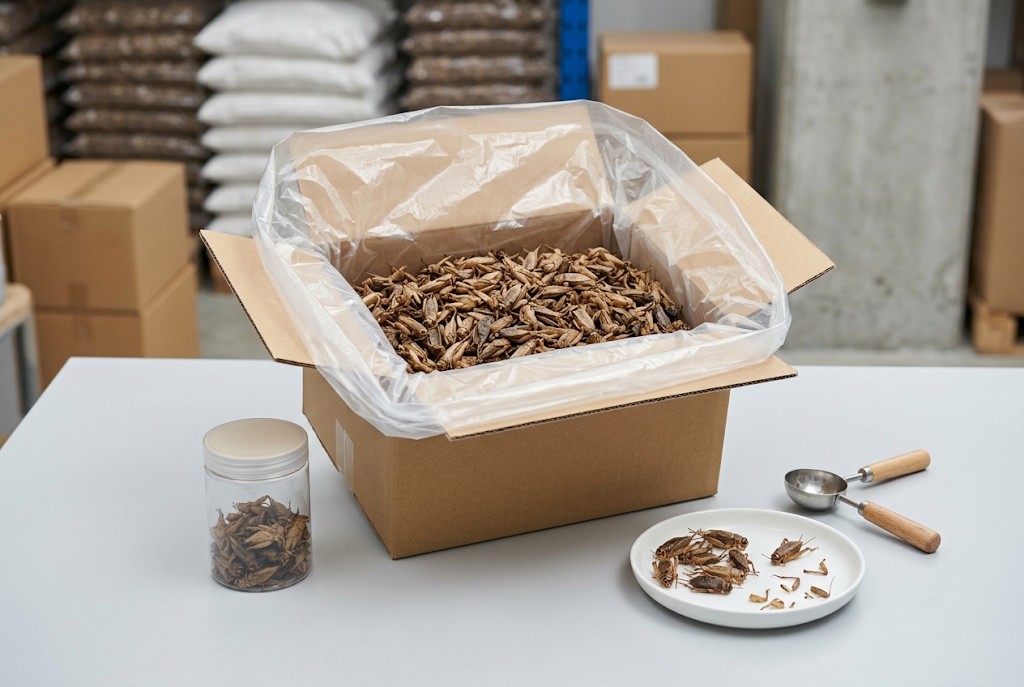
Cricket appendages and dried bodies can be damaged by compression and vibration. Packaging needs to balance bulk efficiency with physical protection.
Confirm:
- inner liner material and seal;
- unit weight;
- outer bag or carton;
- fill level and headspace;
- stacking and pallet configuration;
- batch label information;
- moisture barrier;
- repacking requirements.
Large units may reduce packaging cost per kilogram, but can create more compression and handling. Smaller cartons may protect presentation but increase packaging and logistics costs.
Inspect arriving packages for punctures, open seals, wet cartons, crushing, and excessive fines. Compare the top, middle, and bottom packages from the pallet where practical. Delivered condition—not only the pre-shipment sample—determines commercial usability.
The separate guide to dried insect packaging explains how liners, cartons, seals, pallets, and moisture protection should be specified for bulk orders.
14. Compare Suppliers on Equivalent Grades
Price comparisons are meaningful only when species, grade, testing, and packaging are aligned.
| Purchasing factor | What to compare | Why it matters |
|---|---|---|
| Species identity | Common/scientific name and source information | Prevents unlike products from being compared |
| Whole-body grade | Recognisable bodies and broken-body tolerance | Affects resale and presentation |
| Appendages | Detached legs, wings and antennae | Influences the package’s appearance and loose material |
| Size | Range and grading method | Affects display, packing, and application |
| Moisture | Result, unit, method and limit | Supports storage and acceptance decisions |
| Cleanliness | Foreign matter and non-product residue | Supports downstream quality |
| Testing | Parameters and batch linkage | Connects claims to the shipment |
| Packaging | Liner, unit weight, carton, and pallet | Protects the selected grade |
| Supply terms | Quantity, lead time, Incoterm and destination | Determines delivered value |
A lower quotation may represent more fragments, broader size variation, a different species, less testing or less protective packaging. Ask each supplier to quote against the same written requirements.
15. Match the Grade to the Buyer Type
Distributors and wholesalers
Repeatability, documentation, flexible packaging, and supply continuity may matter most. Establish a grade range that can be reproduced across shipments.
Retail repackers
Recognizable whole bodies, color, size, and low visible fines usually carry greater value. Test packaging and transport before approving large volumes.
Pet, bird, and reptile product businesses
The species, target animal, package format, and product presentation should guide grade selection. Buyers remain responsible for suitability and labeling.
Farms and feed-related processors
Broader visual tolerances may be acceptable when identity, cleanliness, moisture, required tests, and delivered cost meet operational needs.
The appropriate grade is therefore application-specific. Premium visual grading should not be treated as universally necessary, while low presentation requirements should not weaken core identity, cleanliness, or testing controls.
16. What to Include in a Cricket RFQ
An RFQ for bulk dried crickets should include:
- intended application and destination country;
- common or scientific species requirement;
- required quantity and buying frequency;
- whole-body and broken-body tolerance;
- expectations for detached appendages;
- size and color range;
- cleanliness and foreign-matter requirements;
- moisture and other required tests;
- preferred drying method, if mandatory;
- packaging type and net weight;
- sample and document requirements;
- delivery date and trade terms.
Avoid requesting only “best quality.” Describe the grade that creates value for the intended customer. This helps the supplier quote the appropriate option and reduces changes after sampling.
Frequently Asked Questions
What should buyers check when purchasing bulk dried crickets?
Check species identity, recognizable whole bodies, detached legs and wings, fragments, size, color, odor, cleanliness, moisture, batch testing, packaging, and supply terms. The acceptable grade should match the application.
Does “whole dried crickets” mean every leg is attached?
Not necessarily. Some legs, wings, and antennae can detach during processing and transport while the main body remains recognizable. Define whole-body and appendage requirements separately.
Are darker dried crickets lower quality?
Not automatically. Color depends on species, maturity, pretreatment, drying, and storage. Compare the offered sample against a defined range and review moisture and batch testing separately.
Which drying method is best for crickets?
There is no universal best method. Freeze-dried and heat-dried grades can vary in appearance, texture, capacity, and cost. Compare the finished product against the buyer’s requirements.
Should buyers approve a sample before ordering?
Yes. A representative sample helps establish the physical grade and review documents. Each commercial batch should still meet the written specification and agreed testing requirements.
Final Buying Decision
Reliable sourcing of bulk dried crickets combines species confirmation, realistic physical grading, representative samples, batch-linked testing, and protective packaging. The most visually perfect product is not automatically the best commercial choice for every buyer.
Define whether recognizable bodies, appendage retention, size, and color are essential or optional. Then compare suppliers using equivalent specifications and delivery terms. This creates a more useful price comparison and a clearer process for repeat orders.
To discuss an available grade or request a sample, contact BulkInsects with your quantity, destination, application, preferred species, physical grade, packaging, and testing requirements.