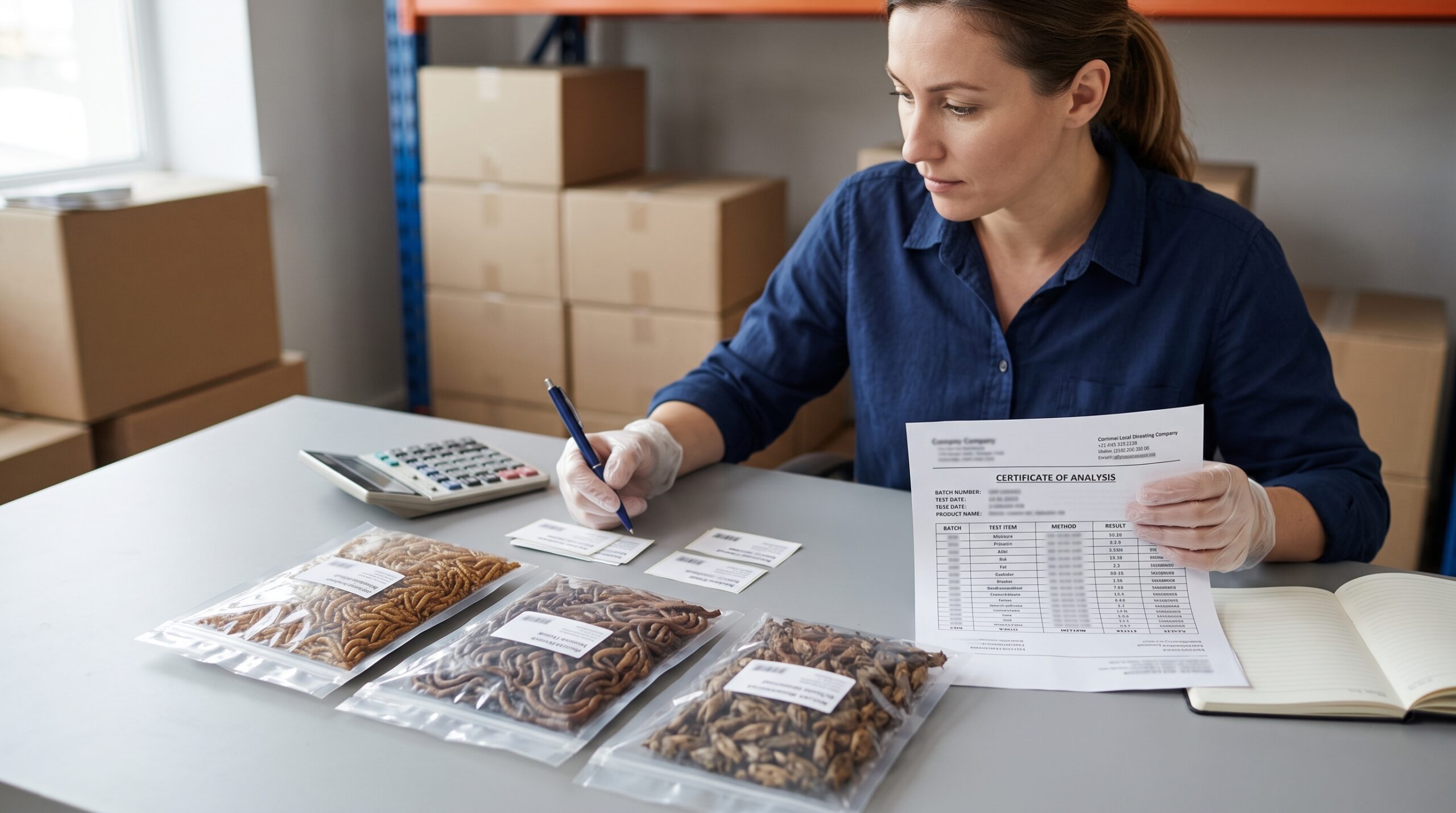

A dried insects COA can help buyers determine whether a tested batch meets agreed product and quality requirements. However, a COA for dried insects should not be judged only by whether the document looks professional or contains favourable numbers.
Buyers need to confirm which product and batch the certificate covers, who performed the testing, which methods were used and whether the reported results meet the relevant specification or purchasing requirement.
This guide explains how wholesalers, distributors, pet product businesses, farms and feed-related commercial buyers can review a COA before approving a sample, trial order or commercial shipment.
What Is a Certificate of Analysis?
A Certificate of Analysis, commonly called a COA, is a document reporting selected test results for a product or sample. Depending on the order, it may be issued from internal quality-control records or by an independent laboratory.
A COA may include:
- product identification;
- batch or lot number;
- sample or production date;
- test date;
- analytical items;
- test methods;
- units of measurement;
- specification limits;
- actual results;
- pass/fail status; and
- laboratory or authorized signatory information.
Not every COA contains the same test items. The appropriate scope can depend on the insect species, intended application, destination market and terms agreed between buyer and supplier.
A COA is useful evidence, but it is not automatically proof that a product complies with every law or is suitable for every application.
1. Confirm the Product Identity
Begin at the top of the document. The product description on the COA should match the item you are purchasing.
Check:
- common product name;
- scientific name where relevant;
- whole dried product form;
- processing or grade description, if specified;
- supplier or sample identification; and
- intended batch or shipment reference.
Descriptions such as “insect protein” or “dried insects” may be too broad when the order is for a specific species. A COA for dried mealworms should not be treated as evidence for dried earthworms, grasshoppers, crickets, maggots or black soldier fly larvae.
If the commercial name differs from your purchase order, ask the supplier to explain the relationship before accepting the document.
2. Match the Batch or Lot Number
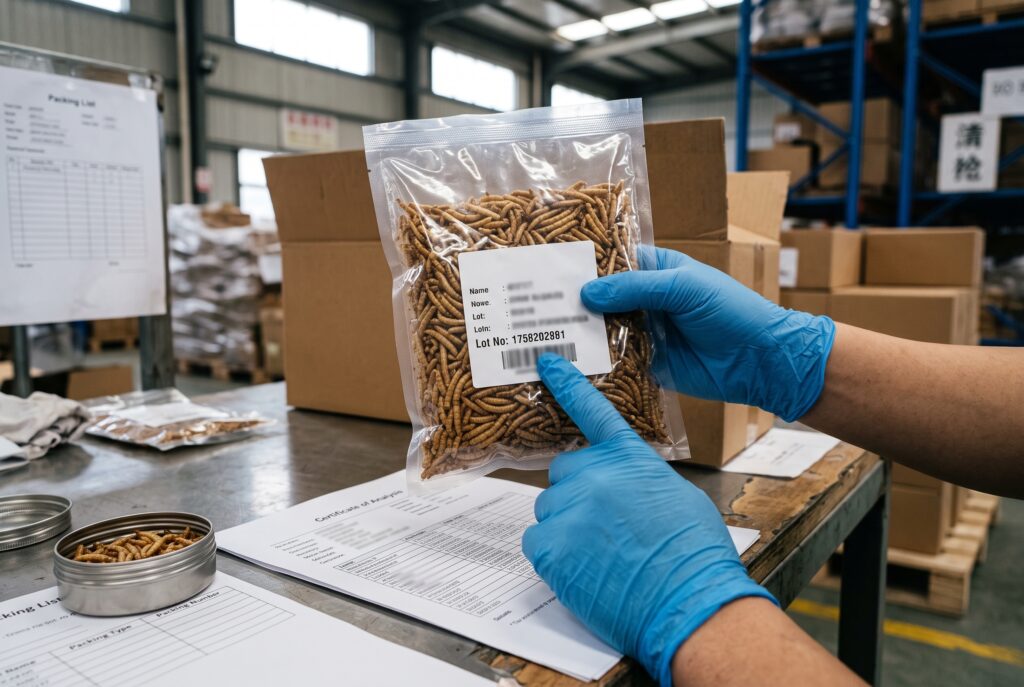
One of the most important checks is whether the COA relates to the product being offered or shipped.
Compare the batch or lot number on the COA with:
- the commercial batch label;
- sample label;
- packing list;
- pre-shipment photographs;
- inspection record; and
- other order documents where applicable.
A test report from an earlier production batch can provide general background, but it should not automatically be presented as the result for a new shipment.
If the supplier provides a typical specification instead of a batch-specific result, the document should be identified clearly as a reference. Buyers can then decide whether shipment-specific testing is required.
3. Check Who Issued the COA
Determine whether the COA is based on:
- supplier or production-partner quality-control records;
- an in-house laboratory;
- an independent third-party laboratory; or
- a report required for inspection or export.
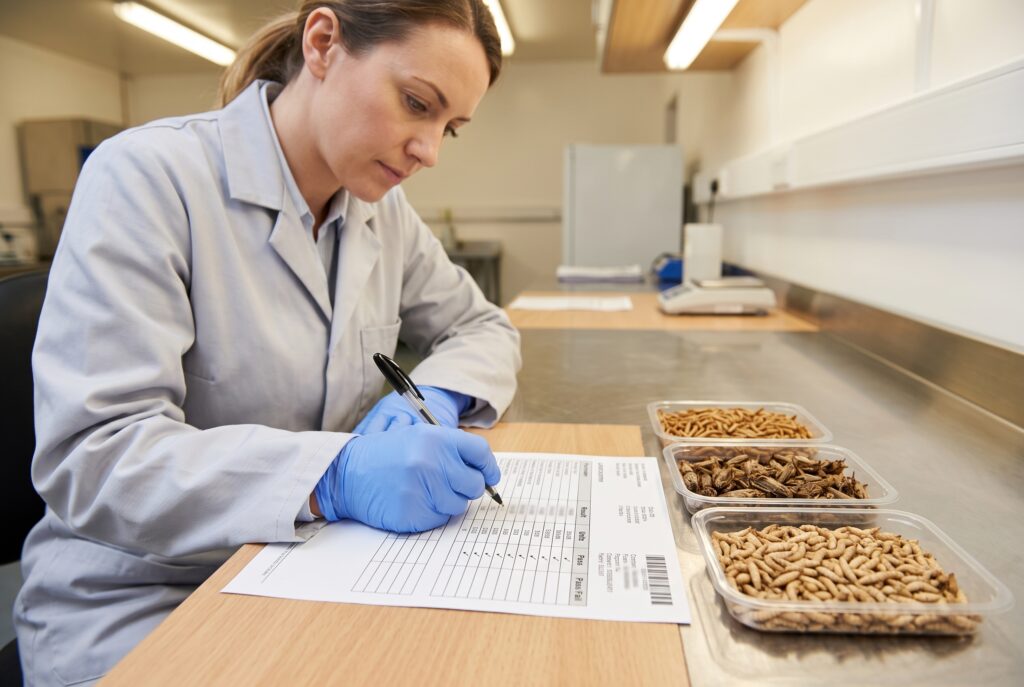
Internal testing can be useful for routine production control. Independent testing can provide additional verification when required by the buyer, destination or risk level. When third-party testing is required, buyers may also ask whether the laboratory is accredited to ISO/IEC 17025 for the relevant testing scope. Accreditation should be checked against the specific test method rather than assumed from the laboratory name alone.
Check whether the document includes the laboratory name, report number, testing dates and authorized approval. If a third-party report is supplied, confirm that the report pages, sample identity and result table belong together.
The presence of a well-known laboratory logo alone is not enough. Buyers should review the actual report details and, when necessary, verify the report through the laboratory’s available channels.
4. Distinguish Specifications from Actual Results
Many COAs include two different types of numbers:
- Specification or limit: the requirement the product is expected to meet.
- Result: the value measured in the tested sample.
For example, a table may show a maximum moisture limit and a separate measured moisture result. Do not confuse the limit with the actual test result.
Look for headings such as:
- Specification;
- Requirement;
- Limit;
- Standard;
- Result;
- Actual; or
- Conclusion.
If the document lists only general target values without individual results, it may be a product specification rather than a batch COA.
5. Review Units, Test Methods and Reporting Language
A number has little meaning without its unit and method.
Check whether results are reported as:
- percentage;
- grams per kilogram;
- milligrams per kilogram;
- colony-forming units per gram;
- presence or absence in a defined sample quantity; or
- another stated unit.
Also check whether nutritional values are reported on an as-is basis or dry-matter basis. Values calculated on different bases should not be compared directly.
Testing methods can also influence results. If you are comparing two suppliers, confirm that the same or comparable methods, units and reporting bases were used.
Microbiological wording requires particular care. Terms such as “not detected,” “negative,” and “below the quantification limit” are not always interchangeable. Read them together with the method and sample quantity.
6. Understand the Main Test Categories
The exact items on a dried insects COA vary, but buyers commonly encounter the following groups.
Moisture
Moisture is relevant to product condition, storage and shelf stability. Review the measured result, unit, method and agreed maximum. Also inspect the packaging and storage condition because a historical moisture result cannot show whether the product later absorbed moisture.
Nutritional analysis
Depending on the order, a COA may report crude protein, crude fat, crude fibre, crude ash or other nutritional indicators. These values can vary by species, raw material, processing and natural batch conditions.
Use batch results and agreed tolerances rather than assuming that one published value applies to every shipment.
Ash and foreign matter
Ash can be commercially important, especially for products where soil removal and cleaning affect quality. However, ash is an analytical value and is not identical to a visual foreign-matter inspection. Buyers may need both test results and physical evaluation.
Microbiological testing
Test items may be selected according to product, intended use and destination requirements. Review the organism or count tested, method, unit, limit and actual result. Do not assume that one negative item represents a complete microbiological assessment.
Contaminants or residues
Where commercially or legally required, testing may cover selected contaminants, residues or other safety indicators. The appropriate panel should be confirmed before ordering because requirements differ between markets and applications.
7. Compare the COA with the Purchase Requirement
A COA should be reviewed against a defined requirement—not simply judged as “good” because the numbers appear high or low.
Use a comparison table:
| Review point | Buyer should verify |
|---|---|
| Product | Correct insect species, form and grade |
| Batch | COA number matches the sample or shipment |
| Test item | Required parameter is actually included |
| Method | Method is stated and appropriate for comparison |
| Unit | Result and specification use compatible units |
| Limit | Requirement is clear and commercially relevant |
| Result | Actual result meets the agreed requirement |
| Date | Sampling and testing dates are relevant to the order |
| Issuer | Internal or third-party source is identified |
| Conclusion | Pass/fail statement agrees with the numerical results |
If your contract, purchase specification or destination requirement uses a different method or limit, ask for clarification before approving the shipment.
8. Check Dates and Sample Handling
Review the production date, sampling date, receipt date and test date where available. Unexplained gaps do not always mean there is a problem, but they may require clarification.
Ask:
- Who collected the sample?
- Was it taken from the commercial batch?
- Was the sample sealed and identified?
- When did the laboratory receive it?
- Does the test date relate to the current order?
A laboratory tests the sample it receives. The value of the report therefore depends on whether that sample represents the shipment.
For higher-risk or larger orders, buyers may agree on witnessed sampling, independent inspection or sealed reference samples.
9. Look for Common COA Warning Signs
Ask questions when you see:
- no batch or lot number;
- a product description that does not match the order;
- missing units or test methods;
- identical results repeated across unrelated batches;
- an old report presented as a current batch result;
- specification limits shown without actual results;
- unexplained edits, inconsistent fonts or incomplete pages;
- a third-party logo without clear report identification;
- results that conflict with the pass/fail conclusion; or
- a report for one species used to support another species.
One warning sign does not automatically prove that a document is invalid. It means the buyer should request supporting information before relying on it. COA review should also form part of your process when you choose a reliable dried insect supplier.
10. Ask the Supplier the Right Follow-Up Questions
After reviewing the document, send focused questions:
- Does this COA relate to the sample, available batch or planned shipment?
- Which tests are performed for every export batch?
- Which results come from internal control and which from a third-party laboratory?
- Can additional test items be arranged before shipment?
- Who collects the sample used for testing?
- Can the batch number be shown on the packaging and packing list?
- Are the values reported as-is or on a dry-matter basis?
- Which specification or destination requirement was used for the pass/fail conclusion?
Confirm additional testing before packing or shipment because it can affect cost and lead time. Buyers should define these requirements when they prepare a complete dried insect RFQ.
COA Review Example
Imagine that a buyer receives a COA with columns for Test Item, Specification, Result, Method and Conclusion.
The review should proceed in this order:
- Match the product and batch number to the order.
- Check that each required parameter appears in the table.
- Read the specification and actual result separately.
- Confirm that the units match.
- Review the test method and reporting basis.
- Check that the conclusion agrees with the result.
- Confirm the report date and issuer.
- Record any missing item for follow-up.
This method is more reliable than scanning only the protein percentage or looking for the word “Pass.”
A COA Is One Part of Supplier Evaluation
A dried insects COA should be reviewed together with:
- representative samples;
- current batch photographs;
- product specification;
- physical appearance and cleanliness;
- packaging details;
- batch labels;
- storage condition; and
- agreed pre-shipment checks.
A COA cannot show every physical characteristic. Whole-product integrity, fragments, colour, odour and visible foreign matter may still require sample or batch inspection.
BulkInsects coordinates product information and batch-related testing according to the insect species, destination and agreed order requirements. Reference values are used for initial discussion; final evaluation should rely on the applicable batch and export testing documents.
Need help reviewing testing requirements for an enquiry? Send us the product, quantity, destination, application and requested test items through our contact form.
Frequently Asked Questions
What does COA mean when buying dried insects?
COA means Certificate of Analysis. It reports selected test results for an identified product or sample and may include batch information, methods, units, specifications and conclusions.
Is a dried insects COA always batch-specific?
Not necessarily. Some documents show typical or reference specifications, while others report actual batch results. Buyers should confirm which type they have and whether shipment-specific testing is required.
Is a supplier COA the same as a third-party laboratory report?
No. A supplier COA may use internal quality-control data, while a third-party report is issued by an independent laboratory. Both can be useful, but their source and scope should be clearly identified.
Which COA value is most important for dried insects?
There is no single value that is most important for every order. Buyers should select test items according to the species, intended application, destination requirements and agreed purchasing specification.
Can a COA replace physical product inspection?
No. A COA reports selected analytical results, but may not show whole-product appearance, fragments, colour, odour, packaging condition or visible foreign matter. visible foreign matter.