
Commercial buyers evaluating dried earthworms for aquaculture need to look beyond a general protein claim. Product form, earthworm identity, cleaning, moisture, batch testing, packaging, and the intended feeding method all affect whether an offer fits a particular operation.
Whole dried earthworms may be purchased for direct use in suitable feeding programs, for grinding or further processing, or for distribution to downstream aquaculture customers. These are different applications. A product that is acceptable as a visible whole-feed item may require additional processing before it can be included in a formulated diet.
This guide explains the questions aquaculture farms, distributors, wholesalers, feed-related businesses, and pet or ornamental-fish suppliers should ask before requesting a sample or placing a commercial order. It does not prescribe inclusion rates or promise animal-performance outcomes; those decisions depend on the cultured species, life stage, complete diet, and professional formulation.
Key Takeaways
- Confirm whether the buyer needs whole dried earthworms, material for grinding, or a ready-to-formulate ingredient.
- Evaluate cleanliness, soil removal, ash interpretation, moisture, and batch identity before comparing prices.
- Do not copy feeding rates or fishmeal-replacement claims from studies using different species, processing methods, or powdered ingredients.
- Match packaging and particle handling to the farm, distributor, or processor’s workflow.
- Trial the intended application under qualified nutritional and farm-management supervision before commercial-scale use.
1. Where Whole Dried Earthworms Fit in Aquaculture
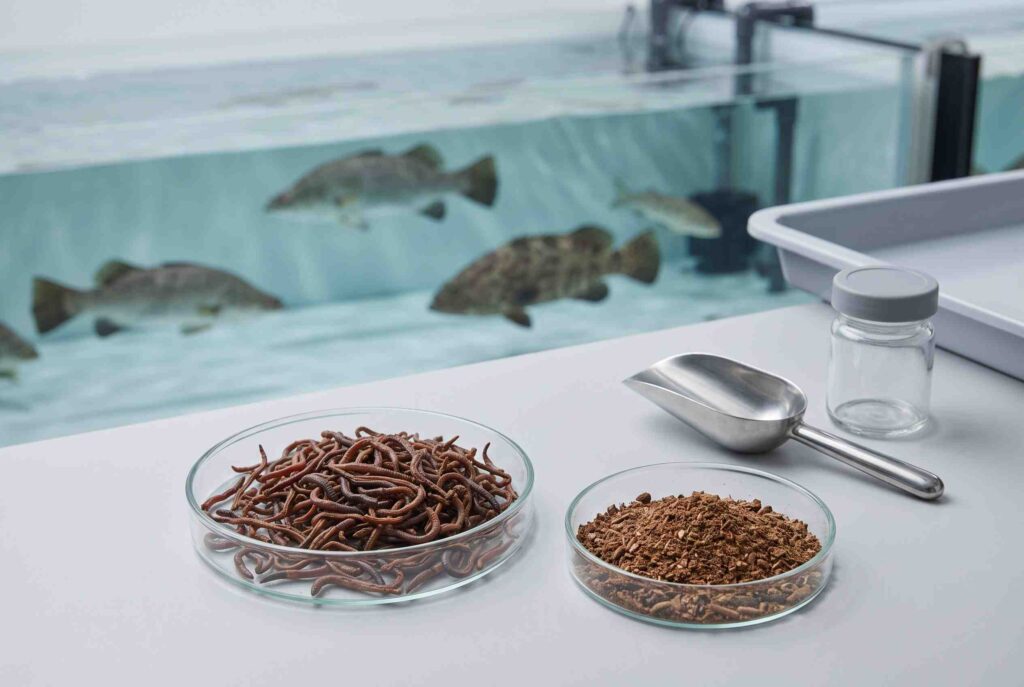
Aquaculture covers many species, production systems, and feeding practices. A whole dried earthworm product may fit differently for different customers.
Potential commercial pathways include:
- direct presentation to suitable fish or other aquatic animals;
- use as a supplemental feed item within a broader feeding program;
- grinding or milling by the buyer before formulation;
- blending into a processed feed after further evaluation;
- repacking for specialist aquaculture or ornamental-fish channels;
- distribution as a dried animal-origin raw material.
The supplier should not assume which pathway the buyer intends to take. Whole dried earthworms are not the same as earthworm meal, protein hydrolysate, or finished aquafeed. Processing changes particle size, handling, formulation behavior, and the basis on which research results may apply.
Buyers can review the entire dried earthworms product page to confirm the available commercial forms, processing, and inquiry details.
2. Define the Aquaculture Application Before Sourcing
A useful inquiry starts with the cultured species and how the earthworms will be used. The term” aquaculture fee” is too broad to define a grade by itself.
Clarify:
- cultured species and life stage;
- freshwater, marine, or ornamental application;
- direct feeding, supplementary feeding, or formulation;
- whether whole appearance matters;
- whether the buyer will grind or process the material;
- expected monthly or seasonal volume;
- destination-country requirements;
- required tests and documents;
- packaging and storage conditions.
This information helps distinguish visual-grade requirements from formulation requirements. A reseller supplying visible whole earthworms may prioritize intactness, color, and low fines. A feed-related processor may focus more on cleanliness, moisture, ash, batch testing, and the consistency of the material entering its process.
The intended use should also determine the sample evaluation. A visually attractive product may not be suitable for a particular formulation, while natural color variation may be irrelevant in a ground application.
3. Whole Product, Ground Material, and Finished Feed Are Different
Research on earthworms in aquaculture often evaluates earthworm meal or processed diets rather than whole dried earthworms. Buyers should not transfer a study result directly to a different product form.
The distinctions matter:
| Product form | Commercial description | Buyer responsibility |
|---|---|---|
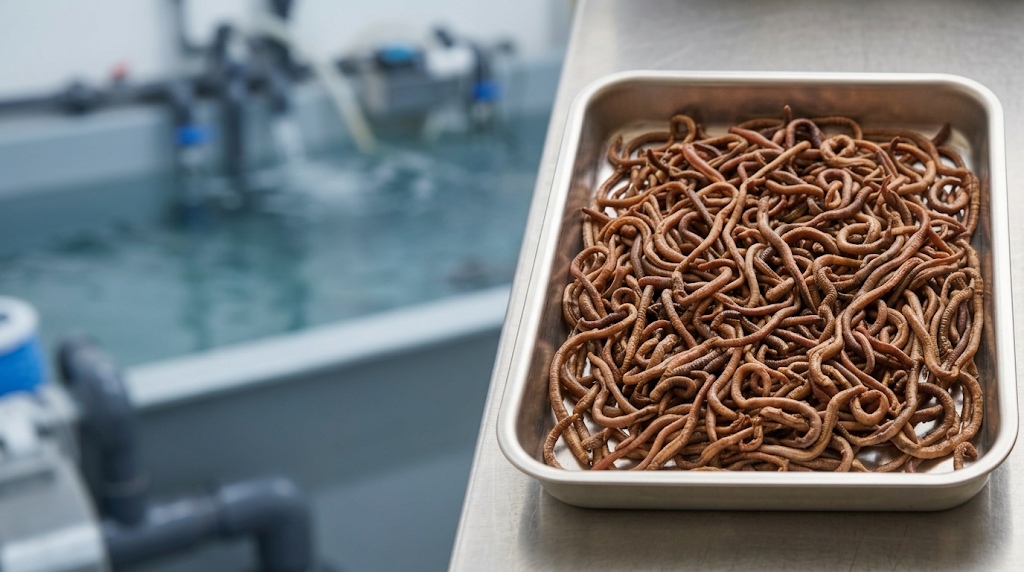
| Whole dried earthworms | Recognisable dried product supplied in bulk | Confirm species suitability, feeding method, size, cleanliness and storage |
| Ground earthworm material | Whole product milled by supplier or buyer | Validate particle size, composition, processing, and formulation behavior |
| Earthworm meal | Defined processed ingredient used in a feed formula | Confirm specification, digestibility evidence and appropriate inclusion |
| Complete aquafeed | Finished a balanced diet | Manufacturer controls full formulation, processing and feeding directions |
BulkInsects supplies whole dried insects, not finished feed formulations. Buyers planning to mill the product should specify whether they need a particular whole-product grade before grinding and whether their processing system can manage the material’s shape, fat content, and variation.
4. Confirm Earthworm Identity and Source Information
Earthworm species and production source may affect size, appearance, and composition. The RFQ should therefore ask for the specific product identity available for the offered supply rather than relying solely on the broad term” worms.”
Confirm where available:
- common and scientific name;
- source or production information;
- whole dried commercial form;
- drying method;
- batch or lot identification;
- whether the sample represents the quoted batch or a reference grade.
Do not assume all published research applies equally to all earthworm species. Studies may use Eisenia fetida, Perionyx excavatus, Eudrilus eugeniae, or other species, and they may process the material differently.
For a regulated commercial application, the buyer or importer should also verify whether the species and intended use are permitted in the destination market. Product identity is part of that assessment, not merely a scientific detail.
5. Cleanliness, Soil Removal, and Foreign Matter
Cleanliness is a priority when sourcing dried earthworms for aquaculture because earthworms naturally live in close contact with soil and organic substrate. The buyer should assess both the raw material cleaning approach and the condition of the dried product.
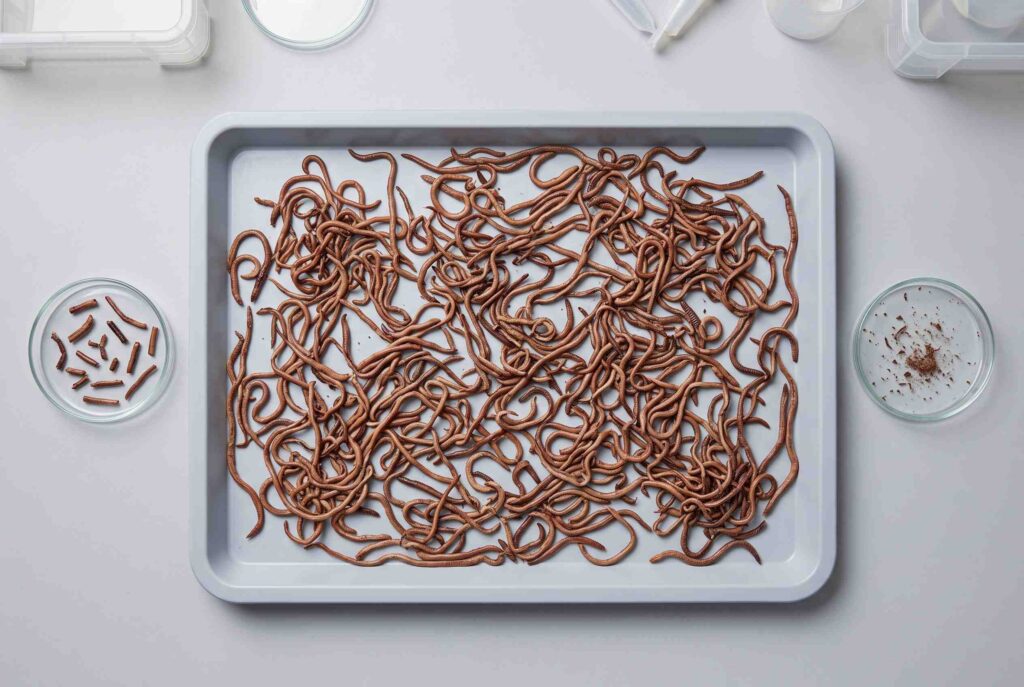
Spread a representative sample over a clean, contrasting surface and check for:
- attached soil or gritty residue;
- stones or hard mineral particles;
- fibers and unrelated plant material;
- excessive loose material at the bottom of the package;
- non-earthworm biological material;
- abnormal clumps;
- packaging fragments or post-process contamination.
Visual inspection does not replace laboratory analysis, but it reveals physical issues that a COA may not summarize. Likewise, an acceptable laboratory result does not excuse the presence of visible stones or foreign matter.
The supplier should be able to explain the general separation, cleaning, and sorting stages without presenting unsupported claims such as”zero impurity.” The purchase specification should identify critical defects and, where appropriate, measurable tolerances.
6. UnAshstand Ash in the Context of Earthworm ProducAsh
Total ash is often reviewed because residual soil can influence the result. However, total ash is the inorganic residue remaining after a defined analytical procedure; it includes naturally occurring mineral content and is not a direct dirt percentage.
When comparing ash results, check:
- test method;
- as-received or dry-matter basis;
- sample preparation;
- unit and specification limit;
- batch represented;
- relationship between the tested sample and the loose residue in the package.
A buyer concerned about sand, grit, or soil-like material may need a physical inspection or a more specific analytical approach in addition to Total ash. Do not reject or approve a batch from an unexplained ash number alone.
The guide to dried earthworm specifications explains how to separate ash, moisture, and cleanliness in a technical sheet.
7. Moisture, Water Activity, and Storage Condition
Moisture affects physical condition, storage decisions, and packaging requirements. Whole dried earthworms should be evaluated with a batch-specific result rather than by touch alone.
Review:
- measured moisture result;
- unit, method, and reporting basis;
- representative sampling across the lot;
- evidence of clumping, softness, or condensation;
- packaging barrier and seal;
- storage conditions after drying;
- time between testing and shipment.
Moisture content and water activity are not interchangeable. Moisture refers to water measured under a defined test method, while water activity reflects the availability of water for reactions and microbial growth. A dry-feeling sample does not establish either value.
There is no responsible universal moisture limit for every earthworm product, market, and aquaculture use. The buyer should state a requirement suited to its processing, storage, and destination, then verify the offered batch on the agreed basis.
8. Nutritional Composition Must Be Batch-Specific
Earthworms are studied as an animal-origin nutrient source, but a commercial buyer should not turn general research values into guaranteed product claims. Composition can vary with species, source, substrate, gut-content control, cleaning, drying, and analytical basis.
When reviewing nutritional information, confirm:
- whether values are typical or batch-specific;
- whether they are reported as received or on a dry-matter basis;
- test methods and laboratory information;
- product form tested—whole, ground, or meal;
- whether the sample matches the offered commercial lot.
Protein percentage alone does not determine suitability in a complete aquaculture diet. Amino acid balance, lipid profile, digestibility, palatability, minerals, contaminants, and interactions with other ingredients may matter. These are formulation questions for the buyer’s nutrition team.
A peer-reviewed review indexed by PubMed describes earthworms as a potential alternative protein source for fish and poultry feeding, while also highlighting the need to consider production, processing, and safety. Buyers can consult Earthworm as an Alternative Protein Source in Poultry and Fish Farming as research background, not as a guarantee for a particular whole dried batch.
9. Do Not Copy Inclusion Rates From Unrelated Studies
Research trials may report different inclusion or fishmeal replacement levels, but those numbers apply only to the tested conditions. Differences may include:
- fish species and life stage;
- earthworm species;
- whole, meal, or hydrolyzed product form;
- drying and preparation method;
- basal diet composition;
- trial duration and rearing system;
- nutrient balancing;
- outcome measured.
A result for earthworm meal in one formulated diet does not establish a feeding rate for whole dried earthworms in another species. It also does not prove that replacing fishmeal on a simple weight-for-weight basis will produce a balanced diet.
Before commercial use, the buyer should work with a qualified aquaculture nutritionist or feed professional, evaluate applicable rules, and conduct a controlled trial. Bulk procurement should follow confirmation of the intended use rather than precede it.
10. Physical Size and Feeding Behavior
Whole earthworms are elongated and irregular. Even after drying, pieces may differ in length, curl, and firmness. Their suitability for direct feeding depends on the target animal’s size and feeding behavior.
Assess:
- average visual size range;
- whole versus broken pieces;
- hardness, brittleness, and rehydration behavior where relevant;
- whether the target animal can take the product safely;
- whether cutting, grinding, or soaking is required;
- how the product behaves when introduced to water.
The farm or product developer should evaluate these questions. Do not assume that a whole product is suitable for every fish size. Fine fragments may disperse differently from whole pieces and can affect feeding observation or water management.
If the buyer intends to grind the product, the purchasing specification can allow broader intactness while maintaining requirements for cleanliness, moisture, and batch consistency.
11. Water Quality and Feed Management
Feed selection and feeding practice can influence uneaten material and water conditions. Whole dried products may float, sink, soften, or fragment differently depending on size, density, and preparation.
Before large-scale use, observe:
- how quickly animals accept the product;
- whether pieces remain uneaten;
- sinking or floating behavior;
- fragmentation in water;
- feeding duration;
- removal of uneaten material;
- any changes in water-quality monitoring indicators.
The product should be evaluated within the farm’s existing feeding and water-management plan. A nutrient-rich ingredient is not automatically suitable when feeding form or ration control leads to waste.
BulkInsects should not prescribe feeding frequency or ration size. These depend on species, biomass, water temperature, production system, and the complete diet.
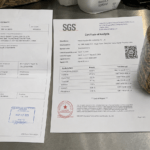
12. Microbiological and Chemical Testing
Drying contributes to product stability, but dried does not mean sterile. Batch-testing requirements should reflect the destination, intended use, and the buyer’s own risk assessment.
Possible review areas include:
- microbiological parameters required for the application;
- moisture or water-activity information;
- relevant chemical or contaminant parameters;
- nutritional composition where commercially required;
- batch and sample identity;
- laboratory, method, units, and specification limits.
The test panel should not be copied automatically from human food, another insect species, or a different country. The buyer or importer is responsible for confirming applicable requirements.
Post-drying handling also matters. Cooling surfaces, sorting equipment, inner bags, and repacking can reintroduce contamination. Review the complete supply and packaging process rather than relying only on the drying method name.
13. Packaging and Commercial Handling
Packaging must protect the approved grade through transport and storage. Whole dried earthworms can break under compression, while inadequate liners or seals may expose them to moisture.
Confirm:
- inner bag or liner material;
- closure and moisture barrier;
- net weight per unit;
- outer bag or carton;
- lot identification;
- units per pallet;
- expected stacking pressure;
- storage requirements after opening.
Aquaculture farms may prefer package sizes that align with routine consumption and reduce the need for repeated openings. Distributors may need flexible pack formats for repacking. Feed processors may prioritize efficient handling and traceability.
Inspect arriving units for punctures, wet cartons, open seals, mismatched labels, condensation, and excessive crushing. Packaging condition is part of product acceptance, not merely a shipping detail.
14. Compare Suppliers on Equivalent Requirements
Do not compare prices until the quoted products are aligned.
| Purchasing factor | What to compare | Commercial importance |
|---|---|---|
| Product identity | Species/source information and whole dried form | Links the offer to intended use and research context |
| Cleaning | Soil removal, foreign matter, and loose residue | Central to earthworm-product acceptance |
| Physical grade | Size, whole pieces, fragments and fines | Affects direct feeding, resale and processing |
| Moisture | Result, method, unit and limit | Supports storage and batch acceptance |
| Composition | Batch-specific or typical, reporting basis and method | Prevents misleading nutrient comparisons |
| Testing | Parameters and batch linkage | Supports buyer risk assessment |
| Packaging | Liner, unit weight, carton and pallet | Protects condition and traceability |
| Supply | Quantity, lead time, and repeat consistency | Determines commercial practicality |
A lower price may represent a different species, broader grade, more residue, less testing, or weaker packaging. Ask suppliers to quote against the same RFQ.
15. Request and Evaluate a Representative Sample
A sample should represent the commercial grade being quoted. Ask whether it comes from the current lot, a typical production batch, or separate reference stock.
Evaluate:
- identity and product form;
- cleanliness and visible residue;
- size and whole-product condition;
- fragments and fines;
- color and odor;
- physical dryness and flow;
- packaging and labels;
- available batch documents;
- behavior in the buyer’s intended trial.
Use consistent lighting, sample weight, and inspection categories. Retain photographs or a sealed approved reference sample where practical.
A sample cannot guarantee every future batch. The purchase order should have measurable acceptance criteria, and each shipment should be checked against the zqzvzk-xqsa specification.
16. What to Include in an Aquaculture RFQ
An RFQ for dried earthworms for aquaculture should include:
- target aquatic species and life stage;
- intended use: direct, supplementary, grinding, or formulation;
- destination country;
- required quantity and buying frequency;
- preferred earthworm species or identity information;
- whole-product, size, and fragment requirements;
- cleanliness and foreign-matter expectations;
- mAshture, ash, and nutritional parameters;
- microbiological or chemical testing needs;
- drying-method preference, if mandatory;
- packaging type and unit weight;
- sample and document requirements;
- requested delivery date and trade terms.
The more clearly the application is described, the easier it is to determine whether a given grade is commercially suitable.
For the broader application context, review the aquaculture dried insect supply page before submitting the inquiry.
Frequently Asked Questions
Can dried earthworms be used directly in aquaculture?
They may be suitable in some feeding programs, but suitability depends on the aquatic species, life stage, product size, feeding method, and complete diet. The buyer should conduct a qualified application assessment and controlled trial.
Are whole dried earthworms the same as earthworm meal?
No. Whole dried earthworms retain their recognizable physical form. Earthworm meal has been ground or otherwise processed and is evaluated as a formulation ingredient. Research on meals cannot automatically be applied to whole products.
Can earthworms replace fishmeal in aquafeed?
Research has evaluated earthworm meal in some fish diets, but replacement levels depend on species, processing, and complete diet formulation. Whole dried earthworms should not be substituted for fishmeal on a simple weight-for-weight basis without professional formulation.
What quality checks matter most for dried earthworms for aquaculture?
Buyers should review identity, cleanliness, soil and foreign matter, ash interpretation, moisture, product condition, batch testing, packaging, and intended feeding or processing method.
Should buyers request a sample before ordering?
Yes. A representative sample allows the buyer to inspect physical quality, review documents, and conduct an application trial. Commercial batches should still be checked against the agreed specification.
Final Buying Decision
Purchasing dried earthworms for aquaculture requires alignment between the physical product and the intended feeding or processing system. Whole dried earthworms can serve as a commercial raw material, but they are not automatically equivalent to earthworm meal or complete aquafeed.
Define the cultured species, application, grade, testing, and packaging before comparing prices. Then review a representative sample and conduct an appropriately supervised trial. Batch-linked documents and arrival inspection should be available for every commercial shipment.
To discuss an available grade or request a sample, contact BulkInsects with your destination, quantity, target species, intended use, packaging, and testing requirements.