
Buying dried insects in commercial quantities involves more than comparing prices. Product type, processing method, appearance, moisture, packaging, batch testing, documentation and intended application can all affect whether a shipment meets your purchasing requirements.
For wholesalers, distributors, repacking businesses, farms, pet product companies and feed-related buyers, understanding these factors before placing an order can reduce sourcing risks and make supplier comparisons much easier.
If you are planning to buy dried insects in bulk, this guide explains the main points to check before requesting samples, evaluating an offer or confirming a commercial order.
1. Start With the Right Dried Insect Product
The first step is to identify which product is suitable for your market and downstream application.
Common whole dried insects available for commercial supply include:
- Dried Mealworms (Tenebrio molitor) – commonly sourced by wholesalers, bird food businesses, specialty pet businesses and other commercial buyers.
- Dried Earthworms – often considered for aquaculture and other feed-related applications where cleanliness and residual soil are important purchasing considerations.
- Dried Grasshoppers – commonly purchased for reptile, bird and specialty pet markets, with appearance and whole-body integrity being important.
- Dried Crickets – suitable for a range of bird, reptile and specialty pet product markets.
- Dried Maggots – sourced for poultry, aquaculture and other feed-related applications, where source, substrate information and microbiological testing may require particular attention.
- Dried Black Soldier Fly Larvae (BSFL) – commonly considered by poultry, aquaculture and feed-related buyers, with separation cleanliness, moisture and microbiological parameters among the key quality considerations.
A buyer should therefore begin with the intended use rather than simply asking for “dried insects.”
For an overview of available products, buyers can review our Wholesale Dried Insects product range.
Internal Link → /products/
2. Define Your Purchasing Requirements Before Asking for a Quote
A clear RFQ helps both buyer and supplier determine whether a product is commercially suitable.
Before contacting a supplier, prepare basic information such as:
- Product required
- Estimated order quantity
- Destination country
- Intended application
- Preferred product form
- Processing preference, if applicable
- Packaging requirements
- Label or shipping mark requirements
- Required testing or inspection
- Required commercial or export documentation
- Preferred trade terms
For example, instead of sending:
“Please send me your mealworm price.”
a commercial buyer can provide:
“We are looking for whole dried mealworms for wholesale distribution. Please quote for our estimated purchasing quantity and advise available processing options, packaging, sample policy and batch documentation.”
This gives the supplier enough information to prepare a more relevant commercial offer.
3. Do Not Compare Products by Price Alone
Price matters, but the lowest price per kilogram does not necessarily represent the best purchasing value.
When buyers buy dried insects in bulk, differences between offers can include:
Product condition: whole-product integrity, color, cleanliness and visible foreign matter.
Processing: different drying and pre-treatment methods can result in differences in appearance, moisture and commercial grade.
Packaging: inner barrier bags, cartons, labeling and shipping preparation can affect both cost and product protection.
Testing: testing and inspection requirements may vary according to the product, batch and destination.
Order quantity: commercial pricing normally depends partly on purchasing volume.
Destination and trade terms: freight and export arrangements can significantly affect the final landed cost.
For this reason, compare offers on a like-for-like basis instead of comparing only the headline unit price.
4. Evaluate Product Quality Before Bulk Purchasing
Dried insects are natural agricultural products. Appearance and analytical values can vary according to species, raw material, processing method, season and production batch.
Commercial buyers should establish the quality factors that matter for their particular product.
Typical evaluation points include:
- Moisture
- Cleanliness
- Foreign matter
- Product integrity and breakage
- Appearance
- Microbiological parameters
- Relevant contaminants
- Product-specific quality factors
Different insects also have different purchasing risks.
For example, residual soil and ash can be particularly relevant when evaluating dried earthworms. Separation cleanliness is important for whole dried BSFL. For grasshoppers, relevant residue testing may require attention depending on the product and destination.
This is why a single generic specification should not be used to evaluate every dried insect product.
5. Understand Reference Specifications and Batch Results
One important distinction for B2B buyers is the difference between website reference values and actual batch results.
Typical specifications published on a product page can help with preliminary product evaluation, but dried insects are natural products and actual analytical parameters can vary between batches.
At BulkInsects, website specification values are therefore presented as general reference information rather than automatically guaranteed contractual specifications.
Actual product parameters are determined by the testing and/or inspection results applicable to the corresponding export batch.
Unless otherwise expressly agreed in writing, reference values published on a website should not be treated as automatically incorporated into a sales contract.
This distinction is particularly important when evaluating moisture, microbiological parameters and other analytical results.
6. Ask About Batch Testing and Inspection
Testing is an important part of commercial dried insect sourcing.
Depending on the product, destination and purchasing requirements, batch evaluation may include relevant parameters such as:
- Moisture
- Microbiological indicators
- Foreign matter
- Product integrity
- Relevant contaminants
- Product-specific parameters
- Destination-specific requirements where applicable
Buyers should ask suppliers what testing or inspection documentation is available for the relevant shipment rather than relying only on a generic specification sheet.
Where a COA or batch test report is provided, check whether the document clearly relates to the product and batch being purchased.
This is more meaningful than relying on broad claims such as “100% safe” or “pathogen free.”
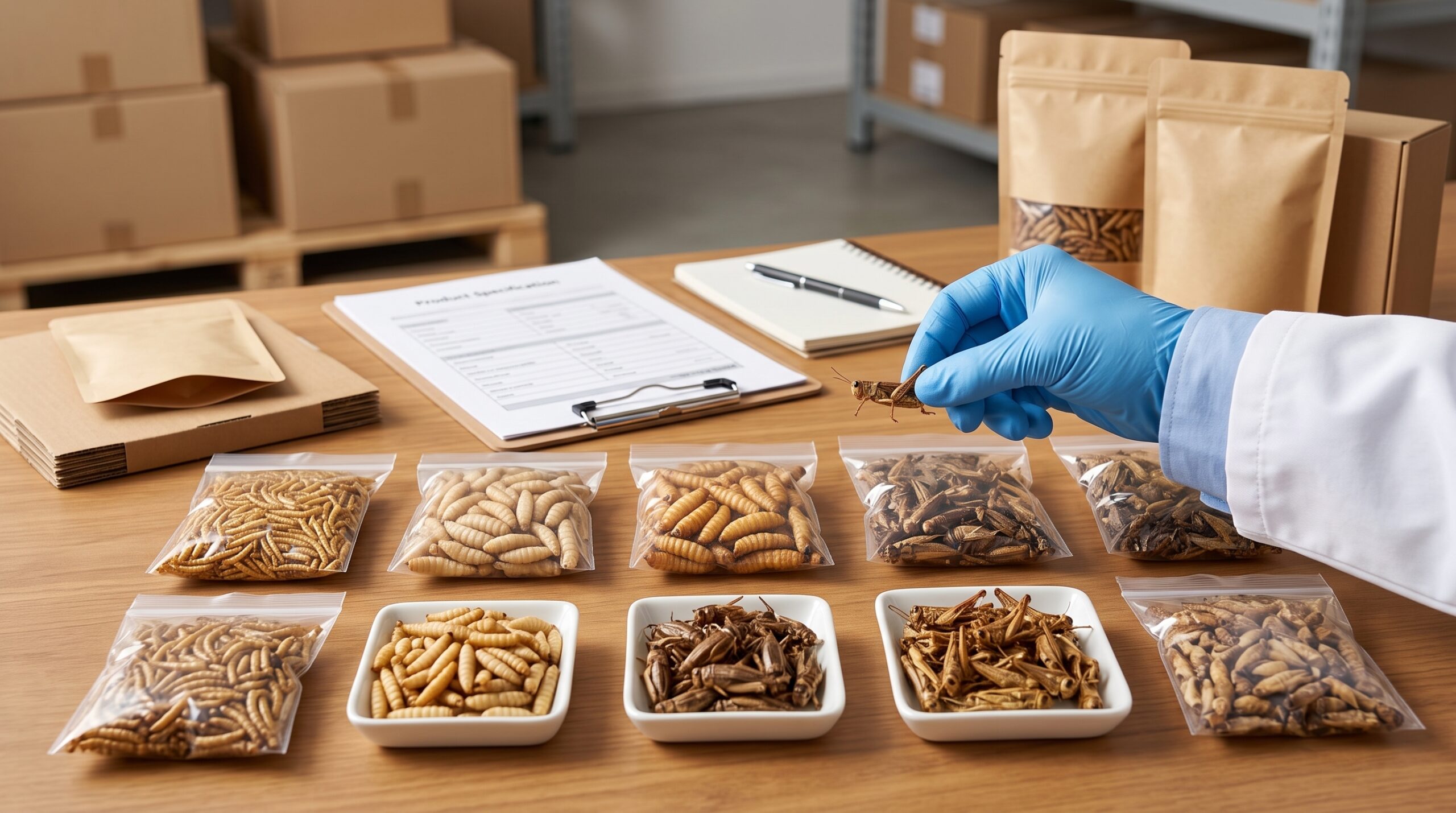
7. Request a Sample When Appropriate
For new B2B relationships, samples can be useful before moving to a commercial order.
A sample can help buyers evaluate physical characteristics such as:
- Color
- Odor
- Size
- Cleanliness
- Breakage
- Whole-product integrity
- Packaging presentation
However, a sample should be treated as an evaluation tool rather than a guarantee that every future batch will be visually identical.
Natural products can show reasonable batch-to-batch variation.
For qualified B2B buyers, sample availability, quantity and shipping arrangements can be discussed according to the product and current supply.
8. Check Commercial Packaging Requirements
Packaging is particularly important when products will travel internationally or remain in storage before repacking or downstream use.
When purchasing wholesale dried insects, discuss:
- Inner packaging
- Outer cartons
- Moisture protection
- Product labeling
- Shipping marks
- Palletization where required
- Repacking requirements
- Destination-specific requirements
Packaging requirements can vary according to product grade, order quantity, shipping method and downstream use.
If you intend to repack dried insects into smaller retail units, tell the supplier during the quotation stage. This can affect the most suitable commercial packaging arrangement.
9. Review Available Documentation
Documentation requirements are not identical for every shipment.
Depending on the product, destination and transaction, commercial buyers may need to discuss documents such as:
- Certificate of Analysis (COA)
- Batch test or inspection results
- Product information
- Commercial invoice
- Packing list
- Certificate of origin
- Other applicable export documentation
Buyers should confirm documentation requirements before the commercial order is finalized, especially when importing into a new market.
Import requirements can vary by destination, product classification and intended use, so destination-specific requirements should be verified for the actual transaction.
10. Evaluate the Supplier, Not Just the Product
When choosing where to buy dried insects in bulk, buyers should also assess the supplier’s ability to support an ongoing B2B relationship.
Useful questions include:
- Does the supplier understand commercial B2B requirements?
- Can it supply the specific dried insect products you need?
- Can samples be arranged for evaluation?
- How are batches tested or inspected?
- What documentation is available?
- Can packaging requirements be discussed?
- Can the supplier support recurring orders?
- How are quality requirements confirmed before shipment?
- Is communication clear when specifications or requirements change?
For wholesalers, distributors and other commercial buyers, reliable communication, batch verification and supply coordination can be just as important as the initial unit price.
A sourcing decision should therefore consider product quality, batch testing, documentation, packaging, commercial service and supply capability together.
You can also learn more about BulkInsects and how we support B2B buyers with whole dried insect sourcing, batch verification, packaging and export coordination.
11. Understand MOQ, Pricing and Commercial Terms
There is no single universal MOQ or price for all dried insects.
Commercial conditions can vary according to:
- Insect species
- Product grade
- Processing method
- Current supply
- Order quantity
- Packaging
- Testing requirements
- Destination
- Shipping method
- Trade terms
For this reason, buyers should be cautious about comparing quotations without confirming that each supplier is quoting for equivalent requirements.
Providing a realistic estimated quantity and destination when requesting a quotation generally results in a more useful response.
12. Follow a Structured B2B Purchasing Process
A typical purchasing process can be organized as:
Requirement Review → Product Selection → Sample & Evaluation → Commercial Confirmation → Batch Testing / Inspection → Packaging → Shipment
This approach allows both buyer and supplier to confirm important requirements before the commercial shipment proceeds.
For repeat purchases, keeping agreed product requirements, packaging information and testing expectations clearly documented can also make subsequent orders more efficient.
Buying Dried Insects in Bulk From BulkInsects
BulkInsects specializes in B2B supply of whole dried insects for wholesalers, distributors, resellers, pet businesses, farms, aquaculture buyers and feed-related businesses.
Our current product range includes whole dried:
- Mealworms
- Earthworms
- Grasshoppers
- Crickets
- Maggots
- Black Soldier Fly Larvae (BSFL)
We work with established production sources and coordinate product selection, commercial requirements, batch testing or inspection, packaging and export arrangements for B2B buyers.
If you are ready to buy dried insects in bulk, send us your required product, estimated quantity, destination and application. We can then discuss current supply, available product options, sample arrangements and commercial quotation.
CTA:
Explore Wholesale Dried Insects
/products/Request a Bulk Quote
/contact/
FAQ
What dried insects can I buy in bulk?
BulkInsects currently supplies whole dried mealworms, earthworms, grasshoppers, crickets, maggots and black soldier fly larvae for commercial B2B buyers.
What is the MOQ for bulk dried insects?
MOQ can vary by product, processing method, packaging requirements and current supply. Buyers should provide their estimated quantity when requesting a quotation.
Can I request a sample before placing a bulk order?
Samples can be discussed for qualified B2B buyers. Sample availability, quantity and shipping arrangements depend on the product and current supply.
Are the specifications on the product pages guaranteed?
No. Website values are provided as general reference values for preliminary evaluation. Actual product parameters are determined by testing and/or inspection of the corresponding batch unless specific contractual requirements are expressly agreed in writing.
Do you provide a COA or test report?
Available batch documentation can be discussed according to the product, shipment and destination. This may include a COA and/or relevant batch testing or inspection results.
Can dried insects be supplied for repacking and resale?
Yes. Whole dried insects can be supplied to wholesalers, distributors and repacking businesses. Packaging requirements should be discussed during the quotation process.