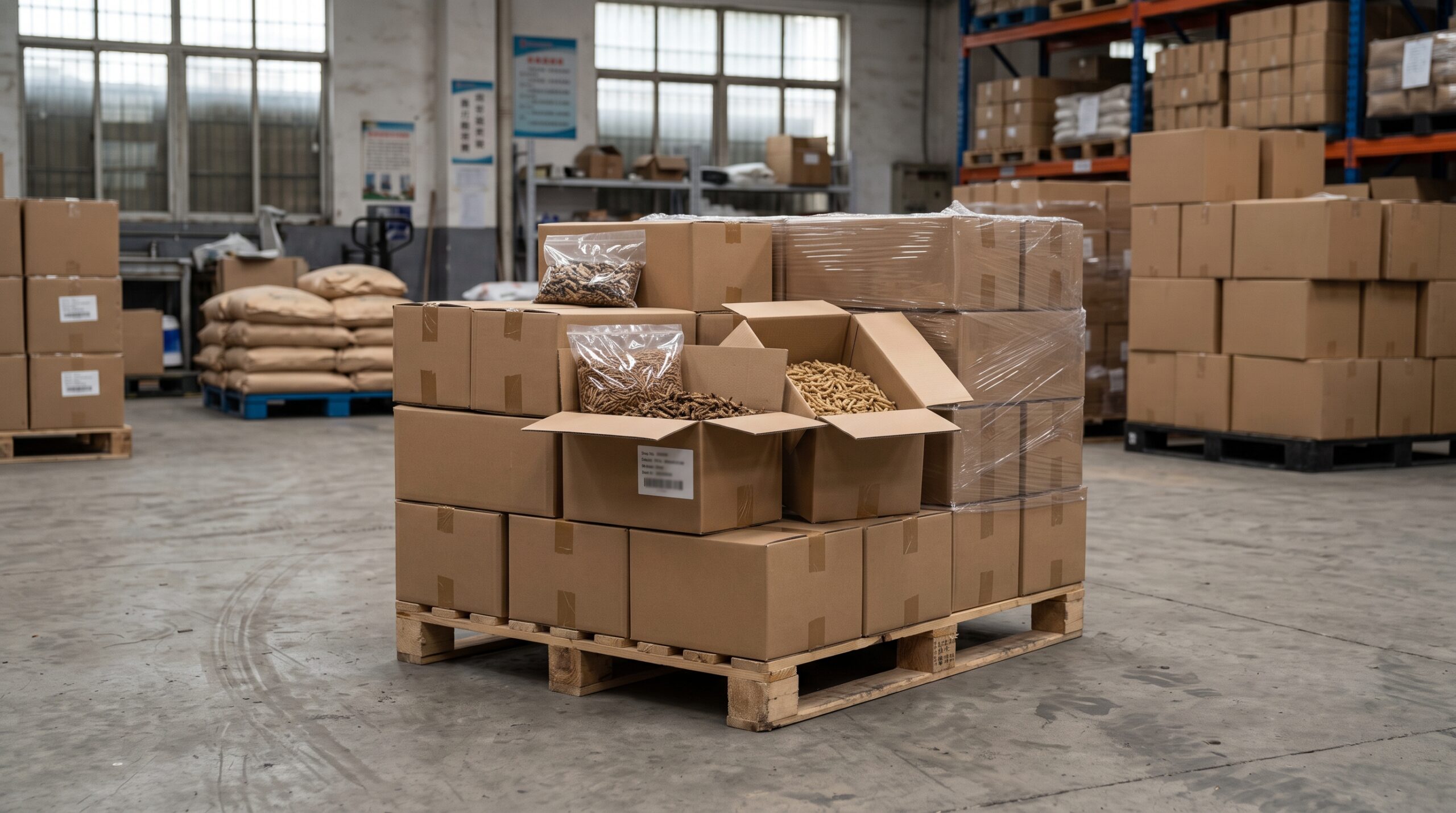

Dried insect packaging does more than hold a product during shipment. For wholesalers, distributors, repackers, pet product businesses, farms, and feed-related buyers, the packaging system affects product protection, warehouse handling, traceability, freight efficiency, and downstream handling efficiency.
The right format depends on the insect species, whole-product characteristics, order quantity, shipment route, storage conditions, and intended application. A package that works for dried mealworms may not perform identically with dried grasshoppers, earthworms, crickets, maggots, or black soldier fly larvae. Buyers should therefore define packaging as part of the purchase specification rather than leaving it until the order is ready to ship.
This guide explains the main layers of a commercial packaging system, the questions buyers should include in an RFQ and the checks that help reduce avoidable damage or confusion in bulk orders.
Why Packaging Is Part of Product Quality
Whole dried insects are lightweight, irregularly shaped and, depending on the species and processing method, potentially brittle. During filling, stacking and transportation, the product may experience compression, vibration and repeated handling. Packaging that is too weak, poorly sealed or incorrectly sized can contribute to punctures, moisture exposure, product loss and additional breakage.
Packaging also carries important commercial information. A buyer may need to identify the product, batch, net weight, packing date, destination, or internal item code without opening every carton. When the physical packaging and documents use the same references, receiving and inventory control become easier.
This means packaging specifications should align with appearance, moisture, batch documentation, and shipment conditions. Our guide to dried insect quality control explains how packaging fits into a wider inspection process.
Understand the Three Packaging Levels
A bulk order usually involves more than one packaging layer. Buyers should specify each layer separately because they perform different functions.
Primary or inner packaging
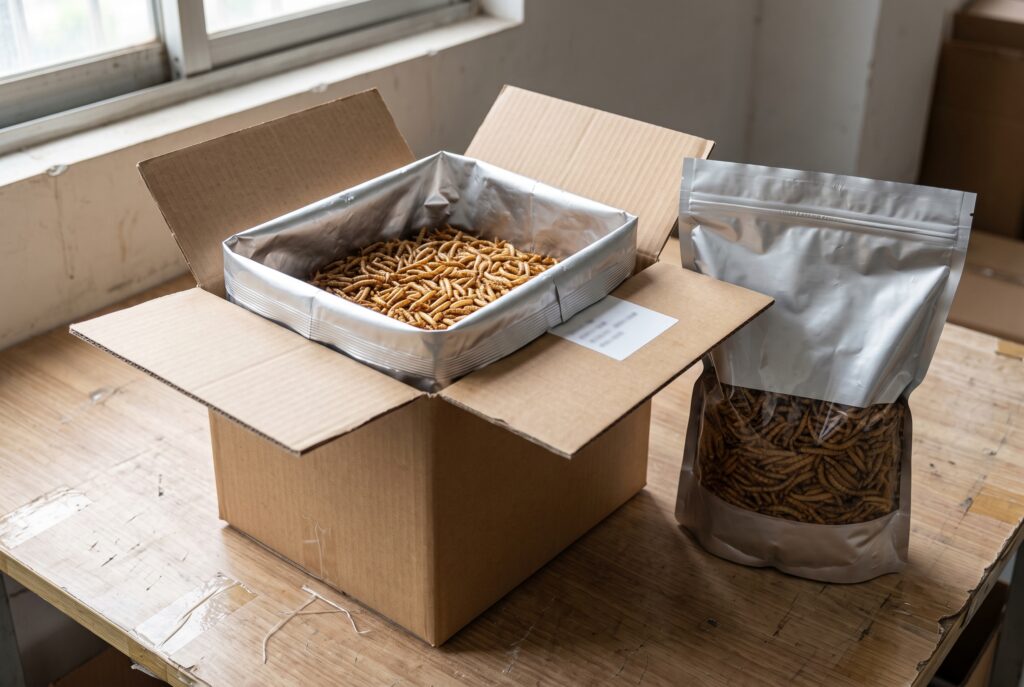
The inner bag or liner directly contains the dried insects. Its main purposes are containment, separation from the outer carton or sack, and protection from the surrounding environment. The selected material, thickness, dimensions, and closure should suit the product and shipment conditions.
Secondary or outer packaging
The outer bag, carton or other container provides mechanical protection and a surface for handling and identification. It must support the chosen net weight without tearing, collapsing or allowing the inner liner to be damaged during routine movement.
Tertiary or transport packaging
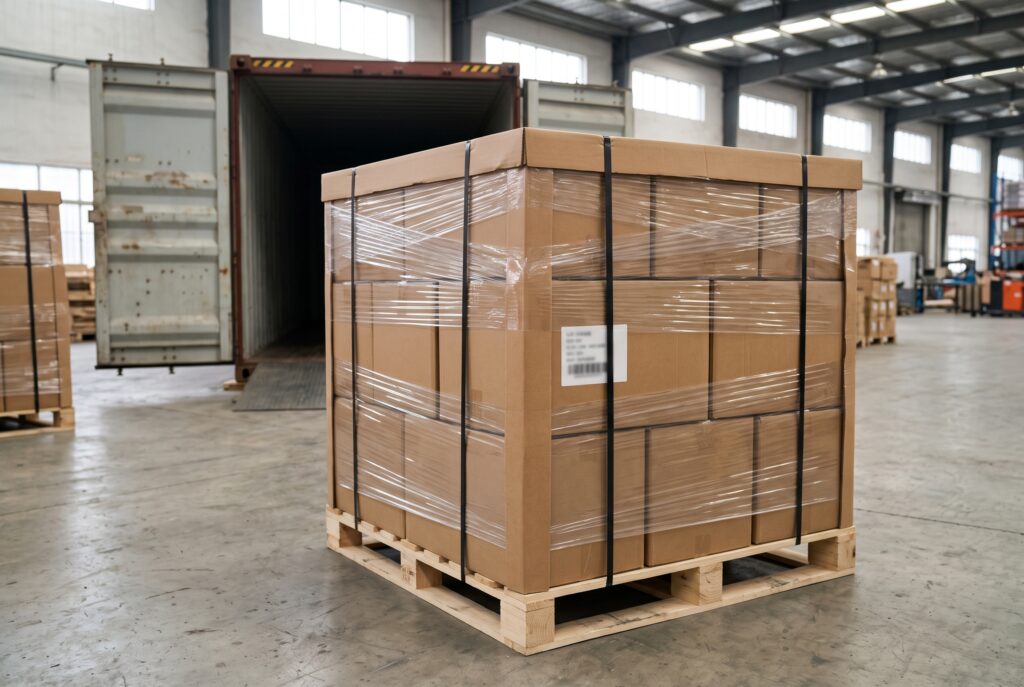
Pallets, stretch wrap, corner protection, strapping and container-loading materials help combine packages into a transport unit. This level affects forklift handling, pallet stability, container use and the condition of cartons on arrival.
A quotation that says only “packed in bags” is incomplete. It does not tell the buyer what contacts the product, how the bag is closed, whether an outer carton is included, or how the packages will be prepared for export.
Choose an Inner Bag and Moisture Barrier
Dried products can exchange moisture with the surrounding air. The practical barrier needed depends on the product, expected transit time, warehouse environment, and agreed shelf-life basis. Buyers should ask what inner material is offered and whether it is intended mainly for containment or also for moisture protection.
Common commercial arrangements may include a food- or feed-contact inner liner inside a woven sack or carton. Exact material specifications and construction must be confirmed for the destination and intended use. Assumed performance across generic plastic bags is invalid.
Important questions include:
- What is the inner bag material and thickness?
- Is it new and suitable for the intended product application?
- Is the bag large enough to close without excessive tension?
- How is the opening sealed or tied?
- Is the liner protected from carton edges or puncture points?
- Will the product be packed only after adequate cooling?
- Are any additional barrier or desiccant arrangements proposed?
Desiccant selection, sizing, and placement require formal evaluation for the product and destination, and must remain physically separated from the dried insects. A desiccant is not a substitute for suitable drying, intact packaging, or controlled storage.
Buyers reviewing a moisture specification should also read how to evaluate dried insect moisture. A satisfactory pre-shipment result can still be affected by damaged seals, humid storage, or condensation during transit.
IMAGE 2 POSITION — insert immediately after this section and before the next H2, “Select the Outer Bag or Carton.”
Select the Outer Bag or Carton
The outer package should match the product’s physical form and the buyer’s handling process. Woven sacks may be efficient for some bulk applications, while cartons can provide better shape and compression protection for products where whole appearance is commercially important. Some orders use an inner sealed bag within a corrugated carton to combine barrier protection and mechanical support.
The decision should consider:
- target net weight per package;
- insect size and likelihood of puncturing a liner;
- importance of whole-product appearance;
- acceptable level of compression and breakage;
- manual versus forklift handling;
- pallet dimensions and stacking pattern;
- warehouse shelving and repacking equipment;
- container utilization; and
- buyer or destination requirements.
Heavier packages reduce the number of units to handle, but they may be harder to lift and can place more pressure on the product. Smaller packages may support easier receiving and repacking, yet increase packaging material, labels, and handling time. The best format is therefore a commercial balance rather than a universal standard.
Buyers should also distinguish net weight from gross weight. Net weight refers to the product; gross weight includes the packaging. Both may be relevant when planning freight, receiving inventory, and checking documents.
Match Packaging to the Dried Insect Product
Different whole dried insects create different packaging challenges.
| Product | Packaging points to review |
|---|---|
| Dried mealworms | Whole-piece appearance, compression, fragments, and liner sealing |
| Dried earthworms | Product shape, cleanliness, moisture protection and carton or bag handling |
| Dried grasshoppers | Irregular body shape, fragile parts, puncture risk and compression |
| Dried crickets | Whole-product integrity, size distribution and void space |
| Dried maggots | Free-flowing condition, liner integrity and batch identification |
| Dried BSFL | Product colour and condition, moisture barrier, sealing and handling |
This table is a purchasing checklist, not a fixed packaging prescription. Actual arrangements require formal confirmation after considering the sample, product grade, processing method, quantity, and route. Buyers can review the available whole dried insect products before discussing product-specific packaging.
Control Filling, Cooling and Sealing
Good packaging materials cannot correct poor packing practice. The product should be in an appropriate condition before the liner is closed. Residual heat in packed material can create an unwanted internal environment, while overfilling can make sealing difficult and increase stress on the liner and carton.
A practical packing check may cover:
- confirmation of the product and batch;
- visual inspection of the empty liner and outer container;
- verification of tare and net weight;
- suitable fill level and headspace;
- removal of product from the sealing area;
- completion of the agreed closure;
- inspection for holes, weak seals or exposed edges;
- application of the correct batch label; and
- transfer to a clean, dry holding area.
Possible closure methods include heat sealing, ties, or other agreed systems. The buyer should know what is being offered and how seal integrity is checked. Phrases such as “moisture-proof packaging” should be supported by a clear description of the material and closure rather than accepted as a complete technical specification.
Define Labels and Traceability Information
Labels should help the buyer identify packages without making unsupported claims. The required information varies by product, destination, and commercial arrangement, but a B2B label may need to show:
- product name;
- batch or lot number;
- net weight;
- packing or production date, when applicable;
- country of origin;
- supplier or exporter identification;
- storage or handling statement;
- package number, when required; and
- buyer-specific item or shipping marks.
Before production, the buyer should approve the label content, language, dimensions, and placement. If neutral packaging or buyer-specific marks are requested, specify these requirements in the RFQ. Review of artwork and regulatory text rests with the responsible buyer or qualified adviser for the destination market.
Batch numbers on the package should correspond with the COA, packing list, and other shipment records. Avoid placing labels where stretch wrap, pallet boards, or carton tape will hide essential information.
Plan Pallets, Wrapping and Container Loading
Transport packaging must keep individual units stable without crushing them. Pallet specifications, cartons per layer, layer counts, stack heights, and edge protections require formal agreement when they affect freight or warehouse handling.
If raw-wood pallets, crates or dunnage are used in international trade, applicable destination requirements must be checked. The International Plant Protection Convention’s ISPM 15 standard for wood packaging material addresses phytosanitary measures for raw-wood packaging used in international movement. It does not certify the dried insect product itself, and destination-specific requirements still need confirmation.
Container planning should consider:
- dry and visibly suitable container condition;
- absence of strong residual odours or obvious contamination;
- protection from rain during loading;
- carton or bag orientation;
- load stability and movement during transit;
- separation from incompatible cargo;
- ventilation or moisture-control decisions where applicable; and
- photographs of the loading condition.
Container desiccants or other humidity-control measures may be considered for particular routes, but their use should be based on the shipment conditions. They should not be presented as a guarantee against condensation or moisture change.
IMAGE 3 POSITION — insert immediately after this section and before the next H2, “Inspect Packaging Before Shipment and on Arrival.”
Inspect Packaging Before Shipment and on Arrival
A packaging inspection is useful at two stages: before shipment and during receiving.
Before shipment, check that the agreed materials, pack size, labels, seals, carton condition, pallet arrangement, and shipping marks have been used. Photographs should show enough detail to link the packaging to the relevant batch without exposing confidential information needlessly.
On arrival, examine the shipment before distribution or repackaging. Record:
- wet, stained, crushed or punctured outer packages;
- open, weak or damaged inner seals;
- signs of condensation;
- loose product inside cartons or the container;
- missing, inconsistent or unreadable labels;
- pallet movement or collapsed stacking;
- differences between received units and the packing list; and
- any unexpected product condition near damaged packaging.
If discrepancies arise, isolate affected units where appropriate and preserve photographs, package numbers, batch details, and representative samples. Packaging damage does not automatically prove that the product is unsuitable, but the condition requires formal assessment before normal use or resale.
What Buyers Should Include in a Packaging RFQ
Detailed packaging specifications are essential with enough detail for suppliers to quote on the same basis. Include:
- insect species and product form;
- total required quantity;
- preferred net weight per bag or carton;
- acceptable inner liner and closure;
- preferred outer bag or carton;
- label language and required information;
- neutral or buyer-specific shipping marks;
- palletized or floor-loaded preference;
- pallet material and destination requirements;
- destination country and port;
- expected storage and distribution process;
- importance of whole appearance or breakage control; and
- any buyer-specific inspection or documentation needs.
The final packaging format may depend on quantity, material availability, product characteristics, and freight method. When preparing an enquiry, send these details through our contact form so that available options can be reviewed for the specific order.
Common Dried Insect Packaging Mistakes
Specifying only the outer package
“Carton packing” does not explain the inner liner, closure, or direct-contact material. Specify the complete packaging system.
Choosing a pack size only by freight efficiency
A larger unit may reduce package count but increase compression, lifting difficulty, or repacking inconvenience. Consider the receiving workflow as well as freight.
Treating packaging as a moisture guarantee
Barrier packaging supports moisture control, but initial product condition, seal quality, storage, and transit environment also matter.
Approving labels too late
Late label changes can delay packing or create inconsistencies between cartons and documents. Confirm artwork and shipping marks before production.
Ignoring pallet requirements
The pallet material, dimensions, and treatment requirements may affect customs clearance, warehouse fit, and freight cost.
Using retail language for a bulk order
Retail-ready pouches, printed artwork, and individual barcodes are different requirements from commercial bulk packaging. State whether the goods will be used directly, repacked, or processed after arrival.
Dried Insect Packaging Checklist
| Review area | Buyer question |
|---|---|
| Product | Which whole dried insect and grade will be packed? |
| Inner layer | What material, thickness, dimensions, and closure are proposed? |
| Outer layer | Is the bag or carton suitable for the net weight and product shape? |
| Moisture | What barrier and storage assumptions apply? |
| Weight | Are net weight, gross weight and tolerance clearly understood? |
| Label | Do the product, batch, and package details match the documents? |
| Pallet | Are dimensions, stacking, and wood-packaging requirements confirmed? |
| Container | How will packages be protected and stabilized during loading? |
| Inspection | What pre-shipment photographs or checks are required? |
| Receiving | How will damaged or inconsistent packages be recorded? |
Conclusion
Dried insect packaging should be specified as a complete system: inner liner, closure, outer package, label, pallet, and container arrangement. Each layer serves a different purpose, and the most suitable combination depends on the product, commercial quantity, route, and buyer’s receiving process.
For B2B orders, clear packaging requirements reduce quotation differences and make inspection more objective. Buyers should confirm materials, net weight, labels, and transport format before packing begins, then connect package identification with the relevant batch documents. Packaging ensures product protection, but it should not replace proper drying, testing, storage, or shipment handling.
Frequently Asked Questions
What packaging is commonly used for bulk dried insects?
Commercial orders may use a sealed inner liner within a woven sack or corrugated carton, followed by pallet wrapping or other transport protection. The exact format depends on the insect, pack weight, route, and buyer requirements.
Are cartons better than woven bags for whole dried insects?
Not in every case. Cartons can provide additional shape and compression protection, while bags may be efficient for some bulk applications. Buyers should compare product fragility, handling, pallet use, freight, and repacking needs.
Does moisture-proof packaging guarantee stable moisture?
No. Barrier materials and seals can reduce moisture exchange, but product condition at packing, storage, temperature changes, damage, and transit conditions also affect the result.
Can buyers request private labels or custom packaging?
Buyer-specific labels, shipping marks, or packaging may be possible depending on quantity, artwork, materials, and destination requirements. The requested format should be included in the RFQ and confirmed before packing.
What should buyers inspect when bulk packaging arrives?
Check outer damage, liner seals, moisture or condensation signs, labels, package count, pallet stability, and consistency with the packing list. Record issues before the goods are distributed or repacked.