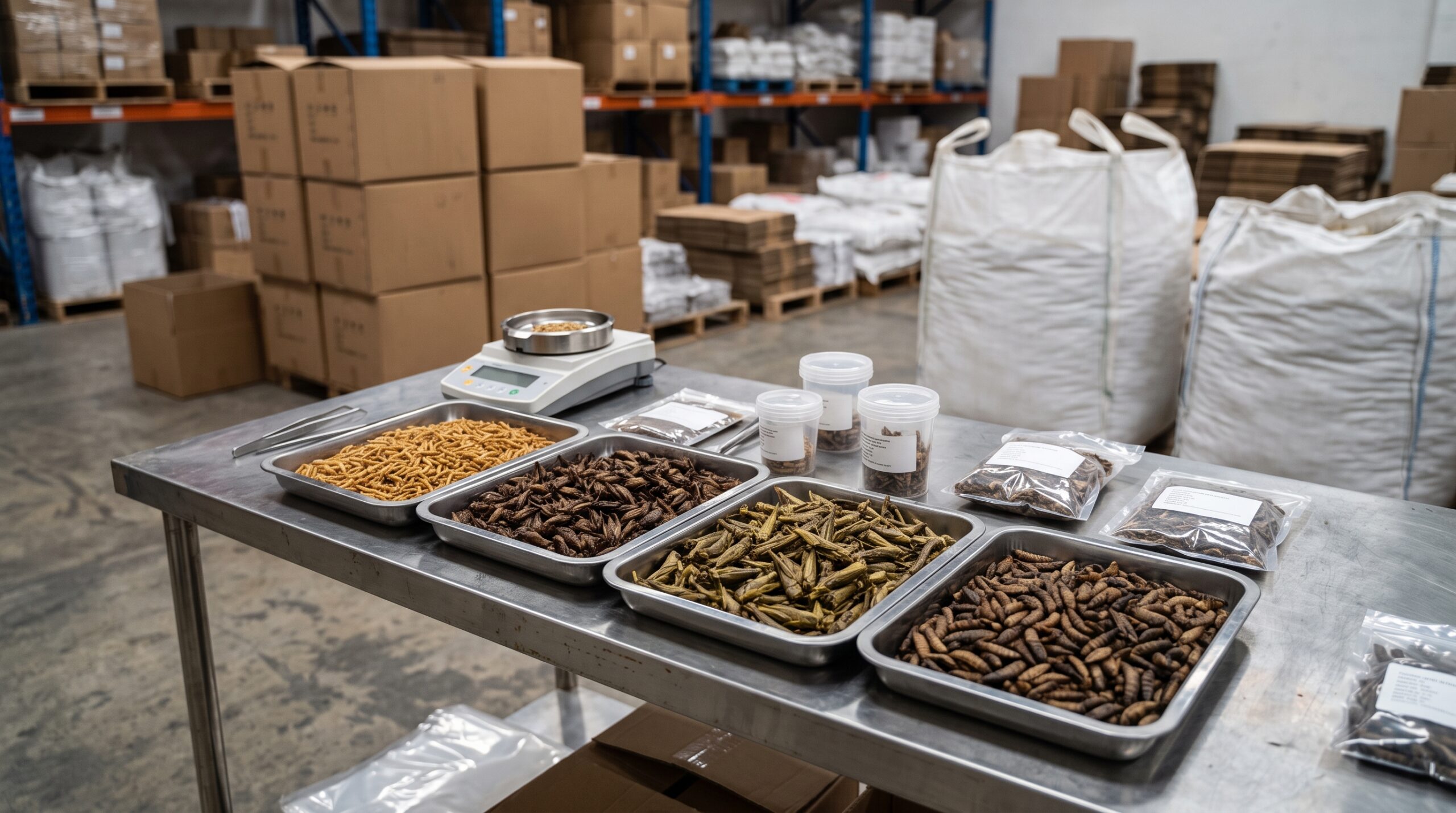

Dried insect moisture is an important quality consideration for wholesalers, distributors, repackers, farms, pet product businesses, and feed-related commercial buyers. It can influence texture, breakage, storage behaviour, packing performance, and the consistency of shipment. However, a single number on a specification sheet does not tell the whole story.
Different insect species, product sizes, processing methods and test methods can produce different results. A useful evaluation therefore considers the reported value along with the batch identity, sampling method, laboratory method, packaging, and condition on arrival.
This guide explains how B2B buyers can review moisture information without assuming one fixed limit applies to every dried insect product or application.
Why Moisture Matters in Bulk Dried Insects
Moisture affects how a dried insect product behaves during handling and storage. If a product contains more moisture than expected, it may feel softer, become less stable during storage or perform differently in repacking and blending. A very dry or aggressively processed product may become more brittle and generate additional fragments during transportation.
The commercial impact depends on the product and its intended use. Whole dried mealworms intended for retail repacking may be judged partly on appearance and breakage. Dried grasshoppers or crickets may have different structural characteristics. Dried earthworms, maggots and black soldier fly larvae can also respond differently to drying, packing and storage conditions.
For that reason, moisture should be evaluated as one part of the overall specification—not as an isolated pass-or-fail number. Buyers comparing suppliers should first confirm that the products, sampling basis and test methods are comparable. Our broader guide to dried insect quality control explains how moisture fits alongside appearance, cleanliness, packaging, traceability and documentation.
Moisture Content and Water Activity Are Not the Same
Moisture content describes the amount of water measured in a sample under a stated test method. It is commonly reported as a percentage, but the basis and method matter. Results may be expressed on an as-received basis or another calculation basis, and different analytical procedures may not produce identical values.
Water activity, usually written as aw, describes how available the water is within a product. It is not simply another name for moisture percentage. Two products can have similar moisture content but different water activity because their composition and physical structure influence how water is held.
The US Food and Drug Administration provides useful technical background on water activity in foods. This reference helps explain the concept, but it should not be treated as a universal dried-insect specification or as a substitute for the requirements of the buyer’s destination market and intended application.
When reviewing a report, buyers should ask:
- Is the result moisture content, water activity, or both?
- What unit and calculation basis were used?
- Which method and equipment were used?
- Was the test performed by the supplier, an independent laboratory or another party?
- Which production batch and sample does the result represent?
These questions prevent a buyer from comparing values that look similar but were produced on different bases.
IMAGE 2 POSITION — insert immediately after this section and before the next H2, “Why Moisture Varies Between Dried Insect Batches.”
Why Moisture Varies Between Dried Insect Batches
Natural raw materials are not perfectly uniform. Insect species, size distribution, growth conditions, harvest conditions, and initial water content can affect drying behaviour. The processing method, drying time, temperature profile, loading density and cooling conditions may also influence the finished product.
Variation can also occur within a batch. Material near the centre of a dryer load may not behave the same as material near an edge. Larger whole insects may dry differently from smaller ones, while broken pieces may react differently again. This is why a test result is only as useful as the sample used to obtain it.
A realistic purchasing specification should account for the product, intended use, and agreed test method. Buyers should avoid copying a moisture limit from an unrelated species or supplier without confirming that it is technically and commercially appropriate. If the intended use has regulatory or customer-specific requirements, those requirements should be stated in the enquiry before pricing and sampling.
Representative Sampling Comes Before Testing
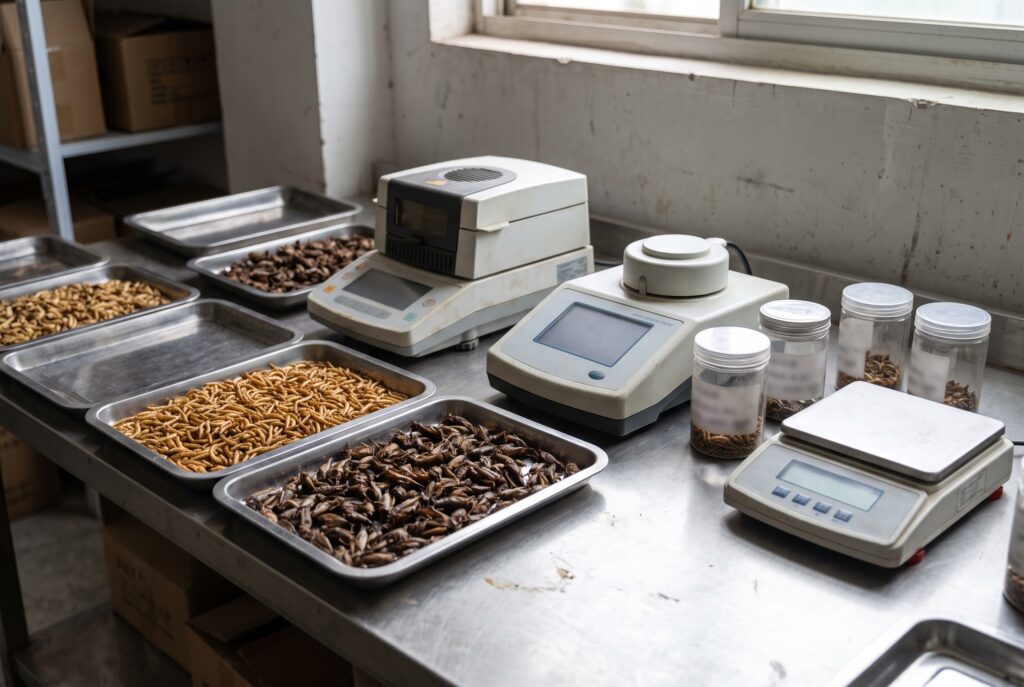
Testing one convenient handful cannot reliably describe a large shipment. A sample taken from the top of a bag may not represent the middle or bottom. One bag may also differ from another because of packing time, location in storage or exposure during handling.
For pre-shipment evaluation, the buyer and supplier should agree on a practical sampling approach. Depending on the order, this may include collecting increments from several bags, different pallet positions or multiple points within the production lot. The increments can then be combined or tested separately according to the agreed plan.
The sampling record should identify:
- product name and form;
- production or lot number;
- sampling date and location;
- number of bags or positions sampled;
- sample quantity;
- person or organization responsible for sampling;
- sealing, storage and transport conditions for the sample.
If a result is later disputed, these details help determine whether the difference came from the product, the sampling process, the test method or sample handling. This is also why dried insect batch testing should be linked to a defined lot rather than treated as a general supplier claim.
Check the Moisture Test Method and Reporting Basis
Several methods can be used to assess moisture, including oven-based loss-on-drying procedures, moisture analysers and other laboratory techniques. Fast instruments can be useful for production checks, but their results depend on settings, calibration, sample preparation and the product matrix. A handheld or portable meter may be helpful for screening, yet it should not automatically be treated as equivalent to a laboratory method.
When comparing quotations or certificates, ask each supplier to identify the method used. The following details are especially useful:
| Item to confirm | Why it matters |
|---|---|
| Test method or procedure | Different methods can yield different results |
| Sample preparation | Whole, crushed or ground samples may behave differently |
| Reporting basis | Prevents comparison of values calculated differently |
| Equipment and calibration status | Supports confidence in the measurement process |
| Test date | Shows whether the result relates to current batch condition |
| Batch or lot number | Connects the result to the goods being purchased |
| Laboratory identity | Clarifies who produced the result |
The Certificate of Analysis should be checked for product identity, batch identity, result, unit, method and specification or acceptance criterion. See our guide to reading a dried insects COA for a fuller explanation of how to review test documentation.
Do not compare two percentages until you know they were generated using sufficiently comparable methods. A small numerical difference may reflect analytical variation rather than a meaningful difference in commercial quality.
Packaging, Storage and Transport Can Change Moisture Condition
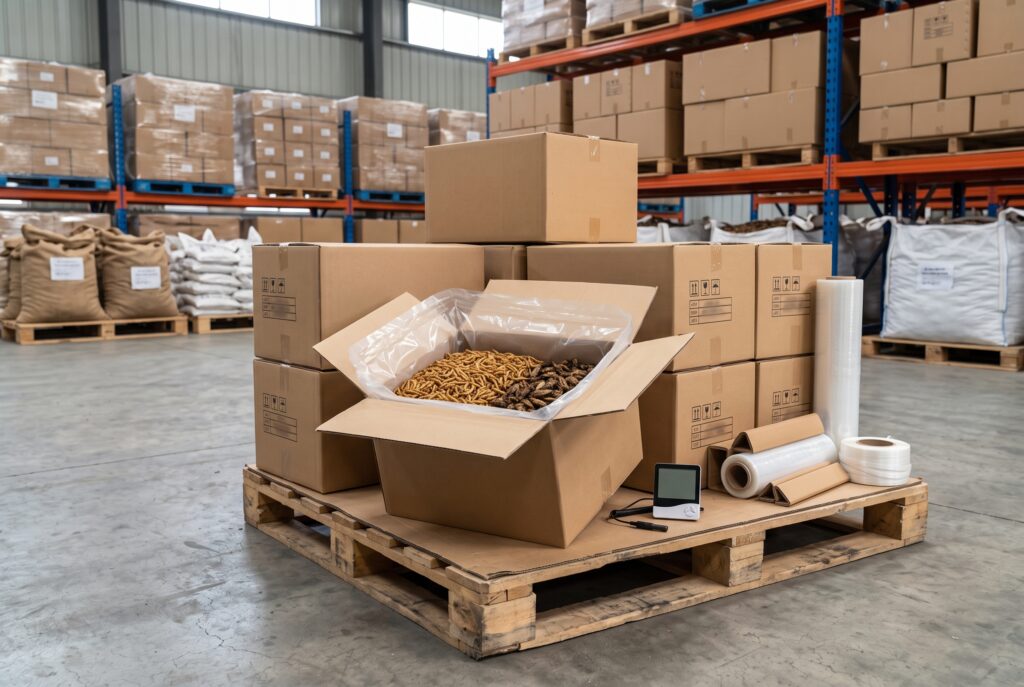
A satisfactory result at the time of production does not guarantee identical condition after storage or shipment. Dried products can exchange moisture with the surrounding environment if packaging is unsuitable, damaged or repeatedly opened. Humid warehouse conditions, condensation, long transit periods and temperature changes can all affect product condition.
Packaging should therefore be considered part of moisture control. Buyers should confirm the inner liner or barrier material, closure method, outer packaging, net weight and pallet protection. The chosen pack should be appropriate for the product, shipment route and expected storage period.
Warehouse and receiving practices also matter. Bags should be kept closed, dry and protected from walls, floors, rain and direct heat. After opening a bulk pack, repackers should minimize exposure and reseal remaining material appropriately. Where relevant, temperature or humidity records can provide context if a shipment arrives in an unexpected condition.
At receipt, inspect for:
- wet or damaged cartons and bags;
- punctured, open or poorly sealed liners;
- visible condensation;
- unexpected softness, clumping or loss of free flow;
- unusual odour or appearance;
- differences between bags or pallets;
- discrepancies between labels, lot numbers and documents.
An abnormal observation does not by itself identify the cause. Preserve representative samples, packaging photographs, shipment records and lot details before discussing retesting or corrective action.
IMAGE 3 POSITION — insert immediately after this section and before the next H2, “How Buyers Should Evaluate Dried Insect Moisture.”
How Buyers Should Evaluate Dried Insect Moisture
A structured process makes supplier comparisons more reliable. The following sequence works well for many bulk purchasing situations.
1. Define the exact product and application
State the insect species, whole-product form, intended application and destination market. A specification for a retail repacking product may differ from one used for bulk feeding or further processing.
2. Request the supplier’s current specification
Ask for the available moisture specification or typical reference range, but confirm whether it is a contractual limit, internal target or historical reference. Do not assume that “typical” means guaranteed for every batch.
3. Agree on the test method
Specify how moisture will be tested, how the sample will be prepared and which reporting basis will be used. If third-party testing is required, agree on the laboratory and responsibility for cost before the order.
4. Confirm the sampling plan
Define the batch, number of packages sampled, sample handling and retention sample arrangements. Larger or higher-risk orders may justify a more formal approach.
5. Review the COA against the correct batch
Match the product name, lot number and test date to the goods being shipped. Confirm that the report shows the result and unit clearly. A generic or undated report should not be treated as evidence for the current shipment.
6. Inspect packaging and condition on arrival
Check the shipment before bags are distributed, repacked or mixed. Record any damage and isolate affected goods where appropriate. If verification testing is planned, obtain samples using the agreed process.
7. Investigate differences systematically
If buyer and supplier results differ, compare sampling location, sample sealing, preparation, method, equipment, laboratory and calculation basis. Retesting a properly retained sample can be more informative than arguing over two results produced under unknown conditions.
Questions to Include in Your RFQ
Clear questions help suppliers prepare quotations on the same basis. Include the following points in a dried-insect enquiry:
- What moisture specification or reference range is available for this product?
- Is the value a guaranteed limit, target or typical result?
- Which test method and reporting basis are used?
- Will the shipment receive batch-specific testing?
- Can a COA be supplied for the shipped lot?
- How will samples be selected and retained?
- What inner and outer packaging will be used?
- What storage conditions and expected lead time apply?
- Can destination-specific or customer-specific requirements be reviewed before quotation?
- What process applies if receiving results differ from the pre-shipment report?
Provide the product, quantity, destination, packaging and intended application when requesting a quotation. For a batch-specific discussion, use our contact form and describe any required limits or test methods. Availability, documentation and testing arrangements should be confirmed for each order.
Common Mistakes Buyers Should Avoid
One common mistake is treating the lowest moisture number as automatically best. Excessive drying can affect appearance and increase brittleness, while the commercially suitable condition depends on product and application.
Another mistake is accepting a result without checking the batch number. A report from an earlier lot or a generic technical sheet cannot confirm the condition of the goods being purchased.
Buyers may also compare results from different methods as though they were directly interchangeable. Without method, preparation and basis information, the comparison can be misleading.
Finally, moisture should not be used as the only evidence of quality or safety. Product identity, cleanliness, microbiological testing where applicable, residues, packaging integrity, traceability and destination-market requirements may all need separate evaluation.
A Practical Moisture Review Checklist
Before approving a bulk order, confirm that:
- the insect species and whole-product form are correctly identified;
- the intended use and destination requirements are clear;
- the specification is appropriate to that product and application;
- moisture content and water activity are not being confused;
- the sampling plan represents the batch;
- the test method, preparation and reporting basis are stated;
- the result is connected to the correct lot;
- packaging is suitable for storage and transit;
- receiving inspection and verification responsibilities are agreed;
- any value described as typical is not mistaken for a guarantee.
This approach gives buyers a better basis for comparing suppliers and discussing deviations. It also reduces the risk of rejecting or approving a shipment based on a number that lacks the context needed for interpretation.
Conclusion
Dried insect moisture should be evaluated through a combination of representative sampling, an appropriate test method, clear reporting, batch traceability and packaging control. The percentage alone is not enough.
B2B buyers should define their product and application first, agree on how the result will be measured, and verify that the COA belongs to the shipment being purchased. Because species, processing, packaging and destination requirements vary, final specifications and testing arrangements should be confirmed for each order rather than assumed to apply universally.
Frequently Asked Questions
What is a good moisture level for dried insects?
There is no single moisture level that is automatically suitable for every dried insect species, product form and application. Buyers should evaluate a supplier’s specification against the intended use, destination requirements, test method and agreed commercial terms.
Is moisture content the same as water activity?
No. Moisture content measures the amount of water in a sample under a stated method, while water activity describes the availability of water in the product. The two values provide different information and should not be used interchangeably.
Can I check dried insect moisture with a portable meter?
A portable meter may provide a useful screening result if it is suitable and calibrated for the product. It may not be equivalent to a defined laboratory method, so important acceptance decisions should follow the method agreed with the supplier.
Should every shipment have a moisture result on the COA?
That depends on the agreed specification, product, destination and purchasing requirements. If moisture is an acceptance criterion, request a batch-specific result and confirm the method, unit, lot number and testing responsibility before ordering.
What should I do if the receiving result differs from the supplier’s result?
First protect the shipment and retain representative samples. Then compare sampling, sealing, storage, sample preparation, test method, equipment, reporting basis and laboratory conditions. If needed, use an agreed independent laboratory to test a properly retained sample.