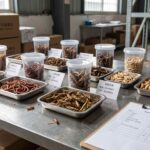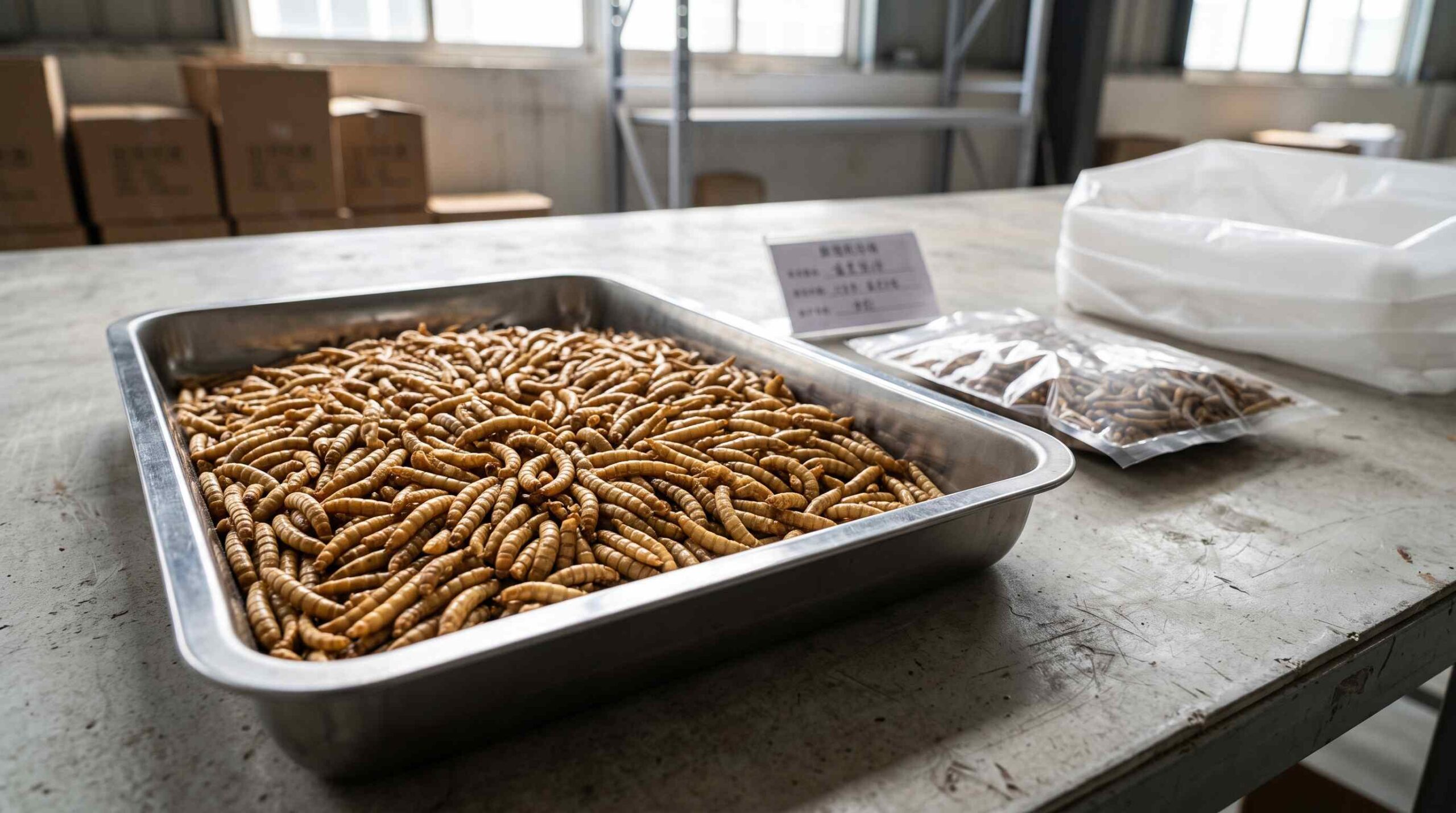

Bulk dried mealworms are purchased by wholesalers, distributors, resellers, repackers, pet product businesses, bird-feed suppliers, farms, and feed-related commercial buyers. Although quotations may use the same product name, the actual products can differ in whole-piece appearance, color, size, fragments, processing method, moisture condition, packaging, and batch documentation.
A reliable comparison, therefore, involves more than price per kilogram. Buyers should first define the intended application and commercial grade, then compare products on the same basis. Samples, photographs, and typical specifications are helpful during sourcing, but the final purchasing decision should also consider the relevant batch, packaging, and shipment requirements.
This guide explains what B2B buyers should evaluate before ordering whole dried mealworms in commercial quantities.
What Are Bulk Dried Mealworms?
Dried mealworms are the dried larval form of Tenebrio molitor. In the BulkInsects product range, they are supplied as whole dried insects rather than live larvae or insect powder.
The term “bulk” describes commercial supply, but it does not define a single fixed grade, pack size, or processing method. One buyer may require visually uniform whole mealworms for repacking, while another may accept a general commercial grade for farm or feed-related use. The correct product depends on the buyer’s application, handling process, and price target.
When comparing suppliers, confirm:
- species and whole-product form;
- commercial grade;
- processing or drying method;
- color and size expectations;
- whole-piece, fragment, and dust condition;
- moisture and cleanliness requirements;
- sample and batch relationship;
- packaging format;
- testing and documentation; and
- order quantity, destination, and timing.
Buyers ready to review available supply options can visit the whole dried mealworms product page for product-specific information and inquiry details.
Which B2B Buyers Purchase Dried Mealworms?
Different buyers evaluate the same product differently.
Wholesalers and distributors
These buyers often need repeatable commercial grades, practical pack sizes, clear lot identification, and supply planning. They may serve several downstream applications, so consistency and documentation can be as important as a premium appearance.
Resellers and repackers
Repacking businesses commonly pay closer attention to the overall appearance, color, visible dust, and how the product behaves during weighing and filling. The difference between a protected courier sample and a large commercial package should be taken into account.
Pet and bird product businesses
These buyers may need recognizable whole mealworms, a suitable size range, and packaging that protects product appearance. The final product format, claims, and destination requirements remain the buyer’s responsibility.
Farms and commercial animal operations
Farms may prioritize commercial value, practical bulk handling, and suitability for their feeding plan. Dried mealworms are supplied as an ingredient or whole dried material, not as a complete formulated feed.
Feed-related processors
Processors may focus on defined analytical information, batch traceability, packaging, and documentation. Requirements should be stated before sampling and quotation so that the offered grade can be evaluated correctly.
Define the Commercial Grade Before Comparing Prices
The phrase “premium mealworms” is not a complete specification. Buyers should translate grade descriptions into observable or testable requirements.
When comparing bulk-dried mealworms, first confirm that each quotation refers to a comparable commercial grade and intended application.
A commercial grade may be influenced by:
- percentage and appearance of whole pieces;
- fragment and dust level;
- color range;
- size distribution;
- visible cleanliness;
- foreign matter;
- Good odor and general condition;
- moisture result;
- processing method; and
- packaging protection.
Two quotations may look comparable while referring to different grades. A cleaner, more uniform product selected for repacking may carry a different price from a general commercial product intended for bulk use. Ask suppliers to describe the quoted grade and provide current photographs or a representative sample.
Avoid choosing the lowest price until you know whether both offers use the same product form, pack weight, Incoterm, test scope, nd quality basis.
Compare Whole Appearance, Fragments, and Dust
Whole-product appearance matters most when buyers will resell or repackage dried mealworms in a recognizable form. Inspect the entire sample, not just the top layer, because fragments and fine material can settle during courier transport.
Use a consistent process:
- record the sample or batch reference;
- photograph the unopened package;
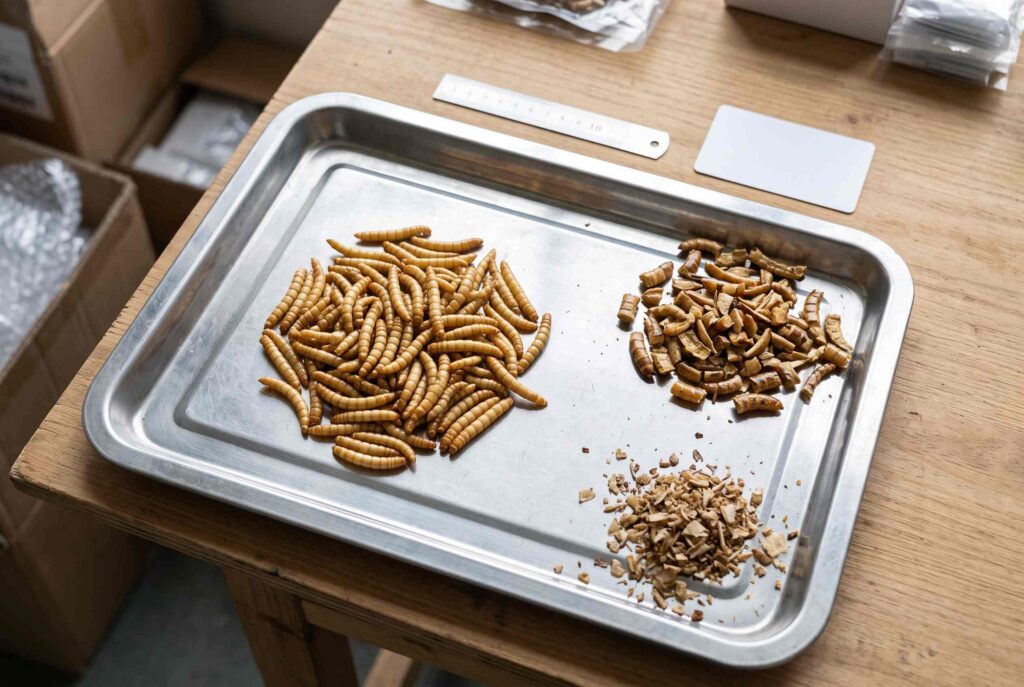
- empty the complete sample onto a neutral tray;
- separate obviously whole pieces, fragments, and fine material;
- note size and color variation;
- record any visible foreign matter; and
- Compare the sample packaging with the proposed bulk packaging.
No realistic supply chain can promise zero breakage. Drying, sorting, packing, and transport can all affect integrity. If a particular whole-piece condition is commercially important, define how it will be assessed and confirm whether the sample represents the commercial batch.
IMAGE 2 POSITION — insert immediately after this section and before the next H2, “Evaluate Colour, Size and Cleanliness.”
Evaluate Color, Size, and Cleanliness
Whole dried mealworms are commonly evaluated for a golden-to-brown commercial appearance, but natural and processing-related variation should be expected. Buyers should look for an acceptable range rather than approve a single carefully selected piece.
Check for:
- consistency across the complete sample;
- unusually dark or scorched pieces;
- excessive pale, uneven, or damaged material;
- visibly mixed size ranges;
- soil, plant matter, packaging fibers, or other impurities;
- unrelated insect material; and
- signs of clumping or moisture exposure.
Lighting affects color judgments. Compare samples under the same neutral light and avoid relying only on edited supplier photographs. If color or size is critical for retail presentation, keep an approved sample record and written description for later batch review.
Cleanliness is not established by appearance alone, and an analytical value cannot show every visible impurity. Physical inspection, agreed specifications, and relevant testing should be considered together.
Understand Processing and Drying Options
Processing influences appearance, texture, breakage, commercial cost, and the information buyers may request. BulkInsects commonly discusses microwave-dried mealworms as a primary commercial option, while hot-air- or freeze-dried alternatives may be considered for specific requirements and availability.
Microwave-dried mealworms
Microwave drying can support efficient commercial processing and a recognizable whole dried product. Buyers should still evaluate the actual batch for appearance, moisture, odor, fragments, and packaging rather than assuming the process name guarantees a specific result.
Hot-air-dried mealworms
Hot-air drying conditions can affect color, texture, and uniformity. Ask for current product photographs or a representative sample and confirm the quoted grade.
Freeze-dried mealworms
Freeze-dried products may have different textures, appearances, densities, and costs. Buyers should confirm whether this option is necessary for the intended application, rather than assuming that the highest-cost process is automatically the best commercial choice.
Processing labels should accurately describe the offered product. If the drying method is important to the buyer’s marketing or technical process, include it in the RFQ and supporting documents.
Review Moisture, Odor, and Product Condition
Moisture affects product condition, storage behavior, and handling, but one universal limit should not be assumed for every order. Any proposed requirement should be reviewed together with the test method, reporting basis, packaging, and intended application.
Buyers should ask:
- Is a moisture result available for the relevant batch?
- Which method and unit were used?
- Does the COA identify the product and batch?
- Was the product adequately cooled before packing?
- What inner liner and seal are proposed?
- What storage conditions are assumed?
Unexpected softness, clumping, condensation, or odor should prompt further evaluation. Physical observations cannot determine microbiological conditions or explain the cause of a difference on their own.
The broader dried insect quality control guide explains how moisture, physical inspection, testing, packaging, and traceability work together.
Treat Nutritional Values as Batch-Dependent Information
Mealworm quotations and product pages may include typical reference values for crude protein, crude fat, moisture, ash,h or other indicators. These figures aid early product comparisons, but they should not be treated as definitive results for every batch or as universal claims of nutritional superiority.
Composition can vary with raw materials, rearing conditions, insect stage, processing, sample preparation,n and reporting basis. Before comparing two reports, confirm:
- whether results refer to the same product form;
- whether values are reported as received or on a dry-matter basis;
- test method and laboratory;
- units;
- batch or sample identity; and
- whether the values are typical references or actual batch results.
If analytical limits are important, state them before quotation and confirm how the commercial batch will be sampled and tested. Final parameters should follow the applicable batch report and agreed order requirements rather than a generic website table.
Request Representative Samples
Samples are useful for checking overall appearance, color, size, fragments, cleanliness, odor, and initial handling. They can also help a repacker test weighing or filling on a small scale.
Representative samples of bulk dried mealworms should be linked to the quoted grade, processing method, and an identifiable lot or reference, wherever possible.
Ask whether the sample:
- comes from the currently available commercial lot;
- represents the quoted grade;
- uses the same processing method;
- has the same packaging conditions as the intended shipment;
- includes a lot of sample references; and
- can support the expected order quantity.
A small rigid courier pouch may protect mealworms better than a larger bulk package. Sample approval should therefore lead to confirmation of the actual commercial packing format and batch relationship.
Our guide to evaluating dried insect samples provides a structured scorecard and explains how to move from sample review to a trial order.
Confirm Batch Testing and Documentation
The appropriate test panel depends on the destination, application, buyer specification, and shipment arrangement. Possible items may include selected moisture, nutritional, microbiological, or other agreed-upon parameters, but a single panel should not be presented as automatically applicable to every buyer.
Review whether the documentation includes:
- correct product identity;
- batch or lot number;
- test date;
- result, unit, and method;
- comparison limit where applicable;
- testing source; and
- a clear relationship to the goods being shipped.
Testing provides information about the sample tested. Its value depends on representative sampling, method, and traceability. It should be combined with physical inspection and packaging checks.
The US animal-food provisions in 21 CFR §507.25 illustrate general principles, including suitable packaging materials, protection against contamination, identification, and appropriate holding conditions. They are not a universal specification or proof of compliance for every dried mealworm order; the buyer must confirm the applicable rules for the destination and intended use.
Compare Packaging for Bulk Dried Mealworms
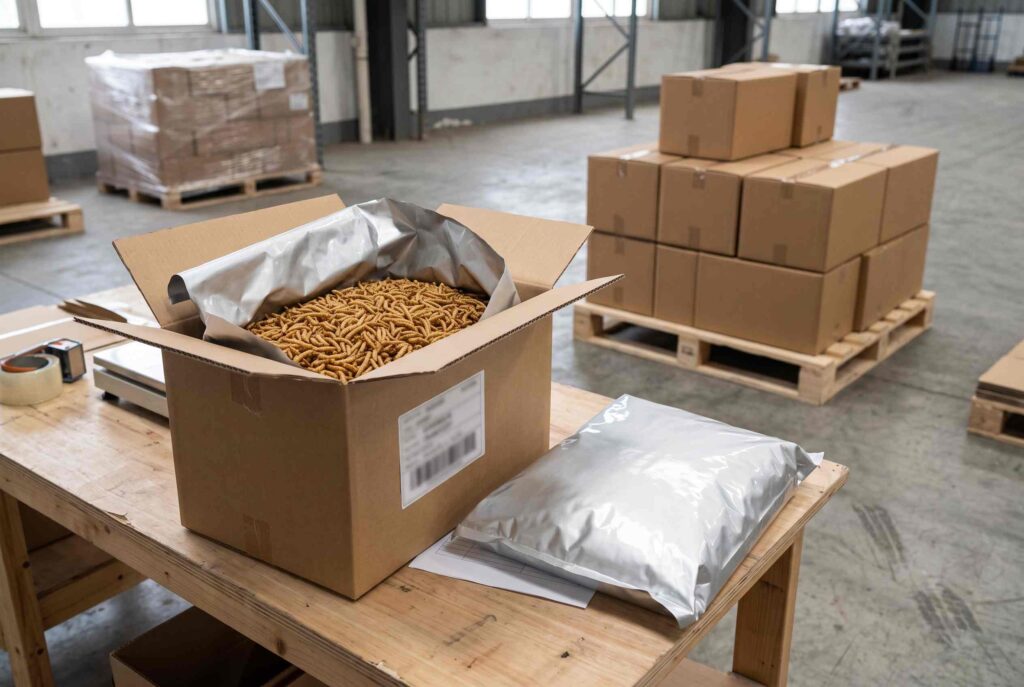
Packaging should protect the product during filling, stacking, shipment, and storage. The best arrangement depends on order size, whole-piece requirements, transport route,e and the buyer’s handling process.
Confirm:
- inner-liner material and closure;
- outer carton or woven bag;
- net weight per package;
- carton strength and fill level;
- label and batch information;
- pallet dimensions and stacking;
- stretch wrap, corner protection, or strapping; and
- whether the buyer will store, resell, or repack the goods.
Heavier packages may reduce the number of handling units but increase compression and manual lifting difficulty. Cartons may provide additional mechanical protection, while bag formats can be practical for some commercial uses. The decision should balance freight, handling, and product appearance rather than follow one universal format.
IMAGE 3 POSITION — insert immediately after this section and before the next H2, “Evaluate the Supplier’s Commercial Process.”
Evaluate the Supplier’s Commercial Process
A reliable supply process should connect the requirement, sample, commercial batch, inspection, packaging, and shipment documentation.
Buyers should ask how the supplier handles:
- product and grade selection;
- batch identification;
- current photographs and samples;
- test and COA requests;
- packaging approval;
- label and shipping marks;
- pre-shipment checks;
- export documentation coordination;
- lead time and availability; and
- questions about results or damaged packaging.
BulkInsects operates as a specialized B2B dried-insect supplier coordinating supply through established production sources. Product grade, samples, testing, packaging,g and documentation are reviewed according to the species, destination, application,n and order requirements. The website should not imply ownership of every production facility or present typical values as fixed guarantees.
Questions to Include in a Mealworm RFQ
To receive comparable quotations, provide:
- product: whole dried mealworms;
- intended application;
- required quantity or quantity range;
- destination country and port;
- preferred processing method;
- required commercial grade;
- whole-piece, color, size, or cleanliness expectations;
- moisture or test requirements;
- sample requirement;
- pack weight and packaging preference;
- label or shipping-mark requirements;
- documentation needed; and
- requested delivery or shipment timing.
Avoid sending only “Please quote your best price.” Without grade, quantity, destination, n, and packaging, two suppliers may quote different products or commercial terms.
For current availability and order-specific options, use the request-a-quotation form and include the application, quantity, destination, n,g, and packaging requirements.
Bulk Dried Mealworms Buyer Checklist
| Review area | Question to confirm |
|---|---|
| Product | Is it whole Tenebrio molitor rather than powder or live larvae? |
| Grade | Are the commercial grade and intended application aligned? |
| Appearance | Are color, size, and whole-piece condition acceptable? |
| Cleanliness | Is visible foreign matter or excessive dust present? |
| Processing | Is the drying method accurately identified? |
| Moisture | Is the batch result, method and reporting basis clear? |
| Sample | Does the sample represent the quoted grade or batch? |
| Testing | Are test items relevant to the destination and application? |
| Packaging | Will the commercial pack protect the product and suit handling? |
| Traceability | Do labels, COA and shipment records use the same batch reference? |
| Commercial terms | Are quantity, price basis, lead time,e and destination clear? |
Conclusion
Buying bulk dried mealworms requires comparing grade, whole-product appearance, fragments, color, cleanliness, processing, moisture, testing, and packaging—not price alone. Samples and reference specifications support early evaluation, while the relevant commercial batch and agreed order requirements provide the basis for final approval.
B2B buyers should define the application first, request a representative grade, and confirm how the sample, batch report, packaging, and shipment relate to one another. This approach makes supplier comparisons clearer and helps turn a general inquiry into a practical quotation or trial order.
Frequently Asked Questions
What should buyers check in bulk dried mealworms?
Check species, whole form, commercial grade, color, size, whole pieces, fragments, dust, cleanliness, odor, moisture information, sample identity, packaging, and batch documentation.
Are microwave-dried mealworms better than hot-air-dried mealworms?
Not automatically. The suitable method depends on the required appearance, texture, application, availability, and price. Buyers should evaluate the actual offered batch or representative sample.
Can typical protein and fat values be used as guaranteed specifications?
No. Typical values are useful references, but composition can vary by batch, processing, and reporting basis. Contractual or acceptance limits must be expressly agreed and verified using the applicable test arrangement.
What packaging is suitable for commercial dried mealworm orders?
Common arrangements may include a sealed inner liner within a carton or woven outer bag, followed by pallet protection. The format should reflect pack weight, route, storage, and whole-piece requirements.
Can buyers request a dried mealworm sample before ordering?
Sample availability and courier arrangements can be discussed for commercial inquiries. Confirm whether the sample represents the quoted grade, a current batch, or only a general product reference.