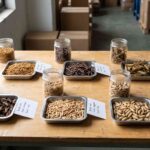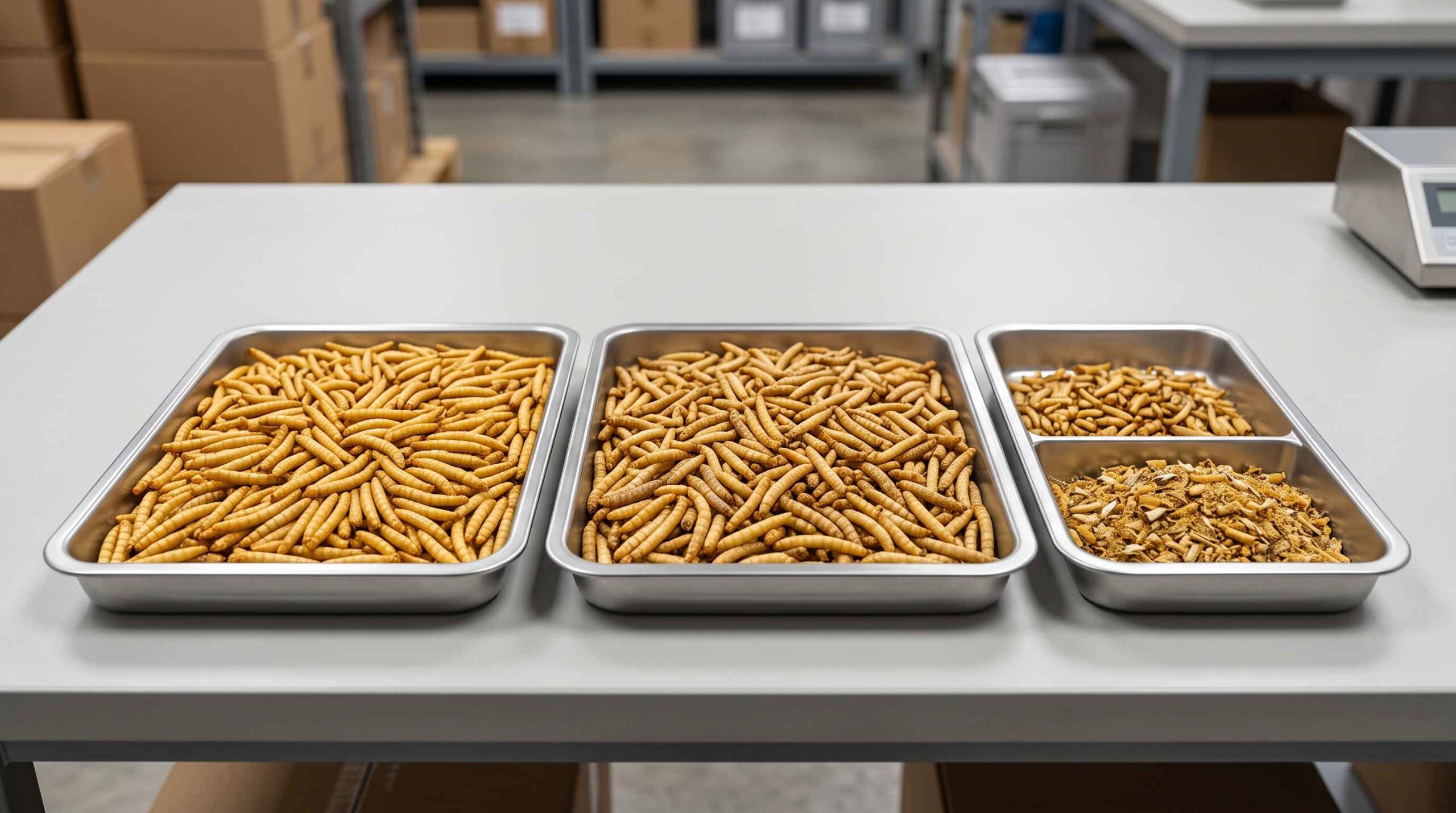

Evaluating dried mealworm quality requires more than just looking for a bright color or comparing prices per kilogram. For wholesalers, distributors, pet-product businesses, resellers, and commercial animal operations, quality also affects product presentation, handling loss, storage stability, and whether one shipment can be compared fairly with the next.
Two samples may both be described as whole dried mealworms while differing in size distribution, breakage, dust, residual moisture, odor, cleanliness, and packaging. These differences can become commercially important when the product is repacked, displayed, blended, or supplied to downstream customers.
This guide explains the practical checks a B2B buyer can use before approving a sample or placing a bulk order. The goal is not to define one universal grade. It is to establish requirements that match the intended application and then verify that the supplier can deliver them consistently.
Key Takeaways
- Define the intended application before deciding what “good quality” means.
- Assess a representative sample for color, size, intactness, fragments, dust, cleanliness, and odor.
- Do not use visual inspection as a substitute for moisture or microbiological testing.
- Compare the sample, specification, batch documents, and packaging as one evaluation package.
- Record an agreed reference sample or acceptance criteria before approving repeat orders.
1. Define the Quality Grade Your Business Actually Needs
There is no single commercial grade that suits every buyer. A reseller packing whole mealworms into clear retail pouches may place greater value on uniform color and a high proportion of intact larvae. A farm or commercial animal operation may accept more natural color variation or a different level of breakage if the product remains clean and suitable for its intended use.
Start by answering three questions:
- Will the mealworms be resold as a visible whole product?
- Will they be repacked under a private label or used as a raw material?
- Which visual, physical, and testing requirements matter to the destination market and application?
A useful purchasing specification separates essential requirements from preferences. For example, cleanliness, product identity, and batch-specific test results may be mandatory, while a narrow color range may be a commercial preference. This helps buyers avoid paying for an appearance grade that provides no practical benefit—or accepting a cheaper grade that creates repacking complaints later.
Buyers comparing commercial options can first review the available bulk dried mealworms, then request a sample that reflects the quoted grade.
2. Check Whole-Product Appearance and Identity
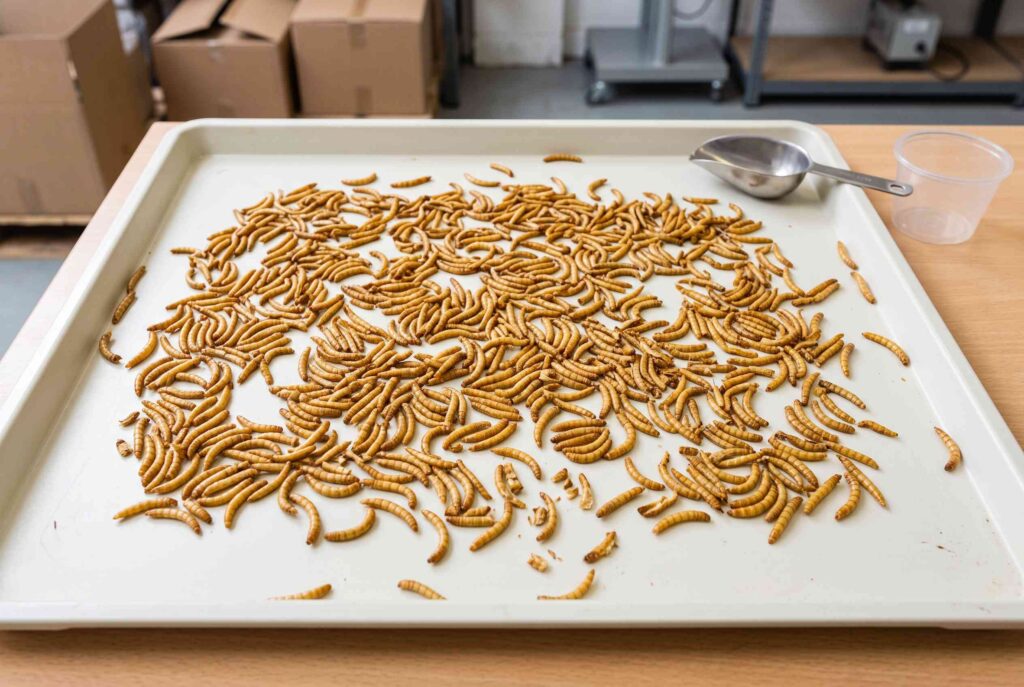
Begin with the product spread across a clean, neutral inspection surface under consistent lighting. A deep container can hide fragments and dust at the bottom, while warm or heavily edited lighting can make color appear more uniform than it is.
Inspect the sample for:
- recognizable whole-mealworm shape;
- general color range and ccolorconsistency;
- visible size distribution;
- excessive darkening, scorching o,r unusual pale areas;
- flattened, sshriveled,or severely damaged pieces;
- material that does not appear to belong in the lot.
Natural variation should be expected in an agricultural product. The more useful question is whether the variation falls within the commercial range agreed with the supplier. Buyers should avoid judging quality based on a single carefully selected photograph. A sample drawn from the offered batch—or a clearly identified pre-shipment sample—provides a better basis for approval.
Appearance can indicate a possible processing or handling issue, but it does not prove moisture level, microbiological status, or nutritional composition. Treat visual inspection as the first screen, not the final decision.
3. Measure Intactness, Breakage, Fragments, and Dust
For whole dried mealworms, physical condition often directly affects commercial value. Breakage can increase during drying, sorting, packing, compression, and transport. The result may be a lot that looks acceptable at the top of the carton but contains more fragments and dust lower down.
Use consistent terms when discussing the result:
- Whole product: larvae retaining a recognizable, complete or nearly complete form.
- Broken product: visibly incomplete pieces.
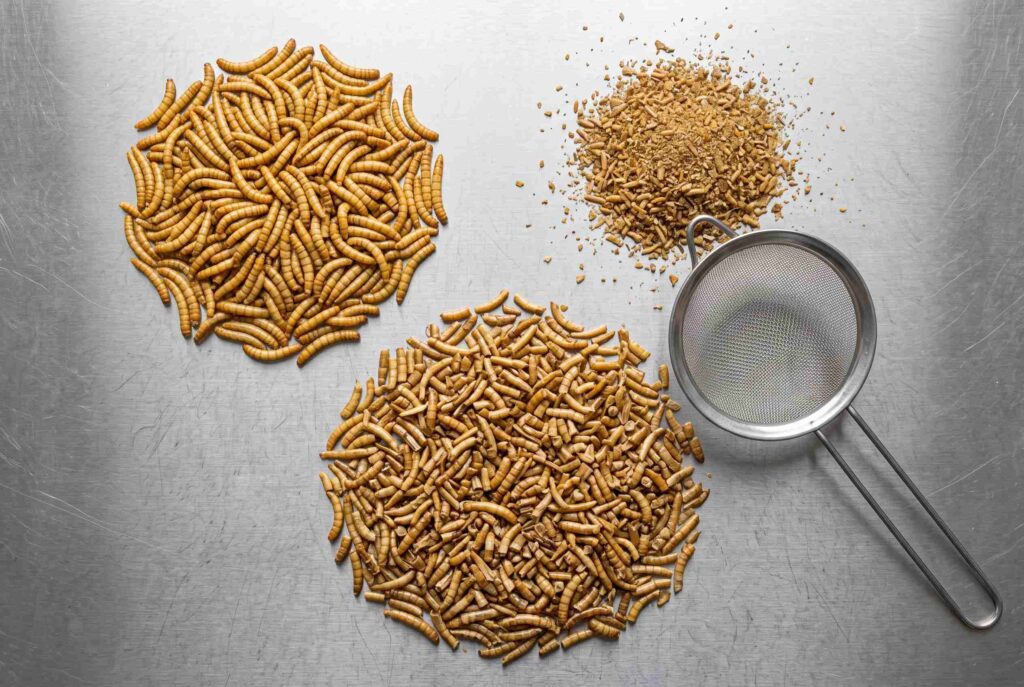
- Fragments: smaller mealworm pieces separated from whole bodies.
- Dust or fines: very small particles that collect at the bottom of the sample or package.
Do not rely only on a visual guess. For higher-value repacking orders, buyers can weigh a representative sample, separate the agreed categories with a suitable sieve or manual sorting method, and record the percentage in each category. The exact method matters: changing sample size, sieve size, or handling pressure can change the result.
The acceptance limit should therefore state both the requirement and the method used to evaluate it. A practical specification might define the minimum proportion ofrecognizablee whole product and the maximum acceptable combined fragments and dust. The values should come from the buyer’s application and approved sample rather than a generic internet benchmark.
4. Evaluate Color Without Making It the Only Standard
Color is easy to notice, which is why it is sometimes treated as a shortcut for overall quality. That can be misleading. Dried mealworms may range from lighter golden tones to deeper yellow-brown shades depending on raw material variation, processing conditions, and storage. A brighter product is not automatically safer, drie,r or nutritionally superior.
Color assessment is still useful when presentation matters. Use the same lighting, background, and sample depth every time. Compare a new sample with an approved reference sample or a documentedcolorr range rather than relying on memory.
Watch for changes that are outside the agreed range, such as:
- unusually dark or scorched-looking sections;
- big differences between cartons from the same lot;
- patchy areas that suggest uneven processing or mixing;
- a major change from the pre-shipment sample.
If color is commercially critical, describe the acceptable range with reference images taken under controlled conditions. Avoid vague contract language such as “premium golden color” unless both parties have defined what that description means.
5. Assess Moisture and Physical Dryness Separately
Physical handling can provide warning signs, but laboratory moisture results are a better basis for a purchasing decision. A product may feel crisp and still differ from another batch in measured moisture. Conversely, texture can change with temperature, packaging, and handling without proving that the lot is unsuitable.
During sample inspection, note whether the mealworms feel dry and free-flowing, whether pieces clump together, and whether the inner packaging shows condensation or unusual moisture. These observations are useful for identifying a possible problem that needs further investigation.
Then review the batch-specific result and test method. Buyers should state the required limit in the RFQ or specification and confirm that the result applies to the lot being offered. Our separate guide to dried insect moisture explains why sampling, method, and storage conditions matter when comparing results.
Do not invent a universal moisture limit for every application. The appropriate requirement depends on the product specification, packaging, destination, intended storage period, and customer requirements. The key is to agree on a measurable limit before shipment and verify it using the same understood method.
6. Inspect Cleanliness, Foreign Matte,r and Odor
Cleanliness is different from color. A naturally variable batch can still be clean, while a visually attractive sample may contain unwanted material. Spread the sample thinly and check for:
- non-mealworm material;
- excessive loose residue;
- abnormal dark particles;
- fibers, packaging debris, or other visible foreign matter;
- evidence of insects or contamination introduced after processing.
Odor should also be evaluated when the package is first opened. The purpose is not to demand a completely odorless product. Dried mealworms have a characteristic product odor. Buyers should be alert to odors that are clearly unusual for the approved sample, such as musty, sour, chemical, or rancid notes.
Record the observation promptly, as odor descriptions become less reliable over time. If an abnormal odor is found, isolate the sample and ask for batch information rather than trying to solve the issue through visual inspection alone.
7. Review Batch Documents and Test Results
A good-looking sample does not provide enough information for a bulk purchasing decision. Documentation connects the physical product to the identified lot and helps the buyer check whether the offered batch was evaluated against the agreed requirements.
At minimum, confirm:
- product name and batch or lot identification;
- production or packing information, where applicable;
- test report or COA identification;
- test parameters relevant to the agreed specification;
- reported results, units, and specification limits;
- test methods or method references were provided;
- laboratory or issuer details;
- whether the document clearly relates to the shipment batch.
The importance of each parameter depends on the destination and intended use. Microbiological, chemical, and nutritional results should be interpreted within the applicable specification and market requirements, not used as universal marketing claims.
For a structured document review, see how to read a COA for dried insects. Buyers importing material for animal-food applications should also check the rules applicable to their own market and supply chain. As one official reference, the U.S. Electronic Code of Federal Regulations publishes 21 CFR Part 507, covering current good manufacturing practice and related requirements for animal food in the United States.
Regulatory requirements differ by country, product and application. The buyer or importer should confirm the applicable requirements before ordering.
8. Check Packaging as Part of Product Quality
Product quality can deteriorate between packing and delivery if the packaging is unsuitable or damaged. Review packaging before approving the commercial order rather than treating it as a shipping detail to be decided later.
Check whether the proposed pack:
- provides an appropriate inner barrier;
- closes securely;
- protects the product from moisture and contamination;
- limits crushing under the expected handling conditions;
- fits the buyer’s repacking or warehouse process;
- carries clear lot identification;
- is compatible with palletisation and the planned transport route.
Ask for the net weight per unit, outer-carton dimensions, liner type, number of units per carton or pallet, and any available packaging options. If presentation and intactness are important, a larger pack is not always better: added compression and repeated handling can increase breakage.
Inspect the delivered lot for punctures, open seals, wet cartons, compression damage and labels that do not match the shipping documents. Quality approval should include both the mealworms and the condition in which they arrive.
Practical Dried Mealworm Quality Checklist
| Check | What to Review | Why It Matters | How to Record It |
|---|---|---|---|
| Product identity | Recognisable dried mealworms and correct lot details | Prevents comparison of different products or grades | Product name, lot number and photos |
| Appearance | Colour range, size distribution and visible condition | Affects presentation and grade consistency | Controlled-light photos and approved reference |
| Intactness | Whole product, breakage and fragments | Influences resale value and handling loss | Defined sorting method and percentage |
| Dust/fines | Small particles at the bottom of the sample | Can affect presentation and repacking yield | Sieve method or agreed visual limit |
| Moisture | Batch result plus physical warning signs | Relevant to stability and storage decisions | Result, unit, method and specification |
| Cleanliness | Foreign matter and unusual residue | Supports product acceptance and downstream quality | Inspection notes and photographs |
| Odour | Characteristic versus abnormal odour | Can indicate a possible storage or product issue | Immediate sensory note |
| Documentation | COA/test report linked to the lot | Connects claims to the batch being purchased | Document number and lot match |
| Packaging | Barrier, seal, protection and label | Protects the approved quality in transit | Packaging specification and arrival check |
How to Approve a Sample Before a Bulk Order
A sample is most useful when the buyer knows exactly what it represents. Ask whether it was taken from the current batch, a typical production lot or a separate reference stock. A “best available” display sample may not predict the grade that will be shipped months later.
Use the following approval process:
- Write the intended application and essential requirements.
- Request a representative sample with product and lot identification.
- Inspect it using a repeatable checklist and neutral lighting.
- Compare physical observations with the specification and batch documents.
- Record accepted tolerances for colour, size, intactness, fragments and dust.
- Retain photographs or a sealed reference sample where practical.
- Confirm that the purchase order refers to the agreed grade, packaging and testing requirements.
One sample cannot guarantee every future shipment. It creates a shared reference point. Repeat orders should still be checked on a batch basis, especially when the source, processing method, packaging or season changes.
Compare Suppliers on Consistency, Not One Perfect Sample
The strongest supplier evaluation focuses on repeatability. A visually excellent sample has limited value if later batches vary widely or if the supporting documents cannot be matched to the goods.
When comparing quotations, ask each supplier to quote against the same specification. Otherwise, a lower price may simply reflect a different grade, more breakage, different packaging or fewer testing requirements. Compare:
- the defined product grade;
- the basis of the sample;
- the batch-testing scope;
- packaging configuration;
- handling of non-conforming lots;
- lead time and shipment conditions;
- ability to provide consistent records across repeat orders.
Commercial quality is therefore a combination of product condition, verified batch information and supply consistency. The best decision is not necessarily the most visually perfect sample or the lowest quotation. It is the option that meets the buyer’s documented needs with acceptable and repeatable variation.
Frequently Asked Questions
What are the main signs of good dried mealworm quality?
The main checks include recognisable whole-product appearance, an agreed colour and size range, acceptable intactness, limited fragments and dust, cleanliness, characteristic odour, suitable moisture results, protective packaging and documents linked to the batch. The required grade should match the buyer’s application.
Does a brighter golden colour always mean better quality?
No. Colour matters for presentation, but it does not by itself prove moisture, microbiological status, nutritional composition or storage condition. Compare colour under consistent lighting and evaluate it together with physical checks and batch-specific documentation.
How should buyers check breakage in a mealworm sample?
Use a representative sample and a consistent separation method. Define what counts as whole product, broken pieces, fragments and dust, then record the proportion of each category. Keep the same sample size and method when comparing suppliers or batches.
Can buyers evaluate moisture by touch?
Touch and flow can reveal warning signs such as clumping or unusual softness, but they do not replace a measured moisture result. Review the batch-specific value, unit, test method and agreed specification limit.
Should the approved sample match every future batch exactly?
Agricultural products have natural variation, so an exact visual match may be unrealistic. The approved sample should establish a reference grade and tolerances. Each shipment should still meet the agreed specification and be supported by relevant batch information.
Final Evaluation: Use a Specification, Sample and Batch Record Together
Reliable dried mealworm quality evaluation combines three things: a written specification, a representative physical sample and documentation connected to the shipment batch. None of these is strong enough on its own.
Before requesting a quotation, decide which characteristics are essential for your application and which are preferences. Then ask suppliers to quote on the same basis. This makes price comparisons more meaningful and gives both parties a clearer process for sample approval and delivery inspection.
For a product discussion or sample request, contact BulkInsects with your required quantity, destination, application, preferred grade, packaging and testing requirements. We can then discuss available whole dried mealworm options on a commercial basis.