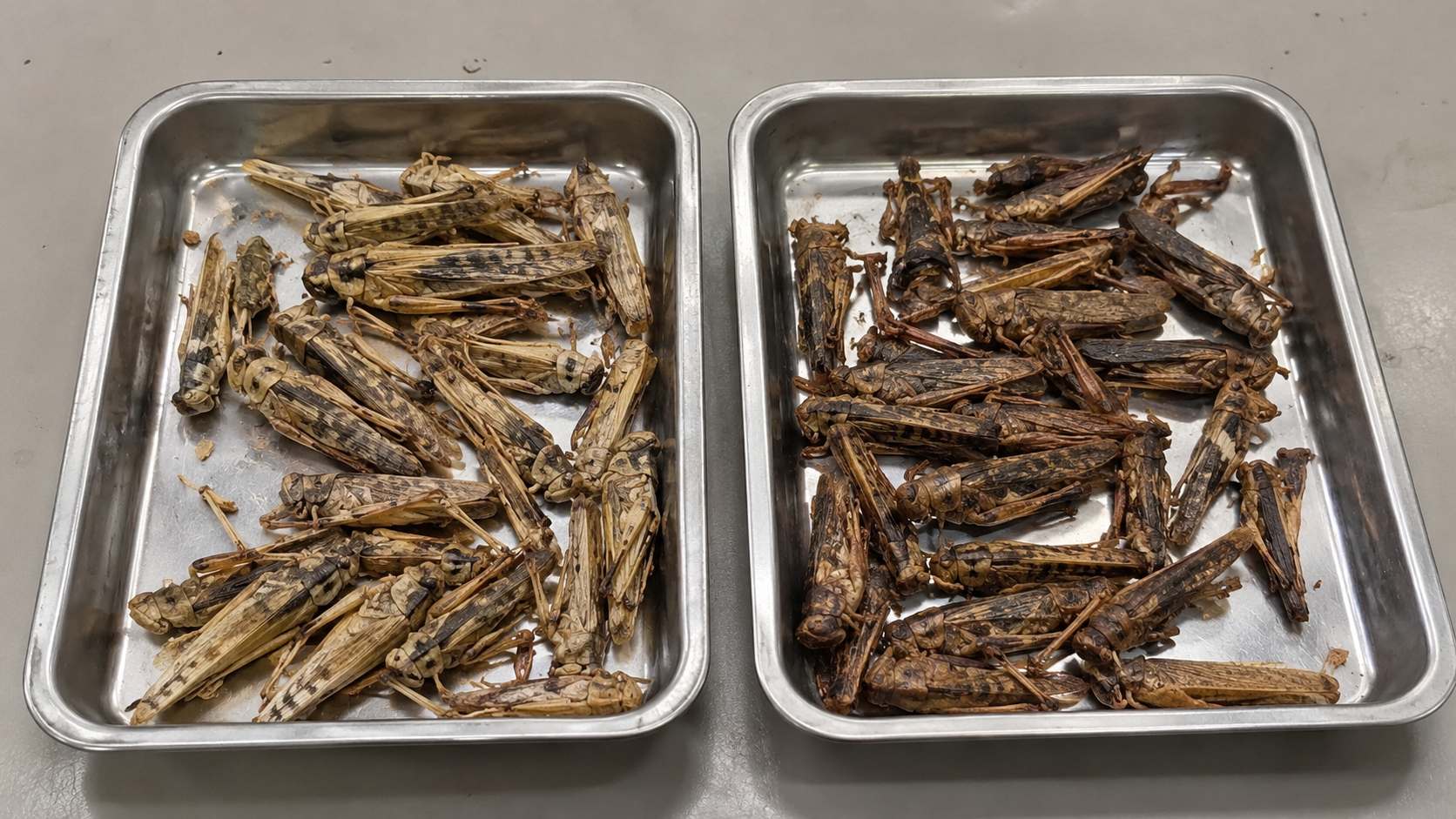

For commercial buyers, choosing between freeze-dried grasshoppers and heat-dried grasshoppers is not simply a question of which processing technology sounds more advanced. The drying method can influence body shape, color, texture, fragility, packaging requirements, and commercial cost, particularly when grasshoppers are purchased and sold as a recognizable whole dried product.
A distributor, wholesaler, or pet-product business may place greater value on visual presentation and whole-body condition, while a feed-related buyer may focus more on moisture, cleanliness, batch documentation, and delivered cost. The appropriate drying method should therefore be selected according to the intended application and purchasing specification rather than the process name alone.
Key Takeaways
- Freeze-dried grasshoppers may offer a stronger three-dimensional body presentation where visual appearance matters.
- Heat-dried grasshoppers can be suitable for commercial-volume sourcing where supply economics are more important.
- Neither process automatically guarantees better safety, shelf life, or overall quality.
- Buyers should compare representative samples using the same standards for body condition, moisture, cleanliness, and breakage.
- Packaging and transportation can materially affect the final condition of whole dried grasshoppers.
- Commercial buyers should compare usable product and landed value, not only price per kilogram.
1. How Freeze-Drying and Heat Drying Differ
Both processes are intended to reduce moisture, but they achieve this under different conditions. Freeze-drying, or lyophilization, typically freezes the product before removing water under reduced pressure. Because relatively low temperatures are used during the main drying stage, the process can help preserve the physical structure of biological materials.
Heat drying removes moisture through controlled thermal energy and airflow. The finished characteristics depend on temperature, drying duration, equipment, pretreatment, insect characteristics, and target moisture. For B2B buyers purchasing whole grasshoppers, these processing differences can influence appearance, structure, texture, brittleness, bulk density, and cost.
The commercial question should therefore not simply be “Which drying technology is better?” A more useful question is: “Which drying method produces the product characteristics required for my application at an acceptable commercial cost?”
2. Freeze-Dried Grasshoppers: Commercial Characteristics
Among bulk dried grasshoppers, freeze-dried products may retain a pronounced three-dimensional body shape and recognizable physical structure. This can be commercially valuable when the insect remains visible in the final product, such as certain reptile, bird, pet-treat, or specialty retail applications.
The lighter, porous structure associated with freeze-drying can also affect handling. Grasshoppers naturally have long hind legs, wings, and antennae, and these appendages can remain vulnerable to breakage during sorting, filling, carton stacking, and international transportation. A visually attractive sample immediately after processing, therefore, does not necessarily represent the condition that will arrive at the buyer’s warehouse.
Freeze-drying is also generally associated with a higher processing cost than conventional heat drying. Buyers considering this option should determine whether the potential improvement in presentation creates sufficient commercial value for their particular market.
3. Heat-Dried Grasshoppers: Commercial Characteristics
Heat-dried grasshoppers may have a denser body structure, deeper brown tones, and different surface texture or brittleness compared with freeze-dried material. These characteristics should not automatically be interpreted as inferior quality. A darker brown product, for example, is not necessarily burnt or defective; the acceptable color range should be established using representative samples and an agreed commercial specification.
Heat drying can be particularly relevant for buyers requiring larger commercial quantities where product functionality, supply economics, and consistency take priority over premium visual presentation. The actual result still depends on the drying process and product specifications, so buyers should evaluate the supplied sample rather than make purchasing decisions based solely on the term “heat-dried”.
4. Compare Appearance, Body Condition, and Breakage
Appearance is one of the most visible differences between the two processing options. Freeze-dried products may retain a more pronounced three-dimensional shape, while heat-dried products may appear denser or darker. Neither appearance is universally better; the correct choice depends on whether visual presentation creates value for the intended application.
Whole-body condition should be evaluated separately from general appearance. For commercial inspection, buyers can classify a representative sample into recognizable whole bodies, whole bodies with missing appendages, large broken pieces, and small fragments or fines. A grasshopper should not automatically be considered broken simply because a leg, wing or antenna has detached.
This distinction is particularly important when comparing quotations. If one supplier defines “whole” as a recognizable main body while another requires nearly all appendages to remain attached, their quoted whole-body percentages are not directly comparable. The definition should therefore be agreed upon before sample approval and commercial production.
5. Moisture, Color, and Product Condition
The drying method alone does not establish final product quality. Commercial buyers should evaluate moisture, color, odor, texture, and cleanliness as separate characteristics. Color can vary with species, maturity, raw-material condition, pretreatment, drying temperature, and storage, so a lighter product should not automatically be classified as better than a darker one.
Buyers should instead investigate abnormal conditions such as severe scorching, unusual blackening, visible mold-like growth, unexpected surface moisture, abnormal odors, or substantial deviation from the approved sample. Moisture should also be verified using an agreed testing method rather than estimated from appearance or crispness.
It is also important to distinguish moisture content from water activity. These measurements describe different aspects of the product, and neither should be treated as a universal guarantee of shelf life. The required parameters should be established according to the product, application, and destination requirements.
6. Packaging Matters for Whole Dried Grasshoppers
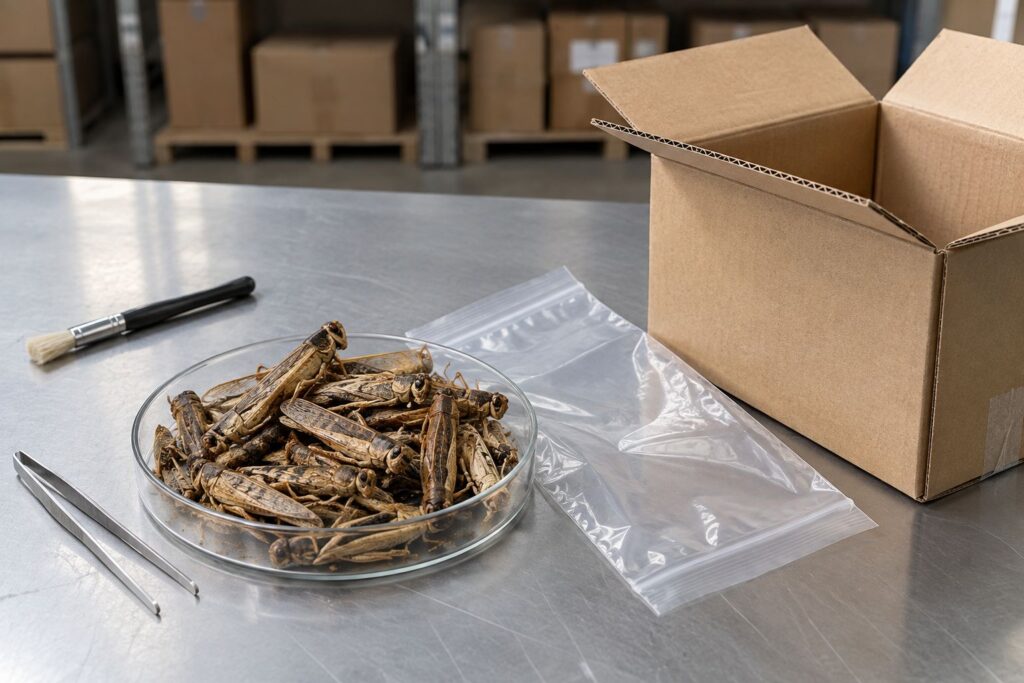
Packaging can materially affect the commercial value of both heat-dried and freeze-dried grasshoppers. Whole grasshoppers need protection from moisture, crushing, excessive compression, contamination, pests, and unnecessary movement during transportation. Long legs, wings, and antennae make packaging particularly relevant when whole-body presentation is an important purchasing criterion.
Buyers should evaluate the inner liner, seal, unit weight, fill density, outer carton, and pallet configuration as one packaging system. A larger package may improve freight efficiency but can increase compression and breakage, while smaller unit weights and stronger cartons may provide better protection at a higher packaging cost.
When visual presentation is critical, buyers should consider the condition of a transport-exposed sample rather than relying only on a sample collected immediately after production.
7. Commercial Cost: Look Beyond Price per Kilogram
Freeze-drying generally involves a different cost structure from conventional heat drying, but B2B buyers should avoid comparing only the supplier’s quoted price per kilogram.
| Comparison Area | Freeze-Dried Grasshoppers | Heat-Dried Grasshoppers |
|---|---|---|
| Body Presentation | May retain a more pronounced 3D shape | Often denser |
| Colour | May retain lighter visual characteristics | Can develop deeper brown tones |
| Structure | Often lightweight and porous | Often denser and firmer |
| Breakage | Protective packaging can be especially important | Depends on process and final texture |
| Commercial Positioning | Often considered for visually sensitive applications | Often suitable for broader commercial applications |
| Processing Cost | Generally higher | Generally more economical |
| Packaging | Strong protection may be required | Moisture and breakage protection still required |
| Best Choice | Depends on application and specification | Depends on application and specification |
The more useful calculation is:
Purchase Price + Packaging + Freight + Breakage + Repacking + Unusable Material = Effective Commercial Cost
A lower-priced product may not provide better value if it creates substantially more fragments, requires additional sorting or arrives in unsuitable condition.
8. Which Drying Method Should Commercial Buyers Choose?
There is no universal answer. Freeze-dried grasshoppers may be worth evaluating when recognizable body structure and premium visual presentation are important, particularly where whole insects remain visible to the final customer. Heat-dried grasshoppers may be more appropriate where commercial volume, supply economics, and functional requirements carry greater weight.
For applications involving further processing, some of the visual advantages of freeze-drying may have less commercial value. Buyers should therefore tell the supplier how the product will actually be used instead of requesting a drying method solely because it appears more premium.
Before confirming a commercial order, compare representative samples of the actual grades being quoted. Both samples should be evaluated using the same criteria: identity, size, whole-body condition, missing appendages, fragments, color, odor, texture, cleanliness, moisture, and packaging.
9. Batch Testing and Documentation
Neither processing method eliminates the need for appropriate batch documentation. Depending on the application and destination, buyers may request a product specification, batch-linked Certificate of Analysis, moisture and composition results, relevant microbiological or contaminant testing, species and origin information, lot identification, production dates, and applicable export documentation.
A term such as “freeze-dried” or “heat-dried” describes a processing method. It does not by itself establish microbiological safety, regulatory eligibility, shelf life, or compliance with a particular destination market. Those issues should be verified separately against the actual product, batch, and intended use. For U.S. animal-food applications, buyers should also review applicable FDA animal food requirements based on the product, facility, and intended use.
10. Before Requesting a Quotation
A useful commercial RFQ should allow suppliers to quote the same requirement rather than different interpretations of “premium dried grasshoppers.”
Buyers should provide:
- destination country;
- intended application;
- required species or product identity;
- freeze-dried or heat-dried preference;
- whole-body grade;
- acceptable missing appendages and breakage;
- target size range;
- moisture requirements;
- required testing and documents;
- packaging requirements;
- order quantity and frequency; and
- preferred Incoterm.
Where possible, connect the approved sample with the written specification so the commercial shipment can be evaluated against the same reference.
Frequently Asked Questions
Are freeze-dried grasshoppers better than heat-dried grasshoppers?
Not automatically. Freeze-drying may be useful when body shape and visual presentation are commercially important, while heat drying may be more appropriate for commercial-volume sourcing. Buyers should compare the actual sample, specification, packaging, and total cost.
Do freeze-dried grasshoppers break easily?
Whole freeze-dried insects can be relatively fragile, particularly around legs, wings, and antennae. Actual breakage depends on processing, product structure, packing density, packaging, and transportation conditions.
Are heat-dried grasshoppers lower quality?
Not inherently. Drying technology is only one part of product quality. Identity, raw-material condition, cleanliness, moisture, sorting, testing, packaging, and storage should also be evaluated.
Which option is more economical for bulk orders?
Heat drying often has lower processing costs than freeze-drying, but buyers should compare actual quotations and effective landed costs rather than assuming a fixed price difference.
What should buyers check before placing a bulk order?
Confirm product identity, drying method, commercial grade, body condition, size, moisture, cleanliness, testing, packaging, quantity, destination, and trade terms. A representative commercial sample should be evaluated before confirming a large order.
Final Buying Review
The choice between heat-dried and freeze-dried grasshoppers should be based on the requirements of the commercial application. Freeze-drying may offer advantages where recognizable body shape and visual presentation matter, while heat drying may provide a practical option where commercial volume, cost, and functional requirements are more important.
Rather than selecting a product by drying method alone, buyers should consider the representative sample, written specification, batch testing, packaging system, and commercial quotation. This provides a more reliable basis for comparing suppliers and reduces disagreements about subjective terms such as “premium,” “whole,” or “high quality.”
For current whole dried grasshopper options, contact BulkInsects with your destination, application, quantity, drying preference, packaging requirements, and required commercial grade.