
Evaluating dried cricket quality requires more than checking whether the insects look dry and reasonably whole. A commercial buyer must confirm product identity, assess body condition and loose fragments, review moisture and cleanliness, examine batch documents, and determine whether the packaging can preserve the approved condition through transport.
The correct standard also depends on the intended application. A distributor selling visible whole crickets may require a higher proportion of recognisable bodies and a narrower size range. A buyer that will grind the material may give greater weight to moisture, cleanliness, composition and batch testing than to detached legs or wings.
This guide provides a structured B2B evaluation method for importers, distributors, wholesalers, feed-related businesses and other commercial buyers. It does not establish one universal grade or fixed acceptance limit. Final requirements should reflect the application, destination market, available commercial grade, and agreed batch specification.
Key Takeaways
- Define quality according to the intended use before comparing quotations.
- Confirm species, commercial form and batch identity rather than relying on the term “dried crickets.”
- Assess recognisable whole bodies, detached appendages and fragments as separate categories.
- Colour variation is natural; darker material is not automatically defective.
- Moisture, visible cleanliness and microbiological status answer different questions.
- Connect a representative sample to a written specification, batch documents and arrival checks.
1. Define the Intended Application and Commercial Grade
Quality begins with the product’s intended use. Without that context, buyers and suppliers may use the same word—“whole,” “clean,” or “premium”—while expecting different products.
Common commercial applications include:
- whole treats for reptiles, birds, fish and small animals;
- repacking into retail or distributor formats;
- use in pet-food or animal-feed products;
- grinding or further processing; and
- use as a raw material in permitted applications.
For whole-product sales, appearance, body recognition, size distribution and breakage during transport may be commercially important. For milling, detached legs may be less important, but moisture, foreign matter, composition and batch documentation can remain critical.
Before requesting a quotation, define the acceptable product form: predominantly whole, whole with an agreed level of detached parts, mixed whole and broken material, or material intended for grinding. Also state the destination and application so the supplier can identify the relevant offer and documents.
For wider purchasing considerations, review bulk dried crickets before finalising the quality requirements.
2. Confirm Species and Product Identity
“Dried crickets” is a broad commercial description rather than a complete specification. Confirm:
- common and scientific name;
- country of origin;
- whole, broken or milled form;
- commercial grade and intended application;
- drying or heat-processing description;
- presence or absence of additives, carriers or preservatives;
- production, packing and best-before information; and
- batch or lot identification.
Commercial products may involve species such as Acheta domesticus or Gryllus bimaculatus, but buyers should not assume that the species are interchangeable or permitted for every market. The offered species and its suitability for the intended destination must be confirmed for the specific transaction.
Product identity should remain consistent across the quotation, specification, label, Certificate of Analysis, and shipment documents. Resolve differences before approving the order.
3. Separate Whole Bodies, Detached Parts and Fines
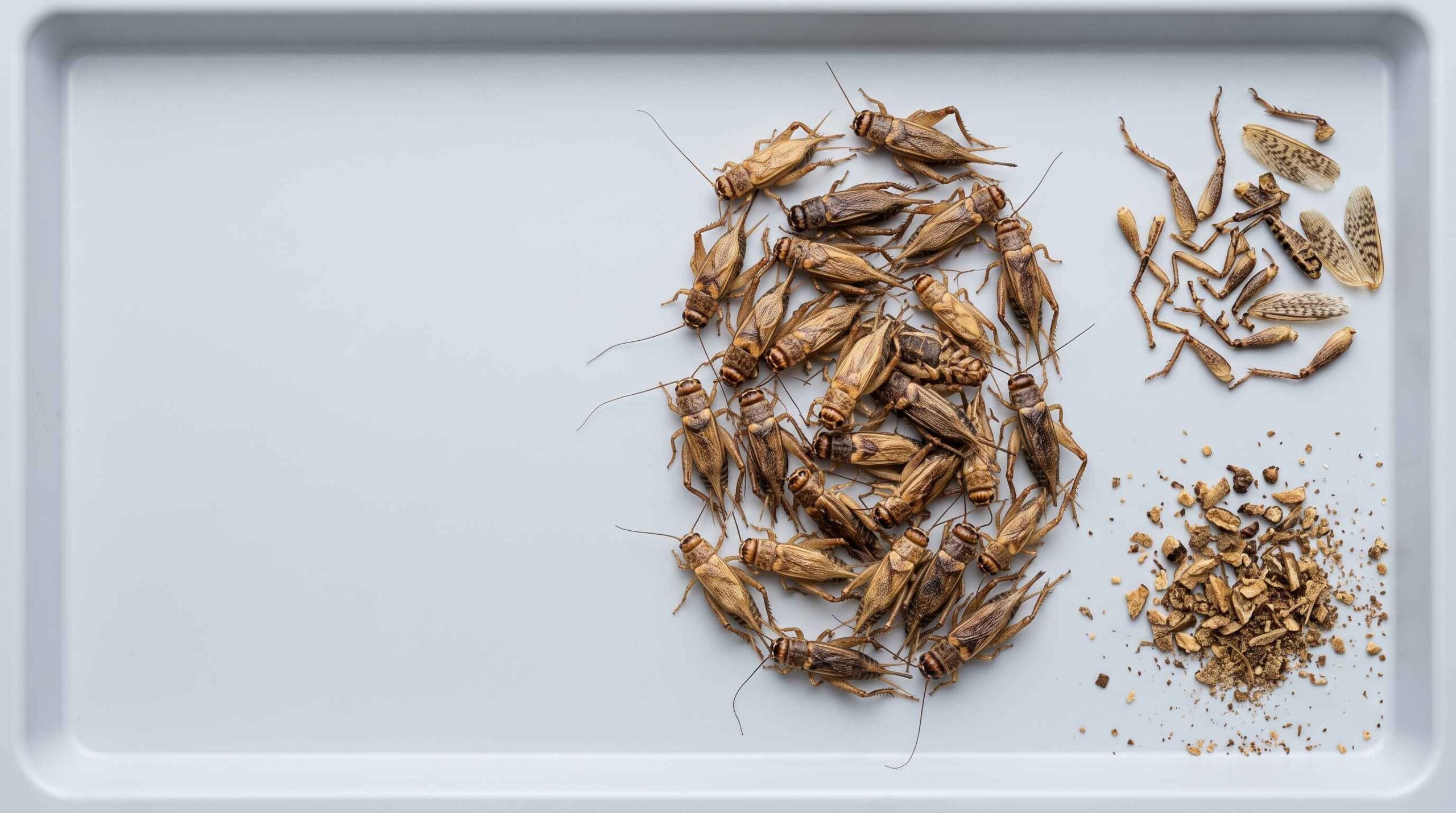
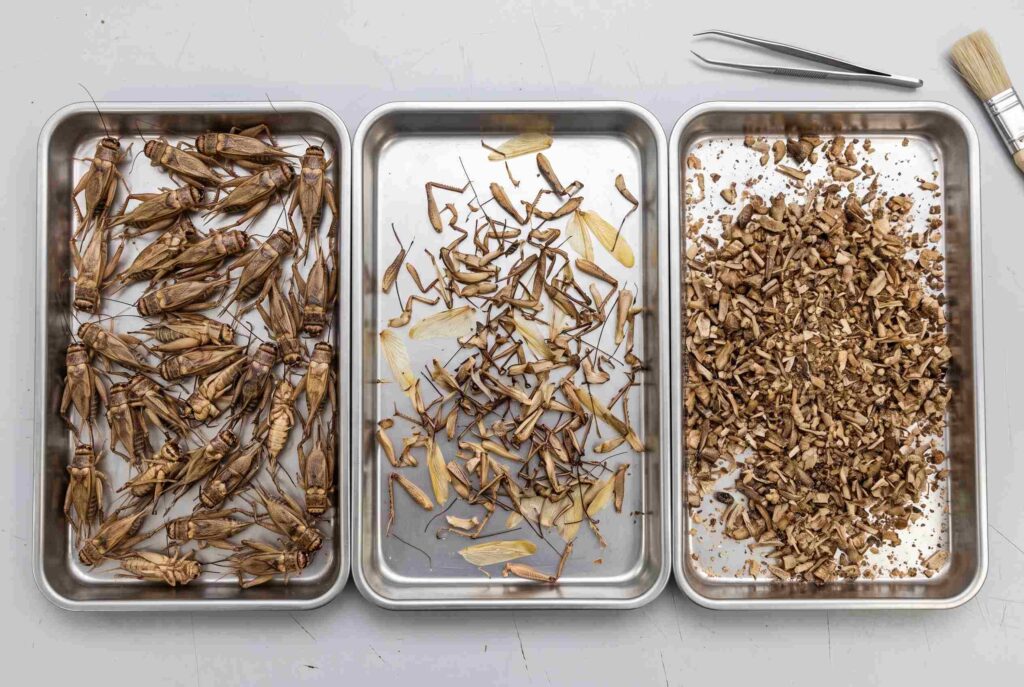
Body condition is one of the most visible features of whole dried crickets, but it is often described too loosely. A practical inspection should separate three categories:
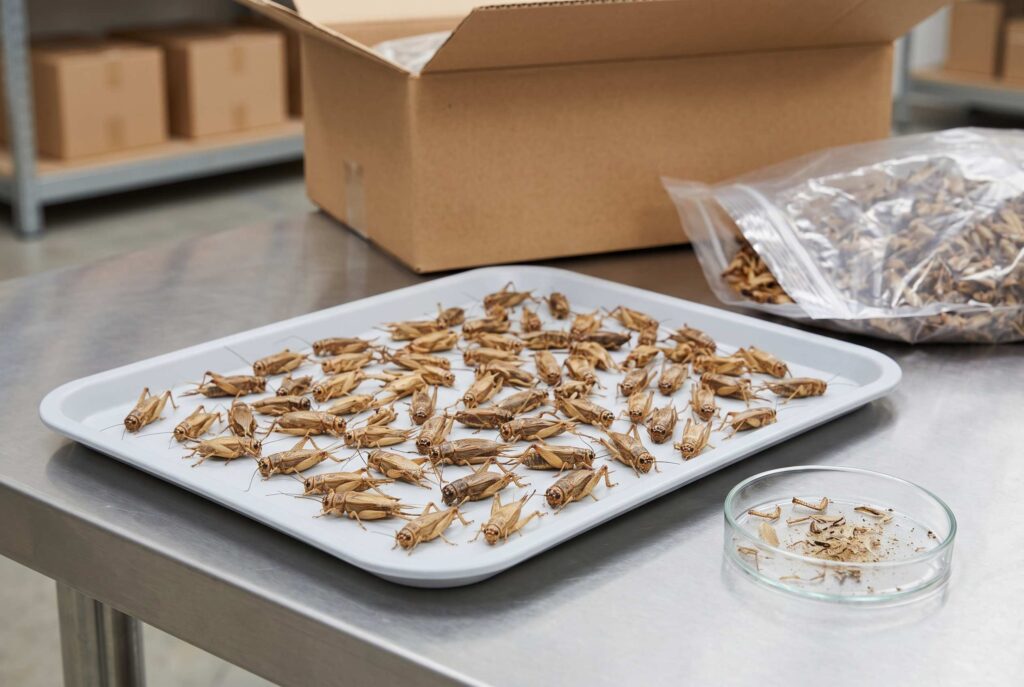
- Recognisable whole bodies: the main cricket body remains substantially intact and identifiable.
- Detached appendages: loose legs, wings or antennae separated from otherwise recognisable crickets.
- Fragments and fines: broken pieces or powder that no longer represent a substantially whole cricket.
These categories are not interchangeable. A cricket can remain commercially recognisable even if one leg, wing or antenna is missing. Requiring every appendage to remain attached is significantly stricter than requiring predominantly whole bodies.
Some detachment is normal because dried crickets are lightweight and brittle. Excessive fragments or fines may indicate rough handling, overcompression, repeated transfers, unsuitable packaging, or a product condition that is too fragile for the route.
If intactness affects acceptance, define the sample weight, sorting method, and maximum permitted proportion for each category. Do not rely only on a close-up photograph of selected insects.
4. Check Size Distribution and Batch Uniformity
Size can affect visual presentation, retail packing, dosing, and processing. Ask whether size is defined by body length, count, sieve fraction, or another consistent method.
Review the typical body-length range, unusually small or large crickets, mixed development stages, uniformity within the sample, and consistency between the approved sample and commercial batch.
Perfect uniformity is unrealistic for a biological product. The purpose is to agree on a commercially acceptable distribution. Avoid descriptions such as “large” or “standard” without a measurement method and tolerance. A retained reference sample or controlled photographs can support the written requirement.
5. Evaluate Colour and Surface Condition
Dried crickets can naturally range from tan and golden brown to medium or deeper brown. Species, age, feed, pretreatment, drying method and storage conditions can influence appearance.
A darker cricket is not automatically poor quality, and a lighter cricket is not automatically better. Compare the product with the agreed reference range and look for:
- localised scorching or severe blackening;
- damp, sticky or greasy-looking surfaces;
- visible mould-like growth;
- unexpected staining;
- excessive dust coating; or
- major variation inconsistent with the approved sample.
Use similar lighting, background and camera conditions when comparing batches. Reference photographs should support—but not replace—the specification and physical sample.
6. Assess Odour, Texture and General Condition
The product should have an odour consistent with dried crickets and the declared process. Strong sour, rancid, musty, chemical or severely burnt odours should be investigated.
Odour is a screening observation, not proof of microbiological safety. It may indicate oxidation, moisture exposure, unsuitable storage, contamination or a processing deviation.
Whole dried crickets are generally dry and relatively brittle. They should not be unexpectedly damp, soft, sticky or clumped. At the other extreme, very fragile product may create excessive breakage during packing and transport.
Record the condition when the sample is opened. If it has been stored in a cold or humid environment, allow a defined equilibration period before comparing texture with a reference sample.
7. Inspect Cleanliness and Foreign Matter
Visible cleanliness should be evaluated on a representative quantity spread over a contrasting tray under consistent lighting. Inspect both the crickets and loose material at the bottom of the package.
Possible foreign matter includes:
- stones, soil or sand;
- plant or substrate debris;
- string, plastic, metal or packaging fragments;
- unrelated insects or biological material;
- abnormal clumps; and
- unidentified non-product particles.
Foreign matter must be separated from cricket fragments in the specification. Loose legs and wings may affect presentation, but they are still cricket material. A stone, fibre or plastic fragment is a different defect category.
Replace the vague word “clean” with defined critical defects, tolerances and an inspection method. State the sample size, inspection conditions and action when unwanted material is found.
8. Review Moisture and Drying Consistency
Moisture affects texture, breakage, storage behaviour and the ability of the product to remain stable in its package. A result is useful only when the method, sample and batch are identified.
Confirm:
- the agreed limit or range;
- analytical method and reporting unit;
- sample preparation;
- batch represented by the result;
- timing of sampling relative to packing; and
- whether drying is reasonably consistent across the lot.
Visual checks may reveal soft insects, clumps, or condensation, but appearance cannot replace measurement. A result from a hand-selected sample may also fail to represent the batch.
Moisture content and water activity are related but not interchangeable. Moisture content measures water under a defined method; water activity relates to how available that water is for reactions and microbial growth.
The guide to dried insect moisture provides more detail on test interpretation, packaging, and storage.
9. Understand the Drying and Heat Process
Ask how the crickets are killed, dried, cooled and packed. Commercial descriptions may include hot-air drying, oven drying, microwave-assisted drying, freeze-drying or combined processes. The process name alone does not establish quality.
Useful questions include:
- Is a defined thermal step used?
- Which process parameters are monitored?
- How is drying uniformity checked?
- Is the product cooled before sealing?
- How is moisture reabsorption controlled?
- Are processing records linked to the lot number?
- How are deviations handled?
Do not interpret “heat-treated” as “sterile.” The effect of a thermal step depends on time, temperature, equipment, product condition, and process validation. Finished-product testing also has limitations and should be considered alongside production and handling controls.
10. Review the COA and Batch Documents
A Certificate of Analysis should be read alongside the agreed specification. Confirm that the product name and lot code match and that reported parameters use the expected methods, units and limits.
Depending on application and destination, the document package may include moisture, crude protein, fat, fibre, ash, specified microbiological parameters, relevant contaminants, production dates, origin, species and packaging details.
Not every parameter is necessary for every order. The scope should follow the application, destination requirements, and buyer risk assessment.
Use how to read a COA for dried insects to check batch identity, methods, units, limits, and pass/fail statements systematically.
For US animal-food contexts, 21 CFR Part 507 provides regulatory background on current good manufacturing practice and risk-based preventive controls for animal food. It does not establish that a particular cricket species or product is approved for every use or jurisdiction.
11. Evaluate Packaging and Transport Protection
Even an acceptable production batch can arrive with excessive breakage or moisture exposure if packaging is unsuitable. Whole dried crickets are light and brittle, so compression and repeated movement can affect the final condition.
Review:
- inner-liner material and seal integrity;
- carton or outer-bag strength;
- pack weight and headspace;
- risk of crushing from stacking;
- pallet configuration;
- protection from humidity, rain, pests and strong odours;
- lot coding and label consistency; and
- storage requirements after delivery.
Ask for photographs of the actual export pack and pallet arrangement. If fragment level matters, compare condition before dispatch with a sample exposed to realistic transport handling. A moisture-barrier liner reduces exposure but cannot compensate for damaged seals, condensation, wet pallets or unsuitable storage.
12. Approve a Representative Sample
A sample is useful only when it represents the proposed commercial product. Avoid approving a hand-selected group of unusually intact crickets and applying that expectation to a bulk lot.
Record:
- sample date, weight and lot reference;
- species and commercial form;
- proportion of recognisable bodies;
- detached appendages, fragments and fines;
- size distribution;
- colour, odour and texture;
- foreign matter observations;
- moisture result where tested; and
- packaging condition.
Retain an approved sample when practical and protect it from moisture, light, pests and physical damage. Controlled photographs can supplement it.
Buyers can request dried insect samples to evaluate the proposed grade before confirming a commercial order.
13. Build a Practical Acceptance Table
| Evaluation item | Requirement field | Verification | Important note |
|---|---|---|---|
| Product identity | Species, origin, form and grade | Specification, label and documents | Avoid relying only on “dried crickets” |
| Whole-body condition | Agreed level of recognisable bodies | Representative sample sorting | Not the same as every appendage attached |
| Detached parts | Legs, wings and antennae | Separate visual or weight assessment | Some detachment is normal |
| Fragments and fines | Defined categories and tolerance | Sorting or agreed sieve method | Inspect material at pack bottom |
| Size distribution | Method and acceptable range | Measured sample | Biological variation is expected |
| Colour and surface | Approved range and prohibited defects | Reference sample and visual check | Darker does not automatically mean defective |
| Odour and texture | Normal condition and rejection signs | Documented sensory inspection | Does not replace laboratory testing |
| Cleanliness | Foreign-matter categories and tolerances | Controlled tray inspection | Separate from cricket fragments |
| Moisture | Agreed limit, unit and method | Batch-linked result | Do not infer from crispness alone |
| Testing | Market-relevant parameters | COA or laboratory report | Match documents to the lot |
| Packaging | Liner, seal, strength, weight and labels | Pre-shipment and arrival checks | Must protect the approved condition |
Do not publish illustrative numbers as guaranteed supply values. Insert fixed limits only after confirming what can be supported for the offered grade, batch and destination.
14. Compare Supplier Offers on the Same Basis
Price per kilogram is not enough to compare offers. Quotations may differ in species, form, moisture basis, breakage, packaging, test scope, minimum order quantity, and Incoterm.
For a fair comparison:
- Send the same written requirements to each supplier.
- Confirm quotations refer to the same form and packaging.
- Evaluate samples with the same method and sample weight.
- Separate batch-specific tests from periodic supplier documents.
- Compare lead time, order quantity, and shipment terms.
- Clarify how non-conforming product will be handled.
- Consider usable yield and landed cost, not only headline price.
A lower-priced lot can become more expensive if fines, weak packaging, or missing documents cause sorting, rejection, or customer-service costs. Equally, a buyer should not pay for a cosmetic feature that does not benefit the intended application.
15. Pre-Shipment and Arrival Checks
Before shipment, verify that the approved specification, representative sample, COA, labels and packaging all refer to the same product and lot.
At arrival, check lot codes, outer packaging, liners, seals, wet or compressed units, condensation, clumping, odour, surface condition, detached parts, fines and variation between selected packages.
If a deviation is found, isolate the affected material and preserve evidence. Record package numbers, photographs, sample details and storage conditions. Retesting or resampling should follow an agreed process rather than continuing until a passing result is found.
16. Common Evaluation Mistakes
Treating every missing leg as a broken cricket
Judge the main body and detached appendages separately. A recognisable cricket may meet the agreed whole-body grade even if one appendage is missing.
Assuming dark colour proves overprocessing
Natural and process-related variation exists. Investigate scorching or abnormal change, but compare colour with the approved range rather than using a light-versus-dark rule.
Using “clean and dry” as the whole specification
Define foreign-matter categories, moisture method, sample size and acceptance limits.
Approving a hand-selected sample
Confirm that the sample represents the quoted grade and intended commercial production.
Assuming heat treatment means sterility
Processing and microbiological status require appropriate controls and evidence.
Relying on one result for every shipment
Agricultural raw materials and processing conditions vary. Apply the agreed batch-review process to repeat orders.
Frequently Asked Questions
What should buyers check when evaluating dried cricket quality?
Buyers should check product identity, recognisable whole bodies, detached appendages, fragments, size, colour, odour, cleanliness, moisture, batch testing and packaging. The importance of each factor depends on whether the crickets will be sold whole, repacked or processed further.
Are detached legs and wings a sign of poor-quality dried crickets?
Not necessarily. Dried crickets are brittle, so some legs, wings and antennae may detach during processing and transport. Assess detached appendages separately from damaged main bodies and fine fragments, then apply the agreed tolerance.
Does darker colour mean dried crickets are overprocessed?
No. Species, age, feed, pretreatment and drying conditions can all affect colour. Severe scorching or abnormal change should be investigated, but darker colour alone does not prove poor quality.
Is moisture content enough to confirm safe storage?
No. Product condition also depends on water activity, microbiology, fat oxidation, packaging and storage. The moisture result must be linked to a defined method and representative batch sample.
Should buyers approve a sample before placing a bulk order?
Yes, especially when intactness, size, colour or fragment level matters. The sample should represent the proposed commercial grade and be evaluated against a written specification. Batch documents and arrival inspection are still required.
Final Quality Review
A reliable assessment of dried cricket quality converts general expectations into observable or measurable requirements. Confirm the species and form, distinguish recognisable bodies from detached appendages and fines, inspect cleanliness, review moisture and batch documents, and evaluate whether packaging can protect the agreed condition.
The strongest purchasing process combines a representative sample, written acceptance table, batch-linked documentation, pre-shipment review and arrival inspection. It also defines how deviations will be handled before a commercial order is confirmed.
To discuss available grades or request batch information, contact BulkInsects with the application, destination, quantity, packaging, and quality requirements. Final parameters should be confirmed against the available batch and applicable import requirements.