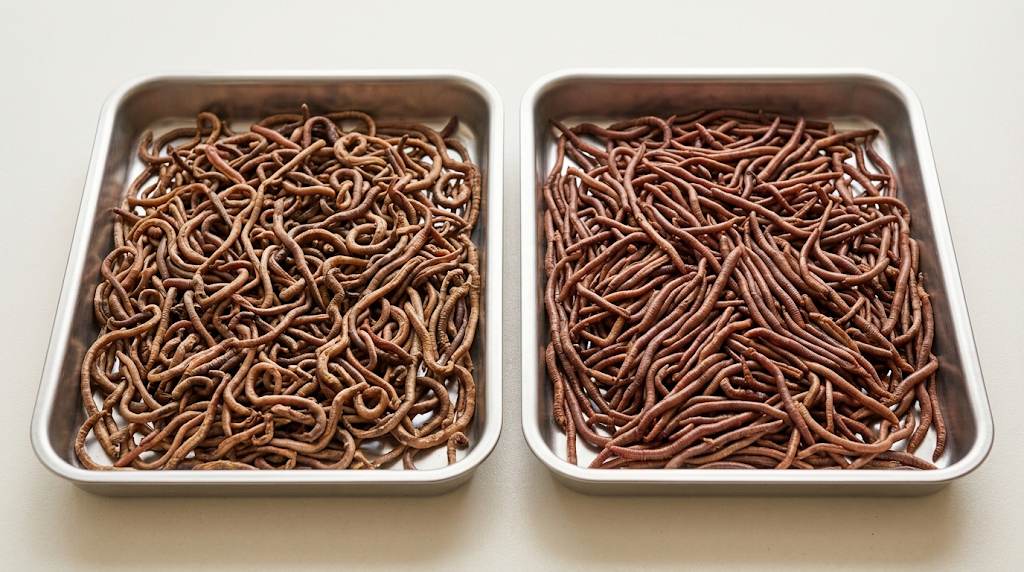

The difference between sun dried earthworms and heat-dried earthworms is not simply “natural versus processed.” Both methods remove moisture, but they differ in heat source, environmental exposure, process control, drying time, capacity, and potential batch variation.
For B2B buyers, the processing label is only the starting point. The real purchasing decision depends on the finished commercial grade: cleanliness, colour, whole-product condition, moisture, drying uniformity, test results, packaging and repeat supply. A well-controlled sun-dried lot may suit one application, while controlled heat drying may provide advantages for another.
This guide explains the practical differences between the two options and shows what distributors, wholesalers, resellers, farms, aquaculture businesses, and pet-product companies should verify before approving a sample or placing an order.
Key Takeaways
- Sun drying depends more heavily on weather, exposure time, and protective controls.
- Heat drying provides adjustable temperature and airflow, but the outcome still depends on equipment and operating settings.
- Neither drying method automatically proves cleanliness, microbiological status, moisture, or nutritional quality.
- Buyers should compare representative samples and batch-linked documents under the same acceptance criteria.
- The appropriate option depends on application, required presentation, volume, price, and consistency.
1. How Sun Drying and Heat Drying Differ
Sun drying uses solar energy and ambient airflow to remove water from the product. In a basic open-air process, earthworms are spread in a thin layer and exposed directly to sunlight and the surrounding environment. More controlled solar systems may use raised trays, screens, covers, or enclosed drying chambers to improve airflow and reduce exposure to dust, insects, and animals.
Heat drying uses a controlled source of thermal energy, commonly with heated air moving around or through the product. Tray, cabinet, tunnel, and other equipment designs can regulate temperature, airflow, loading depth, and residence time to different degrees.
The basic difference is control:
- sun drying responds to weather and ambient conditions;
- heat drying uses adjustable equipment settings;
- protected solar drying falls between simple open sun drying and fully controlled heated-air processing.
These categories should not be treated as identical. When a supplier states “sun dried,” buyers should ask whether the product was dried in the open, on raised protected trays or inside a solar dryer.
2. Typical Characteristics of Sun Dried Earthworms
Commercial sun dried earthworms may show natural variation in colour, shape and surface appearance. Drying conditions can change from hour to hour as sunlight, air temperature, humidity and wind change.
Depending on the process, buyers may observe:
- reddish-brown to deeper brown colour variation;
- naturally curled and irregular whole forms;
- differences in dryness between thicker and thinner pieces;
- longer drying time than controlled heat systems;
- greater dependence on season and weather;
- potential exposure to dust or other environmental material if protection is limited;
- lower equipment intensity in some production settings.
These are possible tendencies, not automatic defects. A protected and well-managed sun-drying process can reduce exposure and improve uniformity. Conversely, a product described as sun dried should not be accepted solely because the method sounds traditional or natural.
The offered sample, batch information, and test results remain the basis for purchasing approval.
3. Typical Characteristics of Heat-Dried Earthworms
Heat drying applies controlled thermal energy and airflow. The operator can select a processing profile and monitor the drying stage more consistently than under changing outdoor conditions.
Commercial characteristics may include:
- more repeatable drying time;
- improved control of temperature, airflow, and loading;
- more consistent moisture removal when the system is operated correctly;
- different color development depending on temperature and exposure;
- capacity that is less dependent on weather;
- potential for scorching, case hardening, or excessive brittleness if settings are unsuitable;
- energy and equipment costs that influence the quotation.
Heat-dried does not mean automatically clean, safe, or uniform. Dense loading can restrict airflow. Excessive heat can darken or damage the product, while insufficient time can leave uneven moisture. Cooling, sorting, and post-process handling are also important.
Buyers should therefore evaluate how the process performs, not just whether equipment was used.
4. Compare Color Without Treating It as Proof of Quality
Color is often the first visible difference. Sun-dried products may exhibit a broader natural range because exposure conditions change over the drying cycle. Heat-dried products may appear more consistent, although temperature and time can also deepen color.
Final color can be influenced by:
- earthworm species and maturity;
- cleaning and pretreatment;
- product thickness and loading depth;
- drying rate and total exposure time;
- processing temperature;
- oxidation during cooling or storage;
- lighting used for product photographs.
A darker batch is not automatically contaminated, and a lighter batch does not prove lower moisture or better microbiological quality. If appearance matters for resale, compare samples on the same neutral surface under consistent lighting. Retain approved photographs or a sealed reference sample and define an acceptable range.
For applications where the earthworms will remain visible, color consistency may carry more commercial value. For ingredient or farm use, modest variation may be acceptable when cleanliness, moisture, and testing meet the agreed specification.
5. Cleanliness and Environmental Exposure
Earthworms require careful cleaning because they naturally come into contact with soil and substrate. The drying method then introduces a second cleanliness question: how well is the product protected after cleaning?
Open sun drying can expose a product to:
- wind-blown dust;
- insects and birds;
- contact with unsuitable drying surfaces;
- rain or sudden humidity changes;
- handling during covering, turning or moving.
This risk can be reduced by raising food-grade trays, using mesh protection, covering solar dryers, controlling access, and documenting cleaning. Buyers should not assume that all sun drying occurs directly on the ground.
Heat drying can reduce outdoor exposure, but cleanliness still depends on equipment sanitation, tray condition, airflow quality, personnel practices, cooling, and packing. The product may also be re-exposed after it leaves the dryer.
Inspect both options for visible soil, fibers, stones, packaging debris, abnormal clumps, and excess loose residue. The guide to dried earthworm specifications explains how to separate physical cleanliness from ash and moisture requirements.
6. Drying Time, Weather, and Production Planning
Sun drying is closely linked to the local climate. Strong sunlight, low humidity, and suitable airflow can support drying, while clouds, rain, or high humidity extend the process. Seasonal conditions may affect both production time and available capacity.
Heat drying is less dependent on outdoor weather and may offer more predictable scheduling. That can matter when buyers need regular shipment dates or repeat monthly volumes. However, equipment capacity, energy availability, and maintenance can still create constraints.
Ask suppliers:
- What conditions determine the drying schedule;
- how products are protected when the weather changes;
- How seasonal capacity affects lead time;
- whether different drying methods may be used between orders;
- how the process is identified in batch records;
- Whether repeat orders can use the same commercial grade.
If drying method is essential, include it in the RFQ and purchase confirmation. If the true requirement is consistent moisture and appearance, state those outcomes as measurable acceptance criteria as well.
7. Moisture and Drying Uniformity
The drying method influences how water is removed, but the process name does not indicate the final moisture level. Both sun-dried and heat-dried products require representative sampling and batch-specific verification.
For sun dried earthworms, check whether variable weather could create differences between drying days or tray positions. For heat-dried earthworms, ask whether airflow, loading depth, or equipment hot spots can create uneven results.
Review:
- batch-specific moisture result;
- test method, unit, and reporting basis;
- sampling across the lot;
- evidence of softness, clumping, or condensation;
- package barrier and seal;
- storage conditions after drying;
- interval between testing and shipment.
Physical crispness is only an observation. It cannot replace a moisture test. Buyers should also avoid confusing moisture content with water activity. The correct requirement depends on the application, packaging, and destination rather than one universal number.
8. Microbiological Control Requires More Than Drying
Drying reduces available water, while heat exposure may also reduce some microorganisms. However, neither method should be described as sterilization without validated evidence.
The microbiological result can be affected by:
- initial raw material condition;
- washing or other pretreatment;
- temperature and exposure time;
- uneven drying;
- contamination from trays or surfaces;
- cooling and transfer after drying;
- packaging and storage.
Sunlight alone does not prove microbiological safety. Heat drying also does not guarantee that every point in a loaded tray received the same treatment. The buyer should define the relevant batch tests according to destination and application.
A study evaluating alternative earthworm-drying techniques compared sun drying, oven drying, drying tunnel, and microwave-assisted drying, illustrating that multiple processing options can produce different technical and practical outcomes. Buyers can review the peer-reviewed paper Evaluation of Alternative Drying Techniques for Earthworm Flour as processing background, not as a universal specification for whole commercial earthworms.
9. Whole-Product Shape, Texture, and Breakage
Whole dried earthworms are naturally long, curled, and irregular. Their physical condition can change during drying and subsequent handling.
Sun-dried material may vary in firmness or brittleness when drying conditions differ. Heat-dried material can become excessively brittle if the process is too intense. In both cases, breakage may increase during sorting, bag filling, pallet compression, and international transport.
Evaluate:
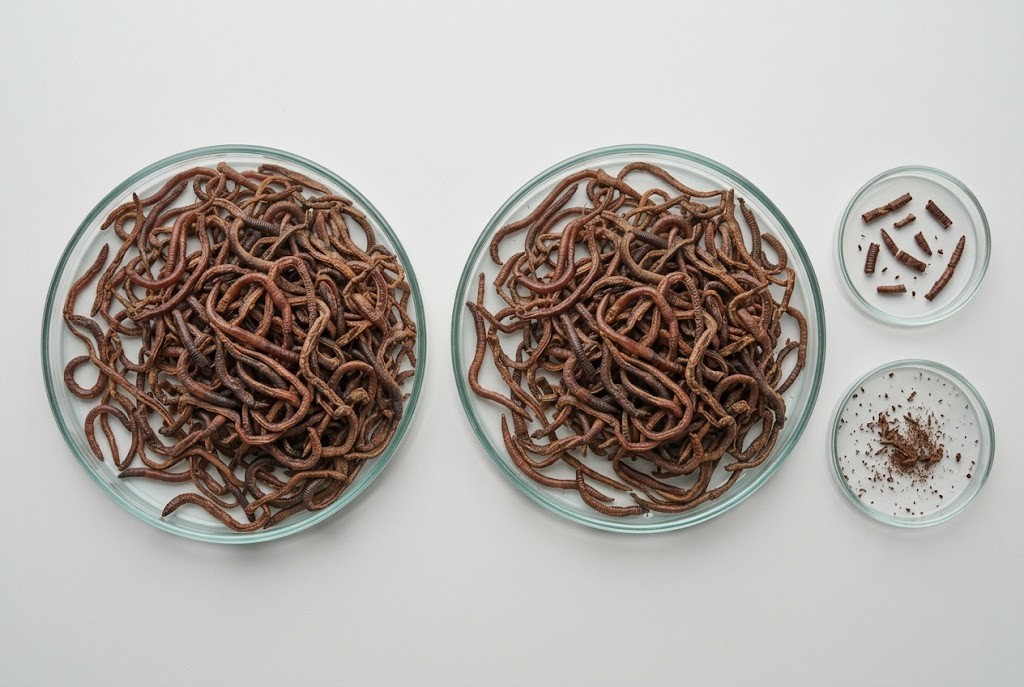
- recognizable whole or nearly whole pieces;
- broken lengths and fragments;
- fines at the bottom of the package;
- severe flattening or crushing;
- flexibility or brittleness;
- condition after transport, not only at the dryer.
Define how “whole” and “broken” will be classified. A representative sample should include material from different positions in the package. Packaging configuration should be considered part of the intactness requirement.
10. Nutritional Values Cannot Be Predicted From the Label
Buyers may encounter broad claims that sun drying preserves nutrition or that controlled heating reduces protein. These statements are too simple for a commercial decision.
Reported composition can vary with:
- earthworm species and source;
- substrate and pre-harvest conditions;
- cleaning and gut-content control;
- processing temperature and time;
- sample moisture;
- analytical method;
- as-received or dry-matter reporting basis.
A change in moisture alone can change the percentage reported for protein, fat, or ash on an as-received basis. Therefore, two COAs should not be compared until the basis and methods are understood.
If nutritional composition matters, review batch-specific data rather than inferring it from the drying method. Do not present typical values as guaranteed unless they are confirmed for the offered lot.
11. Cost, Capacity, and Commercial Consistency
Sun drying may require less powered drying equipment, but commercial cost also includes labor, drying area, weather delays, product loss, protection, and sorting. Heat drying uses energy and equipment but may provide shorter cycles and more predictable capacity.
Compare delivered value rather than the processing label:
| Purchasing factor | Sun drying | Heat drying | Buyer verification |
|---|---|---|---|
| Energy source | Solar and ambient conditions | Powered heat and airflow | Confirm actual process offered |
| Weather dependence | Higher | Lower | Review seasonal lead time |
| Environmental exposure | Depends on protection | Generally more enclosed | Inspect cleanliness controls |
| Drying time | Can vary substantially | More adjustable | Ask for batch process information |
| Moisture consistency | Depends on weather and tray management | Depends on loading and airflow control | Review representative batch result |
| Colour | May show broader natural variation | Maybe more repeatable or darker under stronger heat | Compare samples equally |
| Capacity | Can be seasonal | Linked to equipment throughput | Confirm repeat-order capability |
| Cost | Depends on labour, space and loss | Depends on energy, equipment and throughput | Compare equivalent delivered grades |
A lower quotation may reflect different cleaning, sorting, testing, or packaging rather than a saving created only by the drying method.
12. Which Option Fits Different Buyers?
Distributors and wholesalers
Consistency across orders, documentation, capacity, and packaging may matter more than small color differences. Ask whether the same method and commercial grade can be supplied repeatedly.
Retail repackers
Visible whole-product presentation, color range, and low fragments may be important. Compare transported samples, not only freshly dried material.
Farms and aquaculture businesses
A broader visual range may be acceptable when cleanliness, moisture, required tests and delivered cost meet operational needs.
Pet-product brands
The best option depends on whether earthworms remain visible in the finished pack. Brands should align color and integrity requirements with packaging design and consumer expectations.
The dried earthworms wholesale product page provides the available processing and commercial supply context for a product inquiry.
13. How to Compare Samples Fairly
Use the same procedure for both processing options:
- Request samples representing the quoted commercial grade.
- Record batch, process and sampling information.
- Compare colour under identical neutral lighting.
- Inspect soil, residue and other visible foreign material.
- Separate whole pieces, fragments and fines consistently.
- Note texture, flow and characteristic or abnormal odour.
- Review moisture and other required batch results.
- Compare packaging and likely transport stress.
- Record the accepted range and retain a reference where practical.
Do not compare a hand-selected sun-dried sample with a randomly selected heat-dried sample. The sampling basis should be equivalent. One sample can guide approval, but it cannot guarantee all future production.
The broader B2B guide to bulk dried earthworms explains how processing fits into the overall supplier and product evaluation.
14. What to Include in the RFQ
A processing-focused RFQ should include:
- product: whole dried earthworms;
- preferred method: sun dried, heat dried or open to recommendation;
- whether protected solar drying is acceptable;
- destination and intended application;
- quantity and delivery frequency;
- acceptable colour and size range;
- whole-product, fragments and fines requirements;
- cleanliness and foreign-matter criteria;
- moisture and other test requirements;
- packaging type and unit weight;
- sample and document requirements;
- trade terms and requested delivery date.
If the method is mandatory, explain why. If the buyer’s real priorities are moisture, cleanliness, colour and price, allow the supplier to identify which available processing option meets those requirements.
Frequently Asked Questions
Are sun dried earthworms lower quality than heat-dried earthworms?
Not automatically. Quality depends on cleaning, drying control, protection, moisture, sorting, testing, and packaging. A protected, well-managed sun-dried lot may meet a buyer’s requirements, while poorly controlled heat drying can still produce uneven or damaged material.
Are sun dried earthworms exposed directly to the ground?
Not necessarily. Processes may use raised trays, mesh covers, or enclosed solar dryers. Buyers should ask how the product is supported and protected rather than assuming all sun drying is identical.
Does heat drying guarantee safer earthworms?
No. Heat exposure may contribute to microbial reduction, but the result depends on temperature, time, load, starting condition, and post-process handling. Confirm relevant batch tests.
Which method produces more consistent moisture?
Controlled heat drying can offer more adjustable conditions, but equipment loading and airflow still matter. Sun drying can vary with weather. In both cases, buyers need representative batch testing.
Should the drying method be written into the purchase order?
Yes, when it is a mandatory requirement. The purchase order should also state measurable outcomes such as cleanliness, moisture, whole-product condition, testing, and packaging.
Final Buying Decision
The choice between sun dried earthworms and heat-dried earthworms should be based on the finished commercial product and the buyer’s application. Sun drying may offer a suitable grade and commercial cost where weather and protective controls are well managed. Heat drying may offer more predictable scheduling and process adjustment, but it still requires effective loading, cooling, sorting, and packaging.
Compare identified samples, use the same inspection method, and review batch-linked moisture and testing information. Define what matters in the RFQ so the supplier can quote the correct grade rather than relying on the drying-method name alone.
To discuss an available processing option or request a representative sample, contact BulkInsects with your quantity, destination, application, preferred appearance, packaging, and testing requirements.