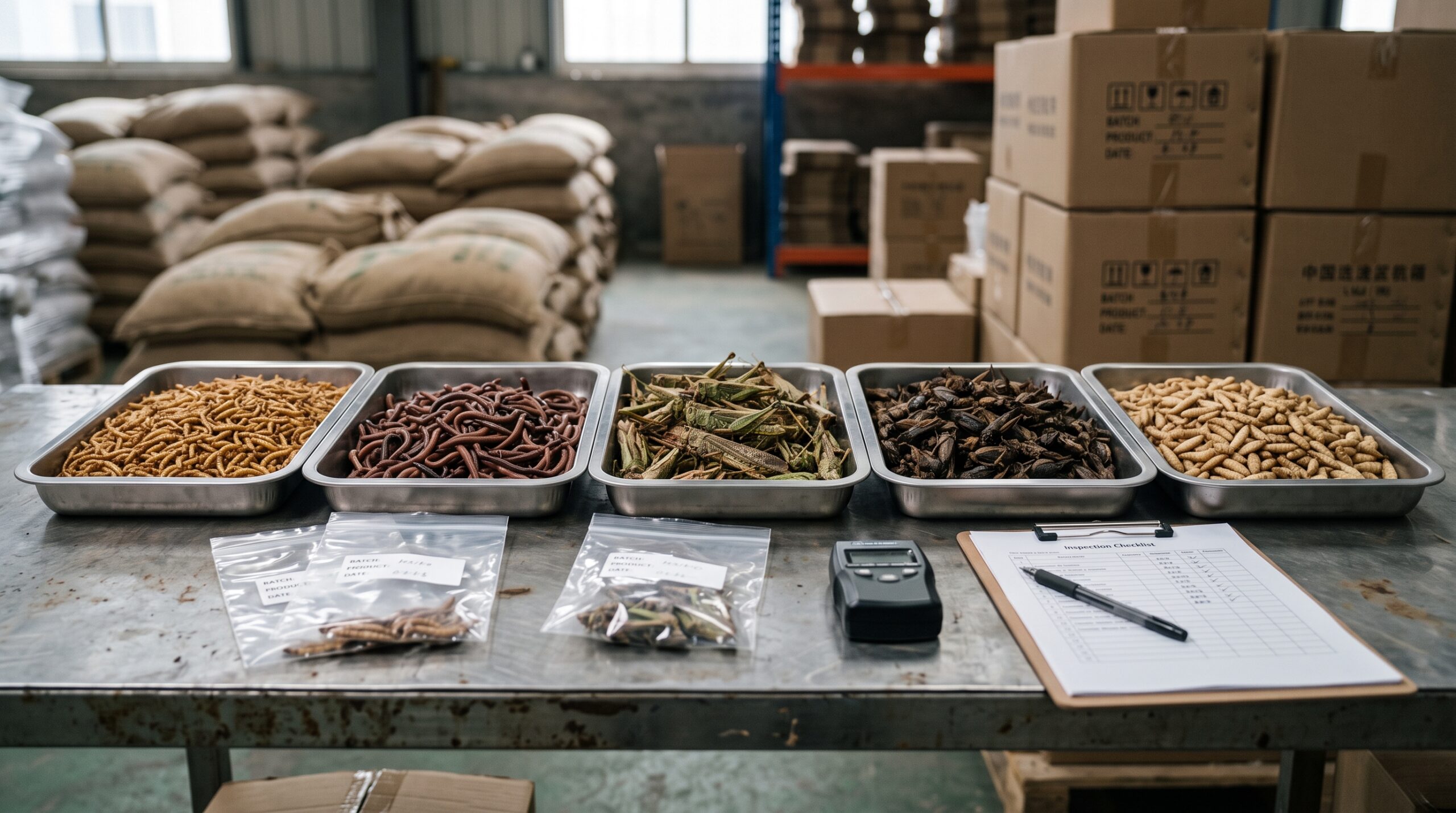

Effective dried insect quality control requires more than checking protein content or looking at a polished product photograph. For wholesalers, distributors, resellers, pet product businesses, farms and feed-related commercial buyers, quality also includes correct species identification, whole-product appearance, cleanliness, moisture condition, batch consistency, packaging and documentation.
Dried insects are natural agricultural products. Their colour, size, composition and physical condition can vary depending on the species, raw-material source, processing method, season, storage and handling. Buyers therefore need a practical approval process that separates reference information from batch-specific evidence.
This guide explains what B2B buyers should check before approving a sample, trial order or commercial shipment of whole dried insects.
1. Confirm Product Identity and Product Form
Quality control starts by confirming that the product is what the buyer ordered.
Check:
- common product name;
- scientific name where relevant;
- whole dried product form;
- grade or size description;
- processing method, if specified;
- batch or lot reference; and
- packaging label information.
Common names can vary between markets. This is especially important for products such as grasshoppers, crickets, earthworms, and black soldier fly larvae. If species identity affects import eligibility or customer acceptance, confirm it before ordering.
The product form should also be clear. BulkInsects focuses on whole dried insects, not live insects or insect powder. A report or specification for a powdered ingredient should not be assumed to represent the condition of a whole dried product.
2. Evaluate Whole-Product Appearance
Appearance can affect commercial value, particularly for distributors, resellers and businesses that repack insects for retail sale.
Review:
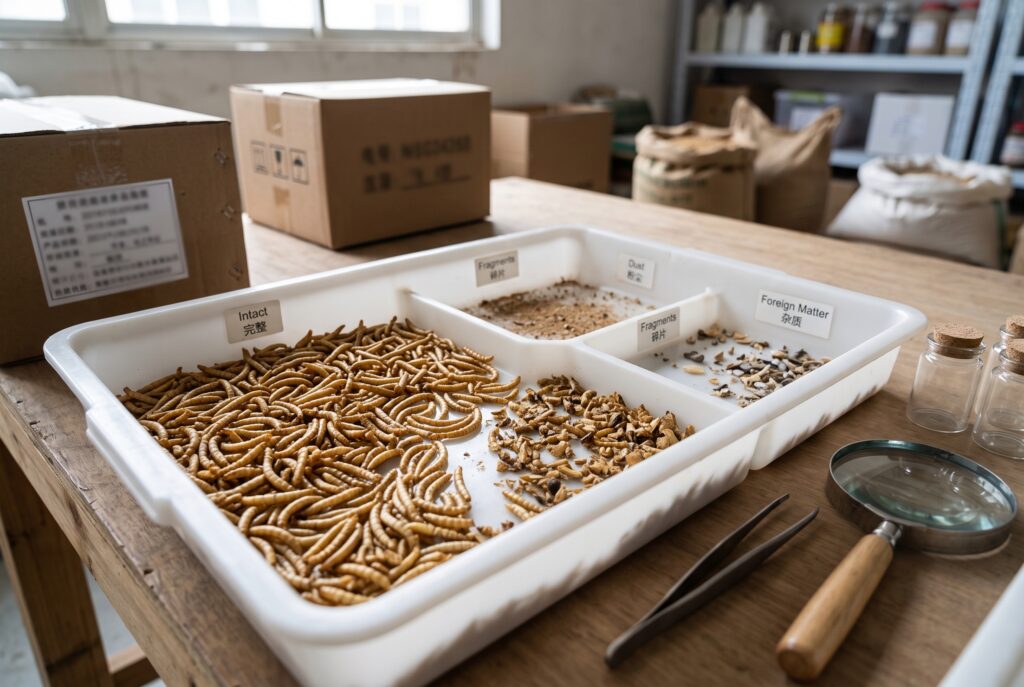
- percentage of recognizable whole pieces;
- level of broken pieces;
- dust and small fragments;
- colour consistency;
- size uniformity;
- visible scorching or excessive darkening;
- signs of moisture damage; and
- evidence of poor handling.
The acceptable balance depends on the application. A premium repacking grade may require better whole-product integrity and visual uniformity than a commercial grade supplied directly to a large farm.
Do not judge appearance only from a carefully selected handful. Ask whether the sample represents the available commercial batch and request current batch photographs where appropriate.
3. Check Cleanliness and Foreign Matter
Evaluate cleanliness both visually and, where relevant, through analytical testing.
Possible concerns include:
- soil or sand;
- plant material;
- packaging fibres;
- stones or hard particles;
- unrelated insect material;
- excessive dust; and
- other visible impurities.
The main risks differ by product. Cleaning and soil removal may deserve particular attention for dried earthworms. Separation from substrate and residual material may be important for dried maggots and dried black soldier fly larvae. Grasshoppers and crickets may require attention to species identification and foreign insect material.
An ash result may support evaluation, but it does not replace visual inspection. Ash is an analytical measurement, while visible foreign matter is a physical quality characteristic. Buyers may need both.
4. Review Odour and Signs of Deterioration
Odour is a useful part of receiving inspection even though it is not always recorded on a laboratory report.
A sample should be checked for:
- unusual sour or rancid odour;
- musty smell;
- chemical-like odour;
- signs of mould;
- condensation;
- caking or dampness; and
- visible insect activity after processing or storage.
Natural odour differs between insect species and drying methods, so buyers should compare the shipment with an approved reference sample rather than rely on a vague requirement such as “no smell.”
If deterioration is suspected, isolate the affected packaging and investigate storage, sealing and transport conditions before accepting the batch.
5. Understand Moisture Condition
Moisture affects storage stability, texture, and vulnerability to deterioration. Evaluate it through both testing and physical inspection.
Buyers should check:
- the reported moisture result;
- test date and method;
- whether the result relates to the shipment batch;
- packaging seal condition;
- evidence of condensation;
- warehouse and container conditions; and
- storage instructions.
A satisfactory result before shipment does not guarantee that the product will not absorb moisture later. Damaged liners, poor sealing, humid storage , or water exposure during transport may change the product condition.
For this reason, moisture control continues through packing, palletizing, container loading and receipt—not only during production.
6. Examine Processing and Drying Consistency
Drying method can influence colour, texture, whole-product condition and cost. Available methods may include sun drying, hot-air drying, microwave drying or freeze drying, depending on the insect and commercial requirement.
Buyers should confirm:
- which method applies to the quoted product;
- whether the sample and commercial batch use the same method;
- whether there are different grades;
- how excessive heating or under-drying is identified;
- how fragments are screened or graded; and
- how products are stored after drying.
The most expensive processing method is not automatically necessary for every buyer. Selection should reflect application, appearance expectations, budget, destination, and required documentation.
If processing changes between orders, the supplier should explain the difference because it may affect appearance and reference results.
7. Verify Batch Identification and Traceability
A practical quality-control system must connect the product, sample, test report and shipment.
Look for a consistent batch or lot reference on:
- sample labels;
- commercial packaging;
- Certificate of Analysis;
- testing request;
- inspection photographs;
- packing records; and
- shipment documents where applicable.
A report from an earlier batch can provide background information but should not be presented as the result for a new unidentified shipment.
Buyers should also ask whether retained samples or batch records are kept. If a concern arises after delivery, traceable records make it easier to identify the relevant shipment and discuss a response.
8. Review Batch Testing and the COA
Testing should answer defined purchasing questions rather than exist only as a marketing tool.
Depending on the order, selected parameters may include:
- moisture;
- nutritional indicators;
- ash;
- microbiological items;
- contaminants or residues where required; and
- other destination- or application-related items.
When reviewing a report, check:
- product and batch identity;
- sampling and test dates;
- laboratory or testing source;
- test method;
- unit;
- specification limit;
- actual result; and
- conclusion.
Do not confuse a typical specification with an actual batch result. Our guide to dried insect batch testing explains how sampling, methods and batch identification affect the value of a result.
When independent testing is required, buyers may also ask whether the laboratory is accredited to ISO/IEC 17025 for the relevant scope. Check accreditation against the specific method and test item, not assumed from the laboratory name alone.
For help distinguishing limits from measured results, see our guide to reading a dried insects COA.
9. Compare the Sample with the Commercial Batch
An approved sample is useful only if both parties understand what it represents.
Ask:
- Was the sample taken from current stock or produced separately?
- Will the order come from the same batch?
- Which characteristics may vary naturally?
- Is the sample the quoted commercial grade?
- Can current batch images be supplied before shipment?
- Will a pre-shipment sample be retained?
Record the approval criteria. Photographs, physical notes and agreed tolerances are more useful than a message stating only that the sample is “good.”
For whole dried insects, sample approval may record colour, approximate size, cleanliness, fragments, odour, dryness and packaging. Analytical requirements can be recorded separately.
10. Inspect Packaging and Labels
Good product can arrive in poor condition if the packaging is unsuitable.
Check:
- inner moisture barrier;
- sealing method;
- outer bag or carton strength;
- net weight;
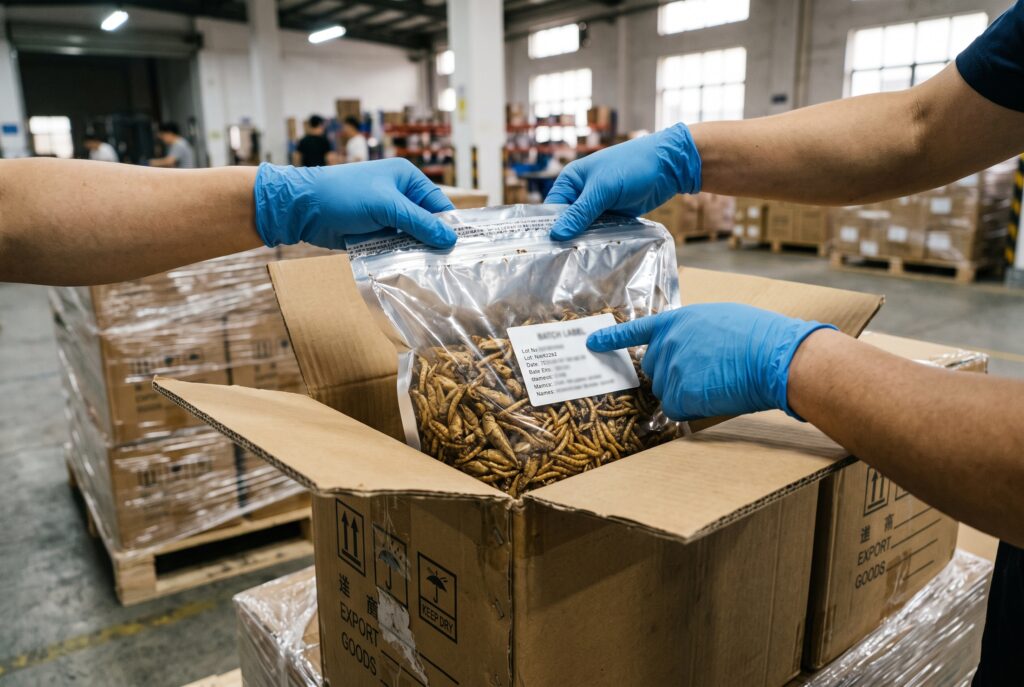
- batch label;
- product name;
- production or packing information where required;
- shipping marks;
- pallet configuration; and
- stretch wrapping or load protection.
Packaging should match the buyer’s handling process. A reseller may need manageable bag sizes and clear batch labels. A farm may prefer efficient bulk handling. Buyers focused on whole appearance should also consider compression and breakage during packing and transport.
Before shipment, request photographs that show the actual packaging format, labels, and pallet condition rather than generic packaging examples.
11. Check Storage and Transport Conditions
Quality control does not stop when the cartons leave the warehouse.
The shipment should be protected from:
- moisture and rain;
- direct sunlight;
- damaged container surfaces;
- strong odours;
- contamination from unrelated cargo;
- excessive crushing; and
- prolonged unsuitable storage.
Before loading the container, the responsible party should check that the loading space is reasonably clean, dry and suitable for the cargo. Arrange pallets or cartons to limit shifting and compression.
When the shipment arrives, record the condition before unpacking. Photographs of the container, pallet, outer cartons, seals, and affected packages can be important if there is transport damage.
12. Define Acceptance Before Placing the Order
Many disputes occur because “good quality” was never converted into clear purchasing criteria.
Before confirming an order, define:
- product and grade;
- quantity;
- processing method;
- key physical expectations;
- required testing;
- packaging;
- destination;
- inspection point; and
- process for handling a non-conforming result.
Avoid writing every typical value as a permanent contractual guarantee. Dried insects are natural products; instead, assess final parameters using applicable batch and export testing.
A reliable supplier should explain what can be controlled, what can vary, and which points require confirmation for the specific batch. This transparency is part of the process when buyers choose a reliable dried insect supplier.
Dried Insect Quality Control Checklist
Use the following checklist for samples, trial orders and repeat shipments:
| Quality area | What the buyer should verify |
|---|---|
| Identity | Correct species, product form, grade and processing |
| Appearance | Whole pieces, fragments, colour and size consistency |
| Cleanliness | Soil, substrate, dust and visible foreign matter |
| Condition | Odour, dryness, mould, caking and deterioration |
| Moisture | Batch result, packaging seal and storage condition |
| Traceability | Matching lot reference across sample, report and packaging |
| Testing | Relevant parameters, methods, units and actual results |
| Sample | Representative of the commercial batch and grade |
| Packaging | Moisture protection, strength, labels and pallet condition |
| Transport | Clean, dry loading environment and protection from damage |
| Documentation | Product, batch and shipment details correspond |
| Acceptance | Requirements and response to non-conformance are defined |
A Practical Approval Process for B2B Buyers
A structured process can reduce misunderstandings:
- Describe the product, application, destination and quantity.
- Review available grades and processing options.
- Request a representative sample.
- Evaluate appearance, cleanliness, odour and packaging.
- Confirm relevant testing and documents.
- Place a manageable commercial trial order.
- Match the batch, report, labels and packaging.
- Complete pre-shipment inspection where required.
- Record the condition at delivery.
- Use the approved reference for repeat orders.
Quality control should match the risk and value of the transaction. A trial order may use a focused set of checks, while a larger or destination-sensitive shipment may require additional sampling, testing, or inspection.
Build Quality Control Around the Actual Batch
Effective dried insect quality control connects four things: the agreed requirement, a representative sample, the relevant batch and the final shipment.
Buyers should evaluate both analytical and physical quality. Testing can provide evidence for selected parameters, while inspection remains important for whole-product appearance, fragments, cleanliness, odour, packaging and transport condition.
BulkInsects coordinates whole dried insect supply through established production sources. Product selection, samples, testing, packaging and documentation are discussed according to the species, destination, application and order requirements. Reference specifications support initial discussion; final values depend on the relevant batch and applicable testing arrangements.
Need to discuss quality requirements for a bulk order? Send us the product, quantity, destination, application, and key acceptance points through our contact form.
Frequently Asked Questions
What does dried insect quality control include?
It can include product identification, whole-product appearance, cleanliness, moisture condition, processing consistency, batch traceability, testing, packaging, storage, and shipment inspection.
Should every dried insect batch have the same test panel?
Not necessarily. The appropriate tests depend on the insect species, intended application, destination, buyer requirements and applicable import conditions.
Can a COA replace physical inspection?
No. A COA reports selected analytical results but may not show fragments, colour, odour, visible impurities, damaged packaging or transport-related deterioration.
How should buyers approve a dried insect sample?
Record the sample’s batch, grade, processing method, appearance, cleanliness, fragments, odour and packaging. Confirm whether the commercial order will come from the same or a comparable batch.
Why can quality vary between dried insect batches?
Dried insects are natural products. Variation can result from raw materials, season, insect size, processing, drying, sorting, storage and handling. Agreed tolerances and batch checks help manage this variation.