Dried mealworm grades are an important consideration for commercial buyers comparing whole dried insects from different suppliers. Product grades can influence appearance consistency, packaging suitability, breakage tolerance, and purchasing decisions. However, descriptions such as Premium Grade, Grade A, or Standard Grade do not necessarily represent the same quality requirements across suppliers.
For wholesalers, distributors, and pet food businesses, the most reliable approach is to evaluate grading claims against measurable product specifications. Size distribution, whole-insect integrity, color consistency, broken material, moisture content, and foreign matter should be reviewed according to the intended application. A clearly defined grading agreement helps buyers compare quotations, assess samples, and reduce disagreements when receiving bulk shipments.
1. What Do Dried Mealworm Grades Mean?
Dried mealworm grades generally describe how a supplier classifies products according to selected commercial characteristics. These may include insect size, physical integrity, visual uniformity, and the amount of broken material. Some suppliers use internal grading systems based on sorting equipment or production practices, while others establish grades according to customer-specific requirements. As a result, the same grade name may refer to different product characteristics depending on the supplier.
A Premium Grade product may emphasize a high proportion of intact insects and consistent appearance, while a Standard Grade product may allow greater variation or more broken pieces. These are illustrative commercial descriptions, not universally recognized grade definitions. Buyers should not assume that Grade A from one supplier is equivalent to Grade A from another without reviewing the underlying specifications and inspection methods.
Product grading should also be distinguished from safety and regulatory compliance. A visually attractive batch is not automatically safer or nutritionally superior to a less uniform batch. Moisture, microbiological status, contaminants, and other relevant parameters must be evaluated separately according to the product’s intended use and destination market requirements. Commercial appearance grades are useful purchasing tools, but they do not replace appropriate quality testing.
2. Key Factors Used to Grade Whole Dried Mealworms
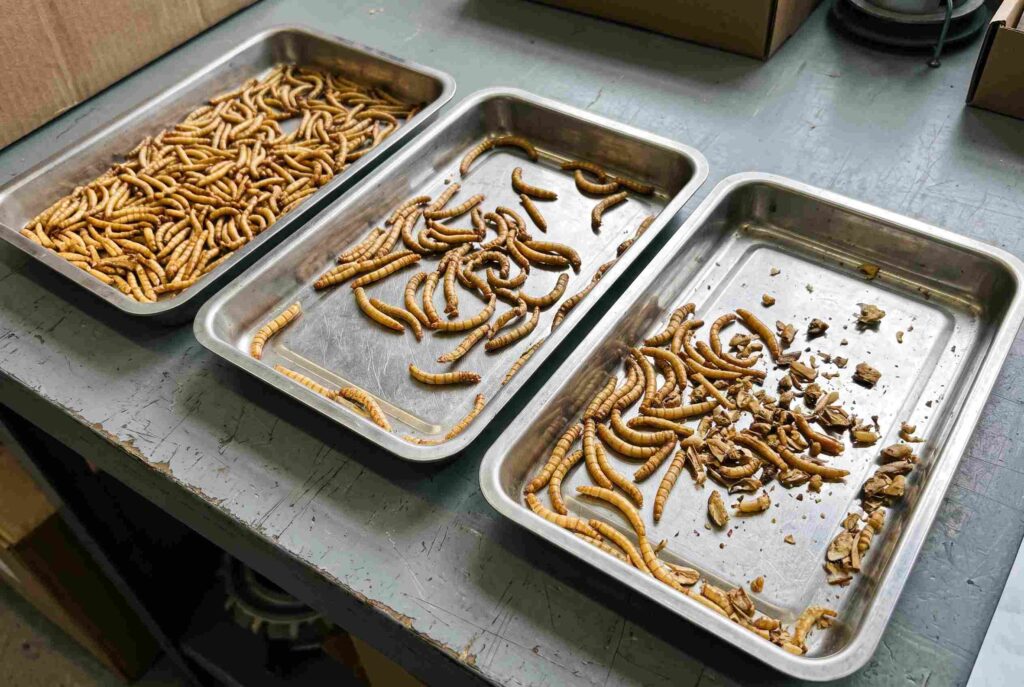
Whole-insect integrity is often a major factor when evaluating commercial dried mealworm grades. Buyers may prefer intact, recognizable insects for retail packaging, bird food, or reptile feeding products where presentation matters. A grade specification should distinguish whole insects from broken insects, fragments, and fines. These categories should be defined before inspection because suppliers may classify partially damaged insects differently, affecting the reported percentage of acceptable material.
Size consistency is another important consideration. Dried mealworms naturally vary in length and body thickness, but buyers may require a particular size range for packaging, portioning, or product presentation. Suppliers can assess size through screening, manual measurement, or other documented sorting methods. A meaningful specification should identify the measurement method, the target size range, and the permitted proportion of material outside that range rather than relying on descriptions such as large or uniform.
Color, odor, texture, and cleanliness complete the physical assessment. Commercial dried mealworms commonly range from golden yellow to amber and brown, depending on processing conditions and natural variation. Buyers should compare these characteristics with an approved reference sample and identify any unacceptable discoloration, unusual odor, dampness, or foreign matter. Moisture content and relevant laboratory results should support the evaluation, since appearance alone cannot establish whether a batch meets all quality requirements.
3. How to Compare Supplier Grading Systems
When comparing suppliers, buyers should begin by requesting the written specification associated with each offered grade. A quotation stating Premium Grade without measurable criteria provides limited information for commercial evaluation. The specification should explain how whole insects, broken pieces, size variation, color range, and foreign matter are assessed. It should also identify whether the grade applies to a particular batch or represents a general product category offered by the supplier.
Representative samples are essential because written grade descriptions may not fully communicate physical differences. Buyers should compare samples under similar lighting and inspection conditions, using equivalent sample quantities where practical. Whole-insect integrity, size distribution, and visible broken material can then be assessed using the same definitions. When two suppliers use different grading methods, the buyer should request clarification or evaluate both samples against a common purchasing specification.
Price comparisons should also consider what each grade includes. A lower-priced batch may be commercially suitable for an application that tolerates more broken insects, while a more visually consistent product may justify a higher price for visible retail packaging. However, buyers should avoid assuming that a higher grade automatically provides better nutritional value or safety. The relevant decision is whether the product meets the intended application’s requirements at an acceptable total procurement cost.
4. Sampling, Testing, and Batch Acceptance
A grading system becomes useful only when its requirements can be verified during batch inspection. Buyers should establish a sampling procedure that reflects shipment size, packaging format, and the characteristics being assessed. Inspecting material from multiple cartons or defined locations within a lot can provide a more representative view than examining a single handful. The procedure should specify sample quantities, inspection tools, and how results will be recorded.
Physical inspection should use consistent category definitions. For example, an agreed method may separate intact insects, broken insects, smaller fragments, and non-product foreign matter before calculating their proportions by weight. The method must specify whether measurements use the total sample weight or another defined basis. Size measurements should follow the same approach across batches, while color and texture observations should be compared with approved reference material under controlled conditions.

Laboratory evidence provides additional information that physical grading cannot establish. A Certificate of Analysis (COA) may report moisture, nutritional composition, microbiological findings, or other parameters, depending on the tests actually performed. Buyers should verify the batch identification, test methods, units, and results against the agreed specification. Unless appearance grading was explicitly included in the inspection, a laboratory report should not be treated as independent confirmation that a batch meets a particular commercial grade.
5. Practical Considerations for B2B Buyers
Before ordering whole dried mealworms in bulk, buyers should confirm whether the quoted grade is based on an established supplier specification or a customized purchasing requirement. The agreement should define the acceptable size range, minimum whole-insect integrity, maximum broken material, color expectations, moisture limits, and foreign matter criteria where applicable. Numeric acceptance limits should be negotiated according to the intended application, sampling method, and commercial requirements rather than assumed from a grade name.
Buyers should also establish how approved samples relate to future shipments. A sample from one production lot may not represent every subsequent batch, particularly when raw material characteristics, drying conditions, or sorting practices change. For repeat purchases, an approved reference sample and written inspection procedure can help maintain consistent expectations. The supplier should clarify whether the offered grade is routinely available and how deviations will be communicated before shipment.
Finally, procurement discussions should cover packaging, transportation, and the point at which grade conformity will be assessed. Whole dried insects can experience additional breakage during handling and international shipping, so pre-shipment and arrival conditions may differ. Buyers and suppliers should agree on inspection timing, supporting photographs, batch documentation, and procedures for retesting or resolving nonconforming deliveries. These arrangements are particularly important when purchasing from multiple suppliers with different grading practices.
6. Frequently Asked Questions
Are dried mealworm grades standardized internationally?
There is no single universally applied commercial grading scale that makes every supplier’s Premium Grade, Grade A, or Standard Grade directly comparable. Buyers should request written specifications and verify the inspection methods used to support each grade.
What is the difference between premium and standard dried mealworms?
The distinction depends on the supplier’s grading system. Premium products may have tighter requirements for whole-insect integrity, size consistency, and visual presentation, while standard products may permit more variation. These differences should be confirmed through measurable specifications and representative samples.
Does a higher dried mealworm grade mean better nutritional quality?
Not necessarily. Commercial grades often emphasize physical appearance and presentation. Nutritional composition, moisture content, microbiological status, and contaminant levels require separate evaluation using relevant laboratory evidence.
How can buyers verify dried mealworm grades before shipment?
Buyers can request representative samples, written grade specifications, pre-shipment inspection records, batch photographs, and applicable laboratory reports. The purchase agreement should define sampling methods, acceptance limits, and the procedure for handling nonconforming material.
7. Conclusion
Dried mealworm grades provide a practical framework for comparing commercial products, but grade names alone are insufficient for reliable purchasing decisions. Whole-insect integrity, size distribution, color consistency, broken material, and supporting quality evidence should be evaluated against clearly defined requirements.
For international buyers, a consistent grading approach can improve supplier comparisons, reduce sample-related misunderstandings, and support more predictable batch acceptance. Written specifications, representative sampling, and agreed inspection methods are more valuable than relying on subjective descriptions such as premium or superior quality.
BulkInsects supports commercial sourcing of whole dried insects through product information, sample coordination, and available batch documentation. To discuss your preferred grade, product specifications, estimated order quantity, and destination market, contact BulkInsects for a bulk quotation.