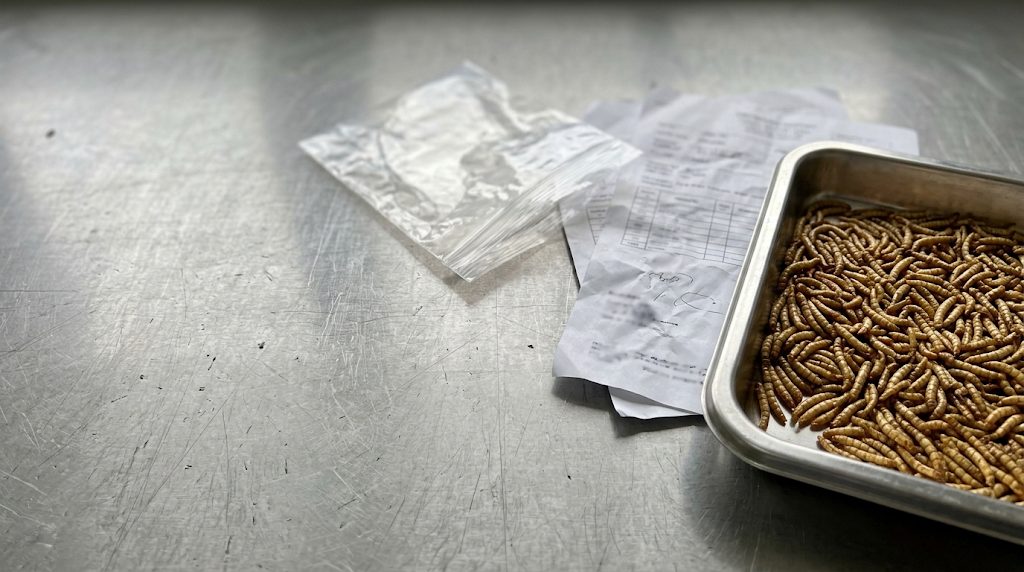

A dried insect lab test report should be reviewed for product identity, batch traceability, testing methods, reported results, units, and applicable acceptance criteria. B2B buyers should confirm that the tested sample represents the offered whole dried insect lot and that the analytical methods are suitable for the intended application. Results for protein, moisture, microbiological parameters, and chemical contaminants must be interpreted against agreed specifications and destination-market requirements. A laboratory report provides evidence about the tested sample, but it does not automatically certify an entire shipment or establish universal regulatory compliance.
1. What Should Buyers Check First on a Dried Insect Lab Test Report?
A laboratory report can contain extensive analytical information, but its commercial value depends on whether the results relate to the product being purchased. Before reviewing individual numbers, buyers should establish the identity of the tested material and its connection to the offered shipment.
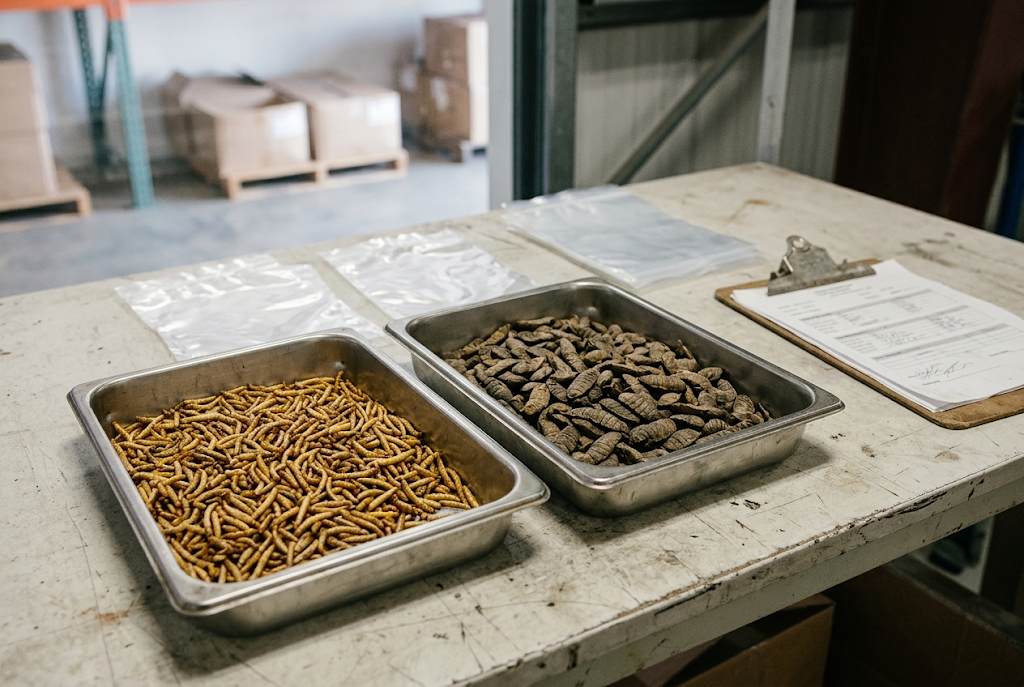
For whole dried insects, the product description should identify the relevant species and physical form. A report for dried mealworms should not be used to substantiate the composition of dried black soldier fly larvae, crickets, grasshoppers, earthworms, or maggots. Similarly, a report for insect powder or an extracted ingredient should not be presented as evidence for an unprocessed whole dried insect product.
The first review should focus on five elements: product identity, batch or lot number, sample identification, laboratory identity, and report date. These details help determine whether the document is relevant to the proposed purchase.
First-Stage Report Verification
| Report Field | Buyer Verification Question | Potential Concern |
|---|---|---|
| Product name | Does the report identify the correct insect species? | Different product tested |
| Product form | Is the sample whole dried insects? | Powder or processed ingredient substituted |
| Batch or lot number | Can the result be linked to the offered lot? | Untraceable or unrelated batch |
| Sample identification | Who collected and submitted the sample? | Unclear sample origin |
| Laboratory identity | Is the testing organization identifiable? | Unverifiable report |
| Report date | Is the testing relevant to the current purchase? | Historical result presented as current evidence |
| Report status | Is the document final, complete, and authentic? | Draft, altered, or incomplete documentation |
A recent report is not automatically more relevant than an older report. A correctly identified batch-specific report may be more useful than a newer test performed on unrelated material. Conversely, a historical report may support initial supplier qualification without proving that the current shipment meets the same specifications.
Buyers should distinguish supplier-provided reference reports from batch-specific Certificates of Analysis (COAs). Both can be useful, but they serve different verification purposes.
2. How Should Buyers Interpret the Main Test Results?
After confirming the report’s identity and traceability, buyers should review whether the test panel addresses the intended application. A dried insect lab test report may include nutritional composition, microbiological indicators, elemental contaminants, and other parameters selected according to the product’s risk profile.
Not every parameter is required for every insect species or destination market. The appropriate scope depends on the legal product classification, intended animal use, purchasing specification, and relevant hazards.
Nutritional and Physical Parameters
Crude protein, crude fat, moisture, and ash are commonly reviewed nutritional or compositional measurements. However, the numerical results are meaningful only when the testing method and reporting basis are understood.
For crude protein, buyers should verify the nitrogen-to-protein conversion factor and whether the result is expressed on an as-received or dry matter basis. Two reports can show different protein percentages even when the underlying nitrogen content is similar, simply because different conversion factors or reporting bases were used.
Moisture content is also important because it affects product condition, storage considerations, and the interpretation of other compositional values. Where shelf stability is a concern, water activity may provide additional information, although moisture percentage and water activity are not interchangeable measurements.
Microbiological Parameters
A microbiological report may include Salmonella, Enterobacteriaceae, E. coli, total viable count, and yeasts and molds, depending on the risk assessment and buyer requirements.
Quantitative results are commonly expressed as colony-forming units per gram (CFU/g), while pathogen detection results may use statements such as “Not Detected in 25 g.” Buyers should confirm the analytical method, sample size, reporting units, and relevant acceptance criteria.
A result of “Not Detected” applies to the tested portion under the stated analytical conditions. It should not be interpreted as a guarantee that the entire shipment is free from the target microorganism.
Chemical Contaminants
Heavy metal testing may cover lead, cadmium, arsenic, and mercury, with results typically expressed in mg/kg. Other chemical contaminants may be relevant depending on substrate-related risks, processing history, and applicable feed safety requirements.
Buyers should verify whether the reported result is on an as-received or dry matter basis, whether the analytical method is suitable, and whether detection or quantification limits support the required acceptance decision.
A generic “Pass” statement is not a substitute for understanding which substances were tested and which limits were applied.
Main Test Result Review Table
| Test Category | Common Parameters | Critical Review Points |
|---|---|---|
| Nutritional composition | Crude protein, fat, ash | Method, conversion factor, reporting basis |
| Moisture and stability | Moisture, water activity where relevant | Units, method, storage implications |
| Microbiological testing | Salmonella, Enterobacteriaceae, E. coli, TVC | Sampling, units, method, detection criteria |
| Elemental contaminants | Pb, Cd, As, Hg | mg/kg, reporting basis, LOQ, applicable limits |
| Physical quality | Whole-insect integrity, foreign material | Inspection method and agreed specifications |
This table is a review framework rather than a universal mandatory test panel. Buyers should select the appropriate parameters for their specific procurement requirements.
3. How Can Buyers Tell Whether Laboratory Results Are Comparable?
Two laboratory reports should not be compared solely by placing their headline values side by side. Differences in analytical methods, sample preparation, reporting conventions, and measurement uncertainty may affect the interpretation of results.
For example, crude protein values calculated using different nitrogen conversion factors are not directly equivalent. Similarly, a heavy metal concentration reported on a dry matter basis should not be compared directly with an as-received result without an appropriate basis conversion.
Units, Reporting Bases, and Detection Limits
Buyers should identify the unit associated with each result. Nutritional composition may be expressed as a percentage, microbial counts as CFU/g, and elemental contaminants as mg/kg. These units describe different types of measurements and cannot be interpreted using the same acceptance logic.
A result below the limit of detection (LOD) or limit of quantification (LOQ) does not necessarily mean the substance is absent. It means the result falls below a specified analytical threshold. Buyers should confirm that the method’s reporting capability is appropriate for the applicable specification.
Laboratory Competence and Accreditation
Laboratory competence is another important consideration. ISO/IEC 17025 establishes internationally recognized requirements for testing and calibration laboratories, including technical competence, impartiality, and consistent operations.
When accreditation is relevant to a purchasing decision, buyers should verify the laboratory’s current accreditation status and scope. Accreditation of a laboratory does not automatically mean that every test it performs falls within its accredited scope.
A laboratory report should also be distinguished from a product certification or regulatory approval. Even a technically valid test result does not independently establish that a product is authorized for import into a particular market.
Measurement Uncertainty and Borderline Results
When a reported result is close to a contractual or regulatory limit, measurement uncertainty may affect the conformity decision. Buyers and suppliers should clarify the applicable decision rule, including how uncertainty will be considered where relevant.
A simple comparison of a measured number against a limit may be insufficient when the contract requires a particular conformity assessment approach. For critical parameters, the acceptance procedure should be established before testing or shipment.
4. How Should Buyers Decide Whether a Report Meets Acceptance Criteria?
A report should be evaluated against documented requirements, not against assumptions about what a “good” dried insect product should contain. Buyers should first identify the relevant legal requirements, then confirm any additional commercial specifications agreed with the supplier.
The destination market, intended animal use, product classification, and insect species can all affect the required test scope and acceptance limits. A specification suitable for one application should not automatically be applied to another.
A Practical Report Review Decision Process
| Review Stage | Buyer Action | Possible Outcome |
|---|---|---|
| 1. Identify | Match product, species, and batch | Relevant or unrelated report |
| 2. Verify | Confirm laboratory and report authenticity | Verified or clarification required |
| 3. Check scope | Compare tested parameters with requirements | Complete or missing tests |
| 4. Interpret | Review methods, units, and reporting basis | Comparable or clarification required |
| 5. Compare | Apply correct acceptance criteria | Meets, exceeds, or cannot yet determine |
| 6. Resolve | Investigate missing or borderline information | Additional evidence or testing |
| 7. Document | Record the acceptance decision | Approved, held, or rejected |
A report may be technically valid but insufficient for the buyer’s intended purpose. For example, a batch-specific nutritional analysis may accurately describe crude protein and moisture while providing no evidence about required microbiological or chemical contaminants.
Where essential information is missing, the appropriate initial response is often to request clarification or supplementary evidence rather than automatically reject the product. However, material that fails an applicable safety requirement should not be approved merely because other parameters are satisfactory.
This decision process should be integrated with broader dried insect acceptance criteria so that laboratory evidence and commercial purchasing specifications remain consistent.
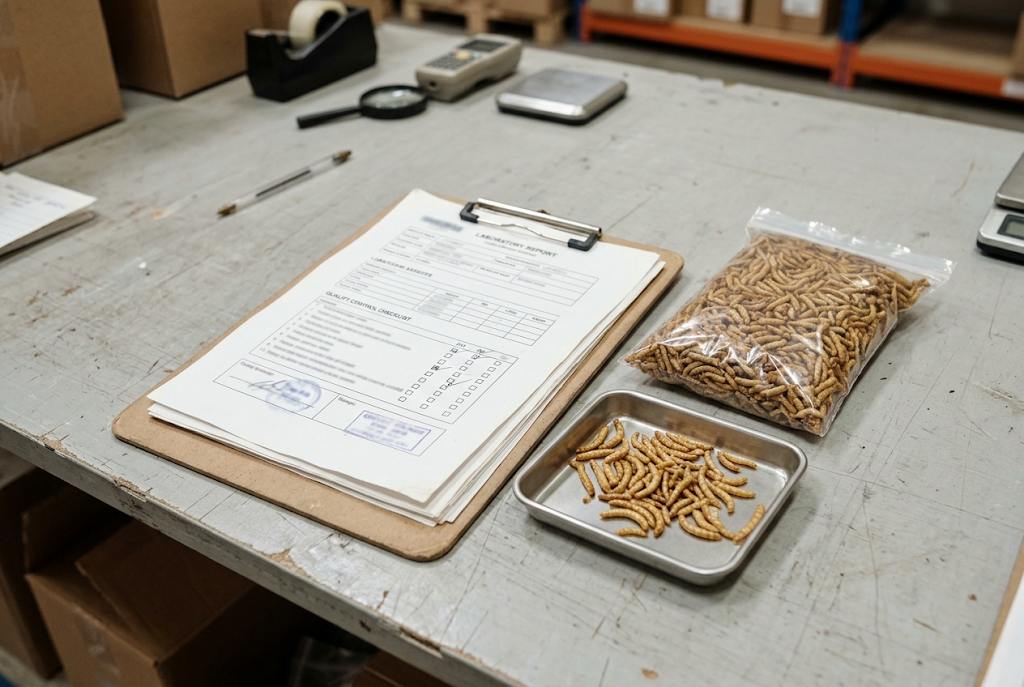
Example: Reviewing a Hypothetical Dried Mealworm Report
Consider a buyer evaluating a whole dried mealworm shipment with the following illustrative information:
| Report Item | Hypothetical Finding | Buyer Interpretation |
|---|---|---|
| Product | Whole dried mealworms | Product form matches |
| Batch identification | Lot number provided | Check against offered shipment |
| Crude protein | 55% as received | Verify method, factor, and agreed minimum |
| Moisture | 8% | Compare with agreed moisture limit |
| Salmonella | Not detected in 25 g | Confirm method, sampling, and required criterion |
| Heavy metals | Not included | Determine whether additional testing is required |
These figures are hypothetical and are not BulkInsects product specifications, current laboratory results, or guaranteed acceptance values.
The report may be suitable for an initial review, but shipment approval still depends on the buyer’s complete specification, applicable regulatory requirements, and the relevance of the tested sample to the commercial lot.
5. What Should Buyers Request Before Placing an Order?
A well-prepared purchasing inquiry can reduce repeated requests for laboratory documents and unnecessary sample exchanges. Before asking for a quotation, buyers should identify the required insect species, whole dried product form, estimated quantity, intended application, destination, and relevant quality specifications.
The buyer should also indicate whether existing reference reports are acceptable for initial evaluation or whether batch-specific testing is required before shipment. If new testing is needed, the parties should agree on the test panel, laboratory requirements, sampling responsibilities, timing, costs, and document delivery schedule.
Pre-Order Laboratory Report Checklist
| Buyer Requirement | Confirm Before Quotation |
|---|---|
| Product identity | Species and whole dried form |
| Commercial scope | Quantity, packaging, and destination |
| Intended application | Relevant animal feed or pet food use |
| Test panel | Required nutritional, microbial, and chemical parameters |
| Acceptance criteria | Applicable legal and contractual limits |
| Laboratory | Required competence or accreditation scope |
| Sampling | Representative sample and lot identification |
| Report type | Reference report or batch-specific COA |
| Testing schedule | Before production, shipment, or another agreed stage |
| Nonconformance procedure | Clarification, retesting, hold, or rejection process |
Buyers should avoid requesting every possible laboratory test without considering its relevance. A risk-based testing plan is generally more useful than an extensive but poorly defined list of parameters.
For commercial whole dried insect sourcing, the objective is to establish a clear connection between the offered product, the tested material, the agreed specification, and the final purchasing decision.
Evidence & Verification: What Makes a Laboratory Report Credible?
The international standard ISO/IEC 17025 provides a framework for evaluating laboratory competence and the reliability of testing operations. Buyers can use accreditation information, including the relevant scope, to assess whether a laboratory has been independently evaluated for the testing activities in question.
The US Food and Drug Administration also explains that animal food may be affected by biological, chemical, and physical contaminants. Its guidance on hazard analysis and preventive controls supports evaluating relevant hazards rather than relying on a single generic testing panel.
For reports containing conformity statements, the International Laboratory Accreditation Cooperation provides guidance on decision rules and the treatment of measurement uncertainty. These considerations are especially relevant when results approach specification limits.
Together, these references support a practical principle: laboratory results should be traceable, technically interpretable, and evaluated against requirements appropriate to the product and intended use.
They do not establish a universal set of acceptance values for every whole dried insect species or destination market.
Buyer FAQs
What is the difference between a dried insect lab test report and a COA?
A laboratory test report presents analytical findings for a tested sample. A Certificate of Analysis generally summarizes specified results associated with an identified product or batch. The documents may overlap, but buyers should verify the underlying testing evidence, sample traceability, and relationship to the offered lot.
Can buyers accept a dried insect lab test report from an earlier batch?
An earlier report may support preliminary supplier or product evaluation, but it does not automatically demonstrate that a new batch meets the same requirements. Batch-specific testing may be necessary depending on the risk assessment, applicable rules, and purchasing agreement.
Does an ISO/IEC 17025-accredited laboratory report guarantee product compliance?
No. Laboratory accreditation supports confidence in the laboratory’s competence for activities within its accredited scope. Product compliance must still be evaluated against the applicable requirements, and laboratory accreditation does not replace import authorization or product approval.
What should buyers do if a laboratory report shows a borderline result?
They should confirm the test method, reporting basis, measurement uncertainty where relevant, and applicable decision rule. Depending on the circumstances, clarification, investigation, or additional testing may be needed before a conformity decision can be made.
Which test results are most important for whole dried insect purchasing?
The most important parameters depend on the product and intended application. Buyers commonly evaluate nutritional composition, moisture, microbiological hazards, and relevant chemical contaminants, but the final testing panel should be based on documented risks and purchasing requirements.
Key Takeaways: Review Evidence Before Approving a Shipment
A dried insect lab test report is useful only when buyers can connect the results to the correct product, sample, and commercial lot. Product identification, batch traceability, laboratory methods, reporting units, and acceptance criteria should be reviewed before drawing conclusions from individual test values.
Buyers should distinguish preliminary reference reports from batch-specific evidence and avoid treating laboratory accreditation, a single passing result, or a generic COA as universal proof of product compliance. A documented review process helps identify missing information before shipment and reduces avoidable procurement disputes.
BulkInsects supports international B2B buyers with whole dried insect sourcing, specification reviews, sample coordination, and batch documentation. Contact our team to discuss the testing information required for your purchasing evaluation.