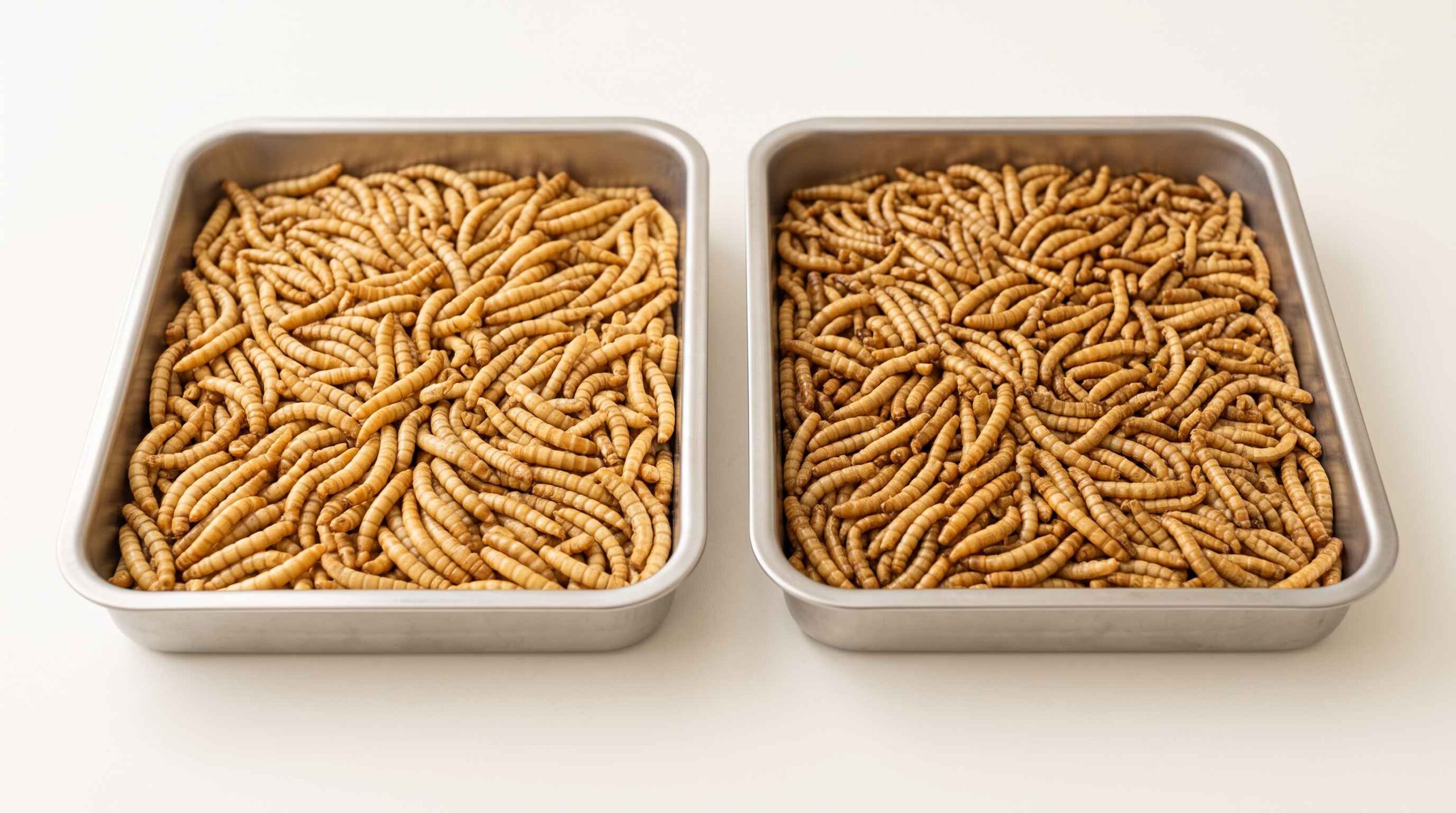

The difference between microwave dried mealworms and hot-air-dried mealworms is not simply that one method is “better.” Each process transfers heat and removes moisture differently, and the final commercial result also depends on pretreatment, equipment settings, loading depth, drying endpoint, cooling, sorting, packaging, and storage.
For a B2B buyer, the useful question is therefore not which method sounds more advanced. It is which finished-product characteristics best match the intended application. A retail repacker may prioritise a bright, recognisable whole product. A distributor may focus on repeatable batches and flexible packaging. A farm or feed-related buyer may accept a broader visual range while giving greater weight to delivered cost, moisture control and documentation.
This guide compares the two processing routes from a purchasing perspective. It explains the differences buyers may observe, the claims that still require verification, and the information that should be included in a sample request or RFQ.
Key Takeaways
- Microwave and hot-air drying can both produce commercially usable whole dried mealworms.
- Microwave drying often uses shorter, more intensive heating, while hot-air drying relies on heated airflow over a longer period.
- Colour, texture and intactness may differ, but the processing label alone does not prove a particular grade.
- Moisture, microbiological results and nutritional composition should be confirmed with batch-specific information rather than inferred from appearance.
- Buyers should compare representative samples under the same conditions and define measurable acceptance criteria before ordering.
1. How the Two Drying Methods Work
Microwave processing generates heat through interaction between electromagnetic energy and polar molecules in the product. Energy can be produced within the material rather than being transferred only from the surface inward. In commercial practice, the outcome depends on equipment design, power, exposure time, batch depth, movement, and how evenly the load passes through the heating field.
Hot-air drying transfers heat from moving heated air to the surface of the mealworms. Moisture then moves from inside the larvae toward the surface and into the surrounding air. Air temperature, velocity, humidity, loading density and residence time all influence the drying curve.
These descriptions explain the mechanisms, but they do not define a universal result. Poorly controlled microwave treatment can create hot spots or uneven colour. Poorly controlled hot-air drying can create extended heat exposure or uneven drying across a dense load. Well-managed systems can reduce these problems through validated settings, controlled loading, intermediate checks, and final sorting.
That is why buyers should evaluate the offered product—not approve or reject it from the name of the drying method alone.
2. Microwave Dried Mealworms: Typical Commercial Characteristics
Buyers often consider microwave dried mealworms when they want an attractive whole-product presentation with a dry, crisp structure. The shorter processing cycle commonly associated with microwave systems may help limit prolonged exposure to heated air, although the actual result varies with the line and operating conditions.
Commercial observations may include:
- a lighter golden-yellow to golden-brown appearance;
- a visibly dry and relatively crisp surface;
- recognisable body segmentation;
- good whole-product presentation after suitable handling and sorting;
- possible local darkening when energy distribution is uneven;
- breakage if the product becomes very brittle or is handled roughly after drying.
These are tendencies rather than guaranteed specifications. A buyer should not assume that every microwave-processed lot will be lighter, more intact, or lower in moisture than every hot-air-dried lot. Raw-larvae condition, pretreatment, and downstream handling can change the comparison.
For BulkInsects, microwave drying is the main processing option presented for bulk dried mealworms. The available grade and batch details should still be confirmed for each commercial enquiry.
3. Hot-Air-Dried Mealworms: Typical Commercial Characteristics
Hot-air drying is a conventional and widely understood thermal process. It can be applied in tray, cabinet, tunnel, belt, or other airflow-based systems. The process can be scaled and adjusted for different batch sizes, but its longer exposure time may produce a somewhat different appearance or texture from microwave processing.
Depending on the temperature-time profile, buyers may observe:
- a golden-brown to deeper brown colour range;
- a firm, dry texture;
- natural variation between pieces or areas of the load;
- more visible shrinkage under some processing conditions;
- a commercially acceptable whole product when loading and handling are controlled;
- different cost or availability characteristics depending on production setup.
A deeper colour is not automatic evidence of poor quality. It may reflect the selected thermal profile, pretreatment or natural raw-material variation. Equally, a lighter colour does not prove better microbiological status or lower moisture. The offered lot must be assessed against the buyer’s specification and intended use.
4. Colour and Visual Presentation
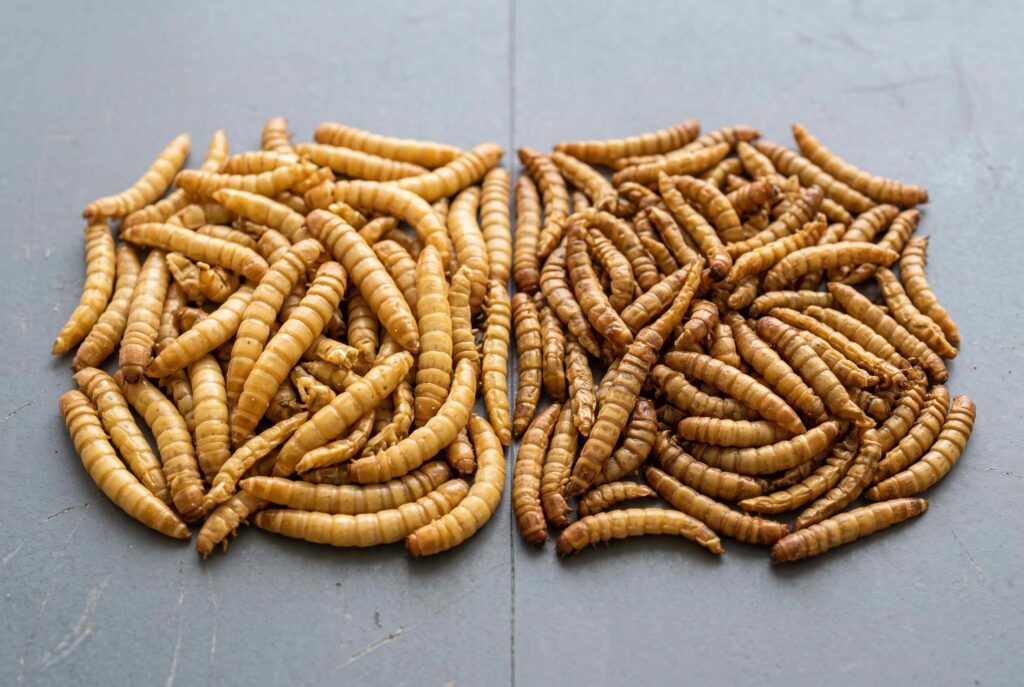
Colour is usually the first difference a buyer notices, especially when comparing product photographs. It is also one of the easiest attributes to misjudge.
Microwave processing may produce a lighter-looking product under some conditions, while longer hot-air exposure may lead to a deeper golden-brown appearance. However, final colour can also be influenced by larvae maturity, feed substrate, blanching or other pretreatment, surface moisture, processing intensity and storage.
Compare samples under neutral, repeatable lighting and on the same background. Do not compare one supplier’s professionally edited image with another supplier’s warehouse photograph. If colour matters for retail presentation, retain an approved reference image or sealed sample and define an acceptable range rather than using vague terms such as “premium gold.”
The commercial decision should be application-led:
- Clear retail packaging: a more uniform, lighter whole product may be preferred.
- Opaque repacking or ingredient use: modest colour variation may have less commercial impact.
- Repeat distribution orders: consistency within the agreed range may matter more than achieving the lightest possible shade.
5. Texture, Crispness and Breakage
Drying changes the structure of the larvae, but transport and handling determine how much of that structure reaches the buyer intact. Microwave-dried product may feel crisp and relatively open in structure. Hot-air-dried product may feel firm or denser, depending on the process. Neither description is an acceptance criterion by itself.
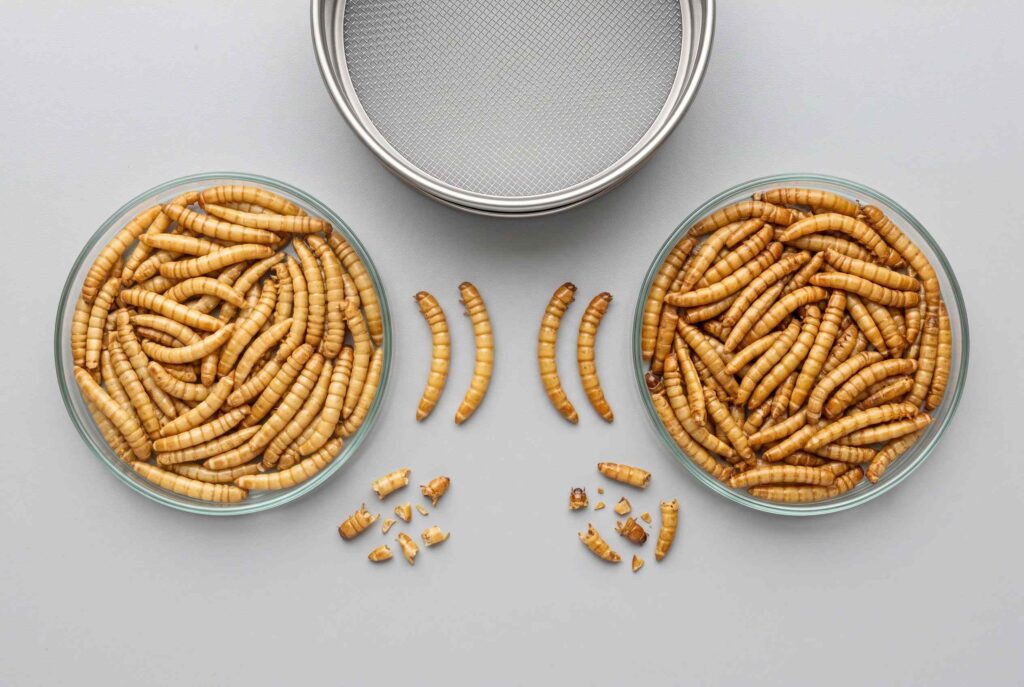
Very crisp mealworms can look attractive but may break during filling, compression, pallet movement and repacking. A firmer product may resist some handling but can still be damaged by excessive load or unsuitable packaging. Buyers should examine:
- proportion of recognisable whole larvae;
- broken pieces and fragments;
- fine particles or dust at the bottom of the pack;
- visible shrinkage or flattening;
- product condition after normal transport, not only immediately after production.
Use the same sampling and separation method when comparing two options. Our guide to dried mealworm quality provides a practical framework for recording whole product, fragments and fines.
6. Drying Speed Does Not Replace Moisture Verification
A shorter drying cycle can be operationally attractive, but cycle time alone does not show whether the commercial lot reached a suitable and uniform endpoint. Surface feel, colour, and crispness also cannot establish the measured moisture level.
For both microwave dried mealworms and hot-air-dried mealworms, buyers should review:
- the batch-specific moisture result;
- the unit and test method;
- the agreed specification limit;
- the sampling basis;
- packaging and storage conditions after processing;
- any difference between the tested sample and shipped batch.
Where relevant, buyers may also discuss water activity. Moisture content measures the quantity of water under a defined method, while water activity concerns the availability of water for reactions and microbial growth. The two measurements are related but not interchangeable.
The separate guide to dried insect moisture explains how sampling, methods, and packaging affect interpretation. Avoid choosing a process solely because one sample feels crisper in the hand.
7. Heat Treatment and Microbiological Control
Both drying methods apply heat, but “heat-treated” is not the same as “sterile,” and a drying-method label is not a substitute for batch testing. Microbiological outcomes depend on pretreatment, starting load, temperature-time history, equipment performance, post-process handling, packaging, and storage.
Published research on mealworm processing shows that thermal treatment and drying can materially affect microbial counts, while also showing that process combinations and organisms respond differently. One peer-reviewed study comparing processing routes for Tenebrio molitor powders found that heat treatments reduced vegetative cells but did not necessarily eliminate bacterial endospores. Buyers can review the study, Quality of Tenebrio molitor Powders: Effects of Four Processes, as technical background rather than as a specification for whole commercial mealworms.
For an order, rely on the agreed microbiological parameters, batch-specific results, and the requirements applicable to the destination and application. Ask how the product is cooled, transferred, and packed after drying because post-process contamination can undermine an otherwise controlled thermal step.
8. Nutritional Results Cannot Be Predicted From the Method Name
Buyers sometimes expect microwave drying to “preserve more nutrition” or hot-air drying to “reduce protein.” Such statements are too broad for purchasing decisions. Reported composition can be influenced by the larvae themselves, feed substrate, defatting status, analytical method, and the moisture basis used for reporting.
Heating can also affect functional properties and digestibility differently from simple crude-protein values. A higher crude-protein percentage on one report does not automatically mean that its drying method is nutritionally superior. Results reported on an as-is basis also cannot be compared directly with dry-matter values without conversion.
When nutritional composition is important, compare batch documents that use understood methods and the same reporting basis. Treat general processing claims as context, not proof.
9. Energy, Capacity and Commercial Cost
Microwave systems are often associated with faster processing, but commercial cost cannot be inferred from drying time alone. Equipment investment, electricity use, throughput, loading efficiency, labour, maintenance, yield, sorting loss and local energy prices all affect the final quotation.
Hot-air systems may have longer residence times but can offer established operating routines and substantial capacity. Microwave systems may offer rapid heating and a product appearance valued by some buyers, but they also require controlled energy distribution and suitable equipment.
From the buyer’s perspective, the relevant comparison is delivered commercial value:
| Purchasing factor | Microwave drying | Hot-air drying | Buyer verification |
|---|---|---|---|
| Processing profile | Often shorter and more intensive | Usually longer heated-air exposure | Ask for the offered process and batch basis |
| Colour | May be lighter under controlled conditions | May be deeper golden-brown | Compare representative samples under equal lighting |
| Texture | Often crisp | Often firm and dry | Assess handling and intended application |
| Breakage | Can rise if very brittle or poorly handled | Can rise with shrinkage, compression or handling | Measure whole product, fragments and fines |
| Moisture | Cannot be assumed from the method | Cannot be assumed from the method | Review batch-specific result and method |
| Microbiology | Depends on the complete process | Depends on the complete process | Review agreed batch tests |
| Cost | Depends on equipment, energy and throughput | Depends on time, airflow, energy and scale | Compare equivalent grades and delivered terms |
Do not compare quotations until grade, test scope, packaging, quantity and trade terms are aligned.
10. Which Method Fits Different Buyer Needs?
There is no single answer for every customer. Use the intended application to set priorities.
Retail repackers and resellers
Whole-product appearance, colour consistency, intactness and low fines may be especially important. Microwave dried mealworms can be a strong option when the offered sample meets these presentation needs, but packaging and transport trials remain necessary.
Distributors and wholesalers
Batch consistency, documentation, packaging choices and repeat supply may matter more than small visual differences. Evaluate whether the supplier can reproduce the approved commercial grade.
Farms and commercial animal operations
Buyers may accept a broader visual range if product identity, cleanliness, moisture, testing, packaging and delivered cost meet their requirements. The intended animals and local rules still need to be considered.
Pet-product brands
The best option depends on whether mealworms remain visible in the finished product. A transparent whole-insect product creates different presentation requirements from a blend or opaque pack.
11. How to Compare Samples Fairly
Request identified samples of the grades actually being quoted. A comparison is weak if one sample is taken from a current batch and another is a hand-selected showroom sample.
Use this process:
- Define application, target grade, and mandatory requirements.
- Request microwave- and hot-air-dried samples in equivalent commercial grades.
- Record sample identification, processing description and date received.
- Inspect colour under the same neutral lighting.
- Separate and record whole larvae, broken pieces, fragments and fines.
- Note texture, flow, cleanliness and characteristic or abnormal odour.
- Compare moisture and other agreed batch documents on the same basis.
- Review packaging and likely transport stress.
- Select the option that best matches the application—not the one with the most attractive single photograph.
A sample is a decision aid, not a guarantee for every future batch. Establish tolerances and continue to verify commercial shipments.
12. What to Include in the RFQ
An RFQ for processed mealworms should make the comparison commercially meaningful. Include:
- product: whole dried Tenebrio molitor larvae;
- preferred process: microwave dried mealworms, hot-air dried, or open to recommendation;
- application and destination country;
- required quantity and delivery frequency;
- expectations for colour, size and whole-product proportion;
- acceptable fragments and fines;
- moisture and other testing requirements;
- packaging configuration and unit weight;
- sample requirement;
- trade terms and required shipment timing.
If a method is mandatory, explain why. Sometimes the buyer’s true requirement is a visual grade, moisture limit or packaging outcome rather than a particular machine. Allowing the supplier to quote a compliant alternative can reveal a better commercial fit.
Frequently Asked Questions
Are microwave dried mealworms always lighter in colour?
No. They may appear lighter under some controlled processing conditions, but colour also depends on raw larvae, pretreatment, power, exposure, loading, cooling and storage. Compare representative samples under identical lighting.
Are microwave dried mealworms better than hot-air-dried mealworms?
Not universally. Microwave processing may suit buyers prioritising a crisp, attractive whole product, while hot-air drying may meet other cost, capacity or availability needs. The correct choice depends on the agreed grade and application.
Which method produces fewer broken mealworms?
Neither method guarantees lower breakage. Drying intensity affects brittleness, while sorting, packaging, compression and transport affect delivered intactness. Buyers should measure whole product, fragments, and fines in representative samples.
Can buyers judge moisture from crispness?
No. Crispness can provide a physical observation, but it does not replace a moisture test. Review the batch result, method, unit, specification, and sampling basis.
Should an RFQ specify the drying method?
Specify it when the processing method is a firm commercial requirement. Otherwise, state the desired outcome—such as colour range, intactness, moisture, testing and packaging—and ask which available method best meets it.
Final Decision: Compare the Finished Product and the Batch
The practical difference between microwave dried mealworms and hot-air-dried mealworms is found in the finished commercial grade, not in a simple good-versus-bad ranking. Processing can influence colour, structure and texture, but raw material, process control, sorting, testing, packaging and transport all shape the product the buyer receives.
Choose by application. Compare identified samples, use repeatable inspection methods and confirm the measurable requirements in the RFQ. Most importantly, verify moisture, microbiological, and other required parameters with information linked to the offered batch.
To discuss a processing option or request a representative sample, contact BulkInsects with your required quantity, destination, application, preferred appearance, packaging, and testing requirements.