Dried insect microbiological testing helps B2B buyers evaluate microbial hazards and hygiene indicators in whole dried insect products before commercial acceptance. A risk-based testing plan may include Salmonella, Enterobacteriaceae, Escherichia coli, total viable count, and yeasts and molds. Buyers should verify the analytical method, sampling plan, reporting units, detection limits, batch identification, and applicable acceptance criteria. A satisfactory test result supports quality verification but does not guarantee that an entire shipment is free from microbial hazards. Requirements must reflect the insect species, intended animal use, destination market, and agreed purchasing specifications.
1. Which Microbiological Tests Matter for Whole Dried Insects?
Microbiological testing is an important part of quality verification for whole dried insects supplied to commercial feed and pet food businesses. Although drying reduces moisture and can limit microbial growth under suitable storage conditions, it does not automatically eliminate pathogens or prevent contamination during handling, packaging, transportation, or storage.
Buyers sourcing dried mealworms, black soldier fly larvae, crickets, grasshoppers, earthworms, or maggots should distinguish between pathogen testing and hygiene indicator testing. Pathogen testing investigates microorganisms that may cause illness, while indicator tests help evaluate general microbial conditions or possible weaknesses in hygiene controls. These categories serve different purposes and should not be interpreted as interchangeable evidence.
Key Microbiological Parameters
| Parameter | What It Indicates | Buyer Consideration |
|---|---|---|
| Salmonella spp. | Potential pathogen contamination | Confirm detection method, sample size, and applicable absence criteria |
| Enterobacteriaceae | General hygiene and possible process contamination | Review quantitative results and agreed limits |
| Escherichia coli | Potential fecal contamination or hygiene concerns | Distinguish generic E. coli from pathogenic strains |
| Total Viable Count (TVC) | General viable microbial population under defined test conditions | Compare only results obtained using comparable methods |
| Yeasts & Molds | Fungal and yeast populations | Assess storage, moisture control, and agreed specifications |
| Listeria monocytogenes | Potential pathogen hazard in relevant applications | Include when justified by the product and risk assessment |
Not every parameter is required for every product or market. The testing panel should be selected according to the intended use, applicable regulations, identified hazards, and buyer-supplier agreement.
For example, Salmonella may be a priority pathogen because contaminated animal food can expose both animals and people. Enterobacteriaceae and total viable count, by contrast, are often used to assess hygiene conditions or process consistency. A low indicator count cannot independently establish that Salmonella is absent.
2. How Should Buyers Interpret Microbiological Test Results?
A microbiological report should be evaluated using the complete analytical context, not just a result labeled “Pass” or “Not Detected.” Buyers need to understand which microorganism was tested, which method was used, how much material was examined, and how the result compares with the agreed acceptance criteria.
Understanding CFU/g and Detection Results
Quantitative microbiological tests commonly report results as colony-forming units per gram (CFU/g). These values estimate viable microorganisms capable of forming colonies under the specified laboratory conditions.
For example, a total viable count result of 2,000 CFU/g indicates a measured count under the laboratory’s defined procedure. It does not establish whether the shipment passes or fails without an applicable acceptance limit and an appropriate sampling plan.
Pathogen detection tests may use a different reporting format, such as “Not Detected in 25 g.” This means the target organism was not detected in the tested portion using the stated method. It should not be interpreted as proof that every unit in the commercial shipment is free from that organism.
Why Sampling Matters
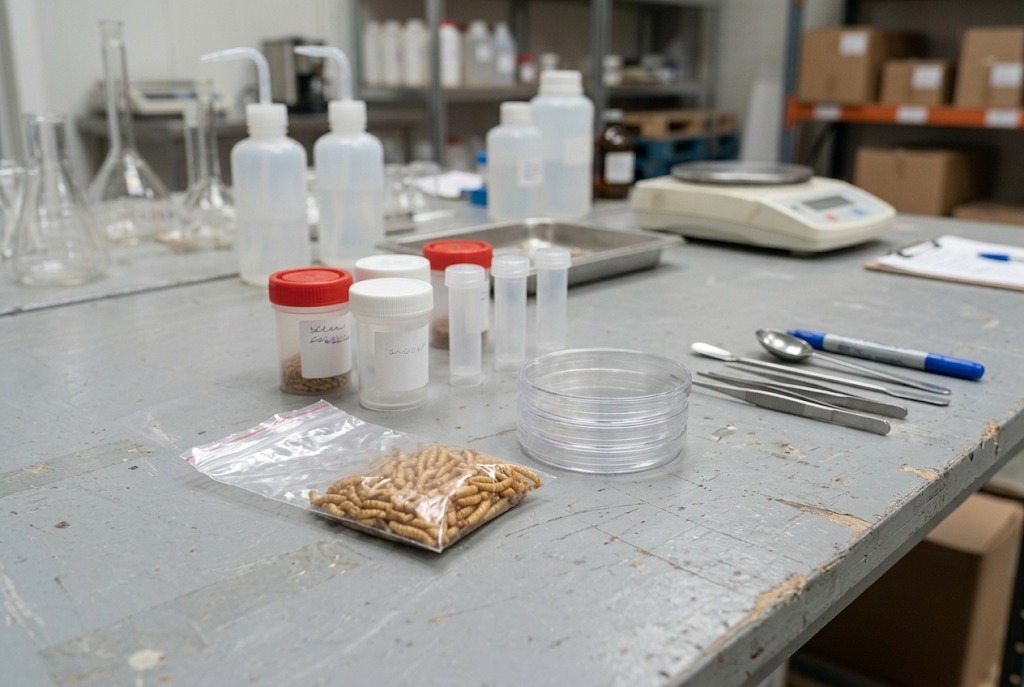
Microorganisms may not be distributed evenly throughout a commercial lot. A small sample collected from one carton may not adequately represent material distributed across multiple cartons or pallets.
Buyers should agree on the number of sample units, sample collection procedure, laboratory sample preparation, and criteria for accepting or rejecting a lot. Sampling tools and containers should be appropriate for microbiological testing to avoid introducing contamination during collection.
Where microbiological results are critical to shipment acceptance, the buyer and supplier should also agree on how inconclusive results, laboratory deviations, or suspected contamination will be handled.
Interpreting “Not Detected” Correctly
A negative pathogen result is useful evidence, but its meaning depends on the method’s performance and the sampling design. Detection limits, sample size, and test conditions affect what can reasonably be concluded.
Buyers should therefore avoid describing a shipment as “guaranteed pathogen-free” solely because one laboratory sample returned a negative result. A more accurate statement is that the specified organism was not detected in the tested sample under the reported analytical conditions.
3. How Are Microbiological Acceptance Criteria Established?
Microbiological acceptance criteria should be defined before commercial shipment. They may arise from destination-market regulations, product-specific requirements, customer specifications, or documented risk assessments.
For whole dried insects, a buyer should first establish the product’s intended use and regulatory status. A dried insect product intended for bird food distribution may have different commercial requirements from material intended for another feed application. The fact that two products are both dried insects does not mean they are subject to identical microbiological specifications.
Buyers should separate mandatory regulatory criteria from additional contractual requirements. Where a legally applicable limit exists, it must be respected. Where a parameter is not governed by a product-specific numerical limit, the buyer and supplier may agree on a scientifically justified commercial specification.
Microbiological Acceptance Framework
| Requirement | What Buyers Should Define | Verification Evidence |
|---|---|---|
| Target organism | Exact microorganism or indicator group | Laboratory test scope |
| Acceptance limit | Applicable legal or agreed contractual criterion | Product specification |
| Analytical method | Recognized or validated method appropriate to the matrix | COA or laboratory report |
| Reporting unit | CFU/g, MPN/g, or detection in a specified sample mass | Laboratory result |
| Sampling plan | Number of samples, collection method, and lot definition | Sampling record |
| Testing frequency | Per batch or another risk-based schedule | Quality agreement |
| Nonconformance procedure | Hold, investigation, disposition, and corrective action | Purchase agreement |
A universal numerical limit should not be assigned to every whole dried insect species without supporting evidence. Buyers should be cautious when suppliers present generic microbial specifications without identifying the product, test method, intended use, or applicable standard.
For broader guidance on setting measurable quality requirements, buyers can review dried insect acceptance criteria before finalizing microbiological specifications.
4. What Should Buyers Verify on a Microbiological COA?
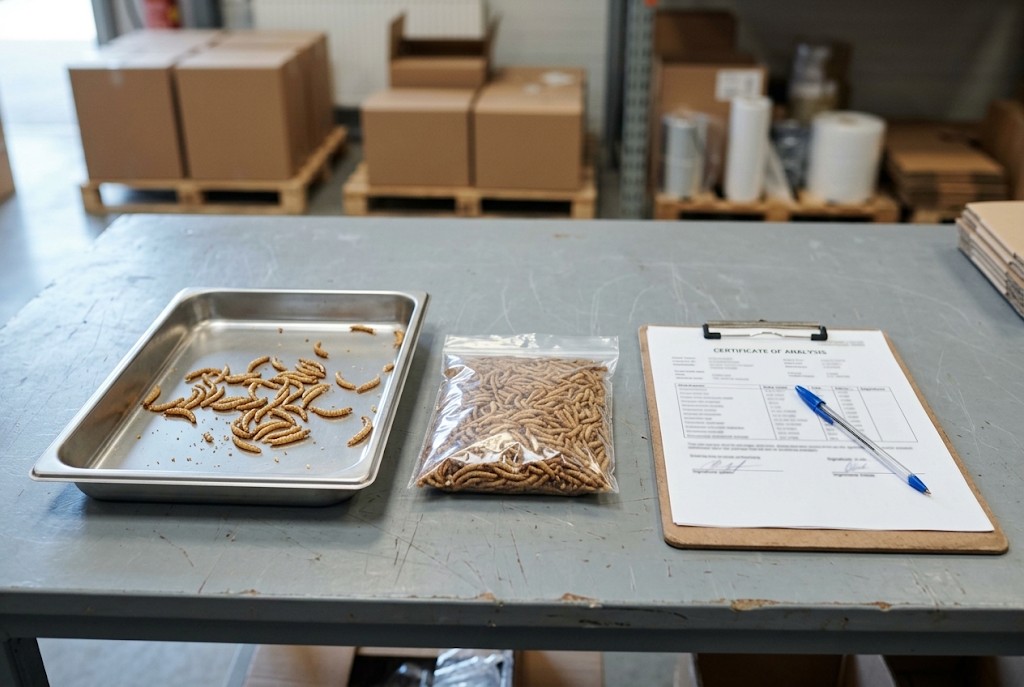
A Certificate of Analysis (COA) can support supplier evaluation and batch acceptance, provided it identifies the tested material and reports the relevant analytical information.
For dried insect microbiological testing, the report should clearly identify the product, sample or batch number, test parameters, analytical methods, results, units, and testing date. Buyers should also verify the laboratory identity and determine whether the methods are suitable for the tested product.
A report showing Salmonella as “Not Detected” should ideally identify the test portion and analytical method. Similarly, a quantitative Enterobacteriaceae result should specify its reporting unit and method so that the buyer can compare it with the agreed specification.
Buyer COA Verification Checklist
| Checkpoint | Question Before Approval |
|---|---|
| Product identity | Does the report identify the correct whole dried insect product? |
| Batch reference | Can the tested sample be linked to the commercial lot? |
| Test parameters | Are all agreed microorganisms included? |
| Analytical methods | Are the methods identified and appropriate? |
| Reporting units | Are CFU/g, MPN/g, or detection units clearly stated? |
| Detection limits | Are relevant method limitations understood? |
| Sampling | Is the sampling plan appropriate for the acceptance decision? |
| Acceptance criteria | Are results evaluated against agreed limits? |
| Laboratory information | Is the laboratory identifiable and technically qualified? |
| Report date | Is the report relevant to the supplied batch? |
Third-party laboratory testing may provide additional independent evidence, particularly for initial supplier qualification or higher-risk purchasing decisions. However, a third-party report is only as useful as its sample identification, analytical scope, and relationship to the commercial lot.
A microbiological COA also does not replace other quality checks. Moisture, water activity, physical integrity, chemical contaminants, packaging, and storage conditions may require separate evaluation.
5. What Should Buyers Confirm Before Ordering?
Before requesting a commercial quotation, buyers should establish which microbiological requirements apply to the intended product and destination. This begins with identifying the insect species, product form, drying method, intended animal use, and import market.
The buyer should then communicate the required testing panel, applicable acceptance limits, preferred analytical methods, and documentation expectations. If batch-specific testing is required, both parties should agree on sampling responsibilities, testing timing, and the procedure for resolving nonconforming results.
Processing information also matters. Microwave drying, hot-air drying, freeze drying, and sun drying are not microbiologically equivalent processes. Their effects depend on the actual operating conditions, and none should automatically be described as guaranteeing pathogen elimination.
Storage and packaging requirements should be reviewed alongside laboratory results. Even when a tested sample meets the agreed microbiological criteria, poor packaging integrity, moisture exposure, or unsuitable handling may compromise product condition before delivery.
For commercial procurement, buyers should request enough information to evaluate both the tested product and the supplier’s ability to coordinate appropriate batch verification. The objective is to establish a practical and documented acceptance process rather than rely on general claims such as “high quality” or “microbiologically safe.”
Evidence & Verification: Which Standards and Sources Matter?
Reliable microbiological testing depends on appropriate laboratory methods, representative sampling, and clearly defined acceptance criteria.
ISO 6579-1:2017 provides a horizontal method for the detection of Salmonella in products intended for human consumption and animal feeding, among other sample categories. It illustrates why laboratory method identification matters when reviewing pathogen results.
The US Food and Drug Administration identifies biological contaminants, including Salmonella, Listeria monocytogenes, and pathogenic E. coli, as relevant hazards in animal food. Its guidance also explains that contamination can originate from ingredients, processing environments, or inadequate process controls.
In the European Union, Regulation (EC) No 183/2005 establishes a feed hygiene framework addressing responsibilities such as hygiene controls, traceability, and quality management for relevant feed business operators.
These sources support a risk-based approach, but they should not be interpreted as providing one universal microbiological acceptance table for all whole dried insects.
The actual requirements depend on the insect species, intended use, product category, destination market, and applicable legislation. Laboratory evidence should be evaluated together with the relevant commercial specification and regulatory requirements.
Buyer FAQs
What is included in dried insect microbiological testing?
A risk-based testing panel may include Salmonella, Enterobacteriaceae, E. coli, total viable count, yeasts and molds, or other relevant organisms. The appropriate panel depends on the product, intended application, and applicable requirements.
Does “Salmonella Not Detected” mean the shipment is completely safe?
No. It means Salmonella was not detected in the tested portion under the specified analytical conditions. It does not guarantee that every part of the shipment is free from contamination or that all other safety requirements have been met.
What does CFU/g mean on a dried insect COA?
CFU/g means colony-forming units per gram. It is a common unit for reporting viable microbial counts under defined laboratory conditions. Whether a result is acceptable depends on the applicable specification and testing method.
Are microbiological limits the same for every dried insect species?
No. Requirements may differ according to species, intended use, product classification, destination market, and contractual specifications. Buyers should not apply an arbitrary universal threshold to all whole dried insect products.
Is microbiological testing required for every commercial shipment?
Testing frequency depends on applicable regulations, the product’s risk profile, the supplier’s quality system, and the purchasing agreement. Some buyers require batch-specific testing, while others use a documented risk-based verification schedule. A supplier should not promise universal compliance without reviewing the specific requirements.
Key Takeaways: Verify Microbiological Evidence Before Shipment
Dried insect microbiological testing helps B2B buyers evaluate pathogen risks, hygiene indicators, and batch-specific quality evidence. Reliable acceptance decisions require clearly defined test parameters, appropriate sampling, recognized analytical methods, and applicable acceptance criteria.
Buyers should distinguish pathogen detection from general microbial counts and avoid treating a negative laboratory result as an absolute guarantee of shipment safety. Testing evidence must be interpreted alongside product identity, traceability, processing conditions, and destination-market requirements.
BulkInsects supports international B2B buyers with whole dried insect sourcing, product specification reviews, sample coordination, and batch documentation. Contact our team to discuss available testing information and quality requirements before requesting a commercial quotation.