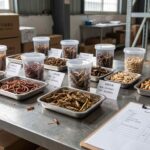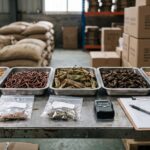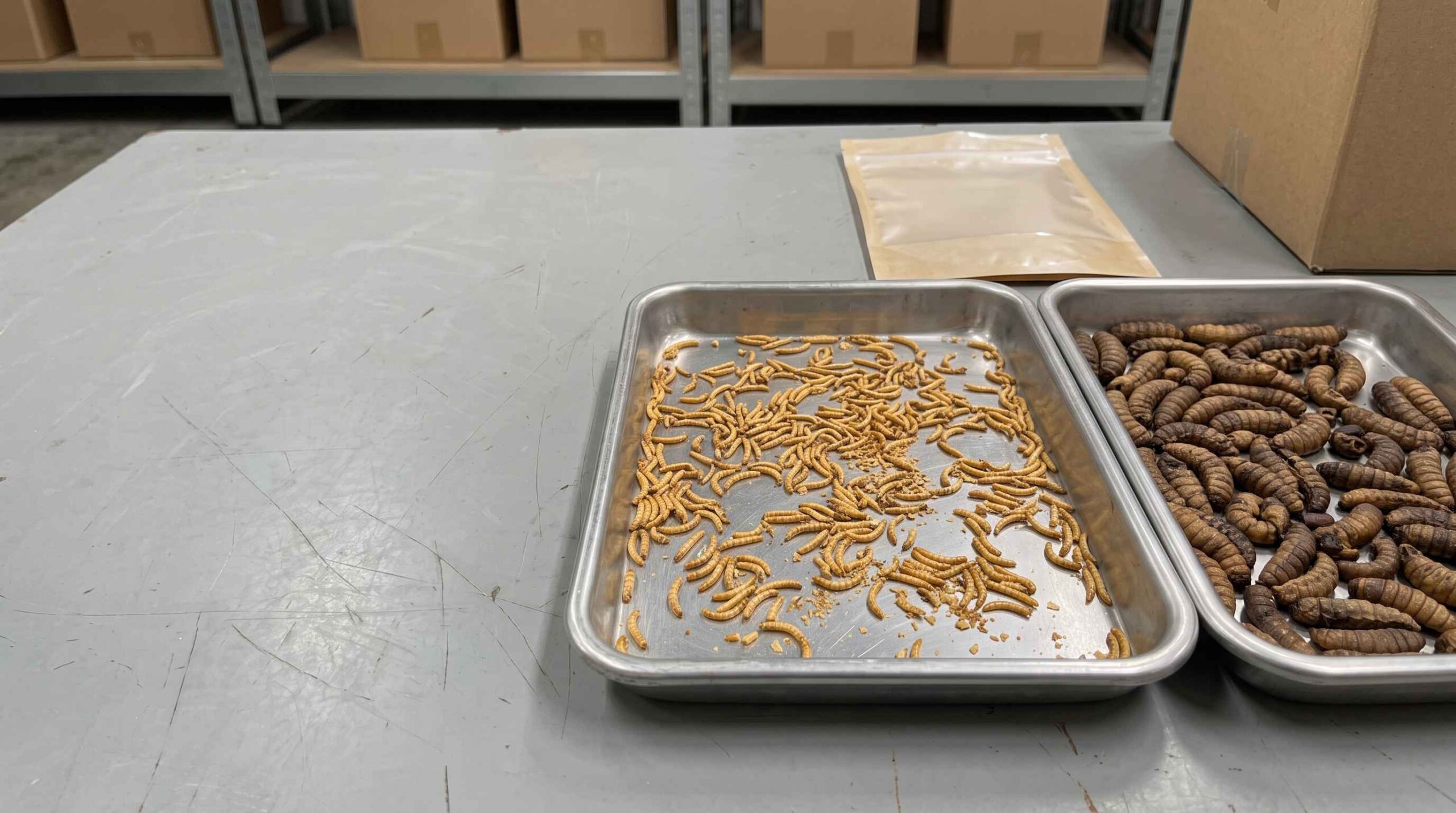

For feed formulators, ingredient researchers and commercial buyers, comparing mealworms protein content with black soldier fly larvae (BSFL) requires more than reviewing two crude protein percentages. Differences in insect species, developmental stage, feed substrate, moisture, processing and laboratory methods can affect the reported values and their relevance to a purchasing decision.
Whole dried mealworms and whole dried BSFL are both commercially available insect products, but their nutritional profiles are not identical. Crude protein is an important specification, yet it does not independently establish amino acid quality, digestibility, ingredient suitability or the overall value of a commercial shipment.
This guide explains how to interpret protein data for whole dried mealworms and BSFL, compare supplier documentation and establish technical purchasing requirements without relying on misleading universal protein claims.
1. Understanding Protein Content in Whole Dried Insects
Protein content is frequently used to describe the nutritional value of insect-based feed ingredients. For commercial buyers, however, the reported percentage is meaningful only when the analytical basis and product form are understood.
Whole dried insects contain protein alongside other components, including fat, minerals and structural materials. The relative proportions depend on the species and production conditions. As a result, two batches of the same insect species may have different reported protein values even when both meet their respective commercial specifications.
Buyers should also distinguish whole dried insects from insect meals, defatted materials and protein concentrates. Results reported for a processed or defatted ingredient cannot automatically be applied to a whole dried insect product because the composition and analytical basis may be different.
2. Mealworms vs. BSFL: What the Data Shows
Published research confirms that mealworms and BSFL can differ in crude protein concentration and broader nutritional composition. However, reported values vary across studies because researchers may examine different developmental stages, substrates, processing conditions and analytical methods.
For commercial evaluation, the most reliable comparison uses results obtained from the actual whole dried products being considered, ideally tested on the same moisture basis and using comparable laboratory methods.
A useful comparison should therefore include crude protein, moisture and other relevant nutritional parameters. Published data on insect nutrient composition can provide useful context, but buyers should distinguish whole dried products from insect meals or defatted ingredients and avoid treating literature values as shipment specifications.
| Comparison Factor | Whole Dried Mealworms | Whole Dried BSFL |
|---|---|---|
| Common commercial identity | Tenebrio molitor larvae | Hermetia illucens larvae |
| Crude protein | Batch- and method-dependent | Batch- and method-dependent |
| Fat content | Varies with production and processing | Varies with production and processing |
| Mineral and ash profile | Requires batch evaluation | Requires batch evaluation; mineral composition can be important |
| Structural nitrogen | Can influence crude protein interpretation | Can influence crude protein interpretation |
| Recommended comparison | Same analytical basis and method | Same analytical basis and method |
This comparison is deliberately based on measurable characteristics rather than unsupported fixed percentages. For a formulation decision, buyers should request actual laboratory results for both products and assess whether the nutritional differences are relevant to the target feed application.
3. As-Fed vs. Dry Matter Protein Content
One of the most common problems in comparing insect protein data is mixing as-fed and dry matter values. An as-fed result expresses protein as a percentage of the product in its current moisture condition, while a dry matter result expresses protein relative to the material remaining after moisture is excluded.
This distinction matters even for dried insects. Two products with different residual moisture levels can show different as-fed protein percentages despite having the same protein concentration on a dry matter basis.
The relationship can be expressed as:
\[ \text{Protein (DM \%)} = \frac{\text{Protein (as-fed \%)}}{100-\text{Moisture (\%)}}\times100 \]
For example, a hypothetical sample containing 52% crude protein and 8% moisture on an as-fed basis would contain approximately 56.5% crude protein on a dry matter basis. This is a mathematical illustration, not a claimed specification for mealworms or BSFL.
Buyers should therefore confirm whether each supplier’s protein value is reported as-fed or on a dry matter basis before comparing the results.
4. Crude Protein and Nitrogen Conversion Factors
Crude protein is commonly estimated from measured nitrogen rather than determined by directly measuring every protein molecule. Traditional calculations frequently use a nitrogen-to-protein conversion factor of 6.25, based on an assumed average nitrogen concentration in protein.
In insects, however, some nitrogen can originate from non-protein compounds, including components associated with the exoskeleton. Consequently, a conventional crude protein calculation may overestimate the amount of true protein under certain analytical conditions.
Research on nitrogen-to-protein conversion factors has proposed a factor of approximately 4.76 for the whole larvae of several insect species, including mealworms and BSFL. This does not mean that 4.76 should automatically replace 6.25 in every commercial specification. The appropriate interpretation depends on the analytical method, insect material, and reporting convention.
For B2B purchasing, the practical requirement is transparency. A supplier’s Certificate of Analysis should identify the protein test method and, where relevant, the nitrogen conversion factor used. Buyers should avoid comparing values calculated using different factors as though they were directly equivalent.
5. Why Protein Content Varies Between Batches
Biological raw materials naturally vary. Insect protein composition can be influenced by species, developmental stage, feeding conditions, substrate composition, production environment, and the point at which larvae are harvested.
Processing and sampling can introduce additional variation. Differences in residual moisture, sample preparation, laboratory method, and reporting basis can affect the results even when the underlying product is commercially similar.
For recurring purchasing programs, buyers should therefore establish an agreed specification and determine how compliance will be verified. A single sample result may support initial evaluation, but it should not be treated as proof that every future batch will have exactly the same nutritional composition.
6. Protein Quality Beyond Crude Protein
Crude protein percentage does not describe the complete nutritional value of an ingredient. Amino acid composition, digestibility, and suitability for the intended animal species can be important when evaluating insect products for feed formulation.
Mealworms and BSFL differ in their broader nutrient profiles, and these differences should be considered in the context of the finished feed. A higher crude protein value does not automatically make one insect product nutritionally superior for every application.
Where formulation performance is important, buyers may need amino acid analysis and other nutritional data in addition to crude protein. Such information should be interpreted by qualified formulation personnel using the requirements of the target animal species and the complete diet.
7. How Drying Methods Affect Protein Evaluation
Whole dried insects may be produced using microwave drying, hot-air drying, freeze-drying, or other appropriate drying methods. These processes can affect residual moisture, physical appearance, texture, and certain nutritional characteristics.
A change in moisture content can alter the protein percentage reported on an as-fed basis without necessarily indicating a corresponding increase in the absolute amount of protein present. Processing conditions may also influence protein functionality or the availability of certain nutrients, depending on the severity and nature of treatment.
Buyers should therefore evaluate the finished product rather than assuming that one drying method always delivers higher protein quality. Comparable laboratory testing, moisture information, and application-specific requirements provide a more reliable basis for purchasing decisions.
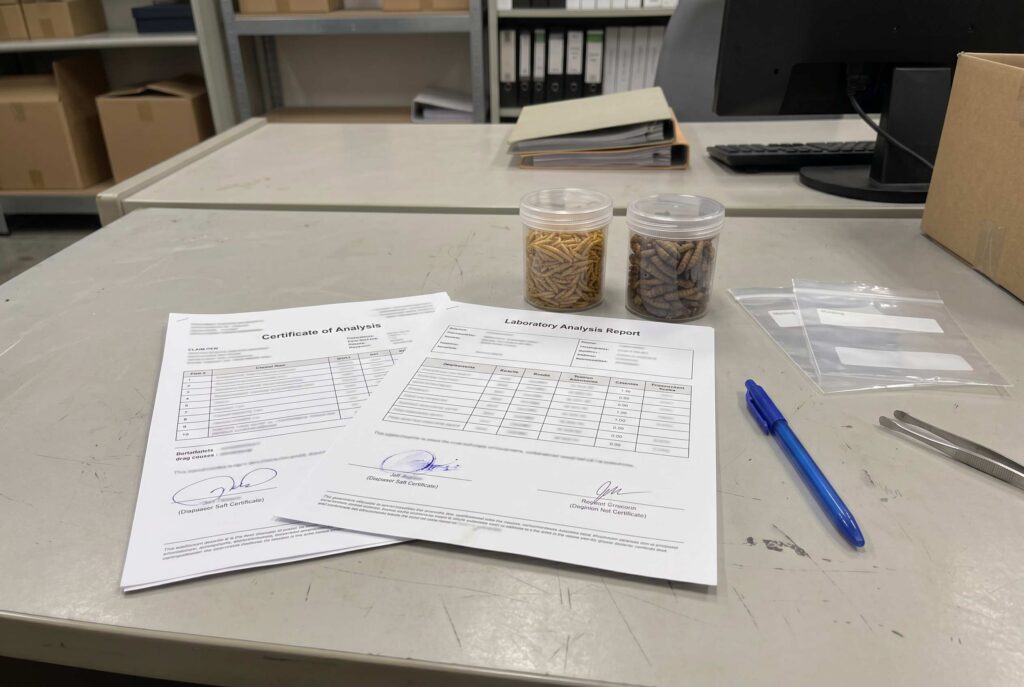
8. Reviewing COAs and Laboratory Reports
A Certificate of Analysis can help buyers verify whether a commercial batch meets agreed nutritional requirements. However, the usefulness of a COA depends on the information it contains and whether the reported results can be connected to the supplied product.
For protein comparison, buyers should review the sample or batch identification, crude protein result, moisture content, analytical method, reporting basis, and laboratory information. Where the specification requires additional nutritional parameters, these should be included in the agreed testing plan.
The document should also distinguish between a typical product specification and a result obtained from a particular batch. Buyers should not assume that a general product brochure represents laboratory testing of the exact shipment being purchased.
9. Comparing Commercial Samples
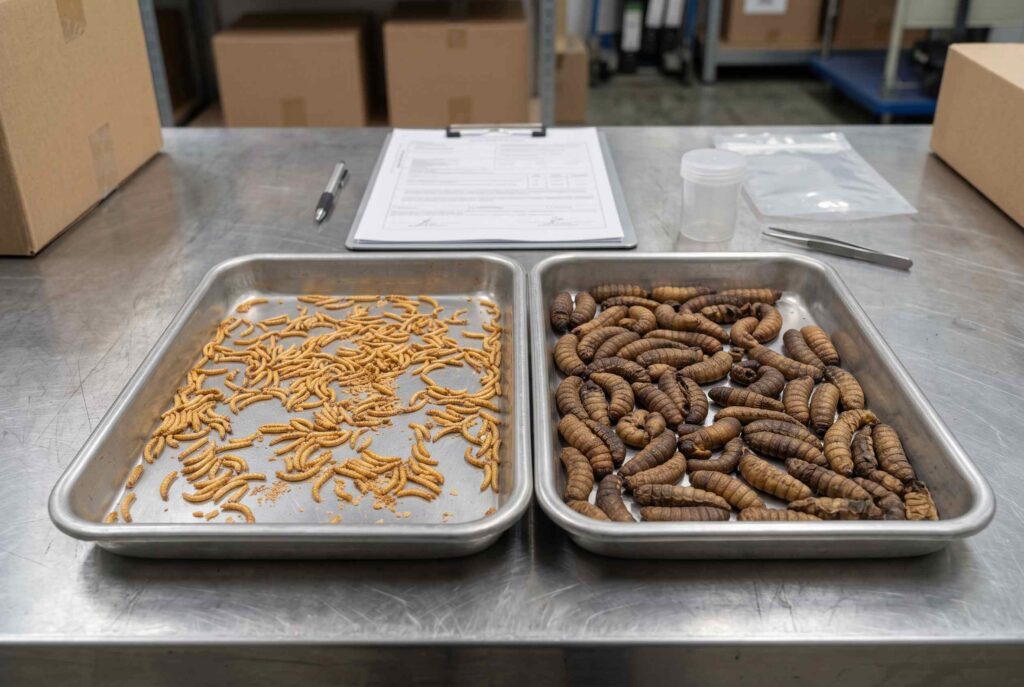
Representative samples provide a practical way to compare whole dried mealworms and BSFL before committing to commercial quantities. Samples should reflect the products that suppliers can actually deliver rather than specially selected material prepared only for presentation.
Where protein content is a critical purchasing parameter, both samples should ideally be tested under comparable conditions. Using the same laboratory, analytical method, and reporting basis can reduce uncertainty caused by differences in test procedures.
Physical product evaluation should remain part of the process. Moisture condition, cleanliness, whole-body integrity, packaging, and batch consistency can influence the suitability of the material even when two products have similar reported crude protein values.
10. Using Protein Data in Purchasing Decisions
Protein data should be connected to the buyer’s intended application and purchasing economics. A product with a higher crude protein percentage may also differ in fat content, ash, moisture, digestibility, packaging requirements, and price.
For buyers comparing commercial quotations, price per kilogram of product and price per kilogram of reported crude protein are not necessarily equivalent measures. The latter can provide an additional purchasing comparison when calculated using consistent data, but it does not replace an assessment of amino acid quality, digestibility, or overall formulation value.
The strongest supplier evaluation, therefore, combines nutritional data with product identity, batch consistency, documentation, packaging, lead time, and total landed cost.
11. Building a Technical RFQ
A technical RFQ should identify the required whole dried insect species, intended application, approximate quantity, and destination. It should also state which nutritional parameters are required and whether results must be reported on an as-fed or dry matter basis.
Where crude protein is commercially important, buyers should request the relevant analytical method and clarify the conversion factor or reporting convention. Requirements for moisture, fat, ash, amino acids, or other parameters can be added according to the intended application.
Commercial details should be included in the same request. Packaging, MOQ, sample availability, lead time, trade terms, and required batch documentation all affect whether a supplier can meet the purchasing program.
Frequently Asked Questions
What is the typical protein content of dried mealworms?
Reported crude protein values vary with product composition, moisture, production conditions, and analytical methods. Buyers should use comparable published data for initial research and obtain batch-specific test results before setting commercial specifications.
Do mealworms contain more protein than BSFL?
Not necessarily on every analytical basis or in every commercial batch. The comparison depends on moisture, developmental stage, production conditions, and testing methods. Buyers should compare actual results on the same basis.
Why can two laboratories report different protein values?
Differences may arise from sampling, analytical methods, nitrogen conversion factors, moisture basis, and normal measurement variation. Laboratory reports should be reviewed before interpreting the difference as a product-quality issue.
Is crude protein the same as true protein?
No. Crude protein is generally estimated from measured nitrogen using a conversion factor. Non-protein nitrogen can influence the result, which is particularly relevant when interpreting insect composition.
Does freeze-drying increase protein content?
Freeze-drying removes moisture and may change the reported as-fed protein concentration. It does not automatically create additional protein or establish superior nutritional quality.
What protein information should commercial buyers request?
Buyers should request crude protein results, moisture, reporting basis, analytical method, and relevant batch identification. Depending on the application, fat, ash, amino acid composition, and other nutritional information may also be necessary.
Final Buying Review
Evaluating mealworm protein content against BSFL requires a consistent analytical approach. Crude protein percentages should be interpreted alongside moisture, nitrogen conversion factors, batch variation, and other nutritional characteristics rather than treated as fixed values for an entire insect species.
For commercial sourcing, the most useful comparison connects laboratory results with the actual whole dried product, its intended application, and the supplier’s ability to deliver consistent batches. Representative samples, clear specifications, and traceable documentation provide a stronger foundation than generalized protein claims.
Buyers evaluating whole dried insect ingredients can review BulkInsects’ dried mealworms supply and whole dried BSFL supply, or contact BulkInsects with their target specifications, order quantity, destination, and testing requirements to discuss available commercial options.