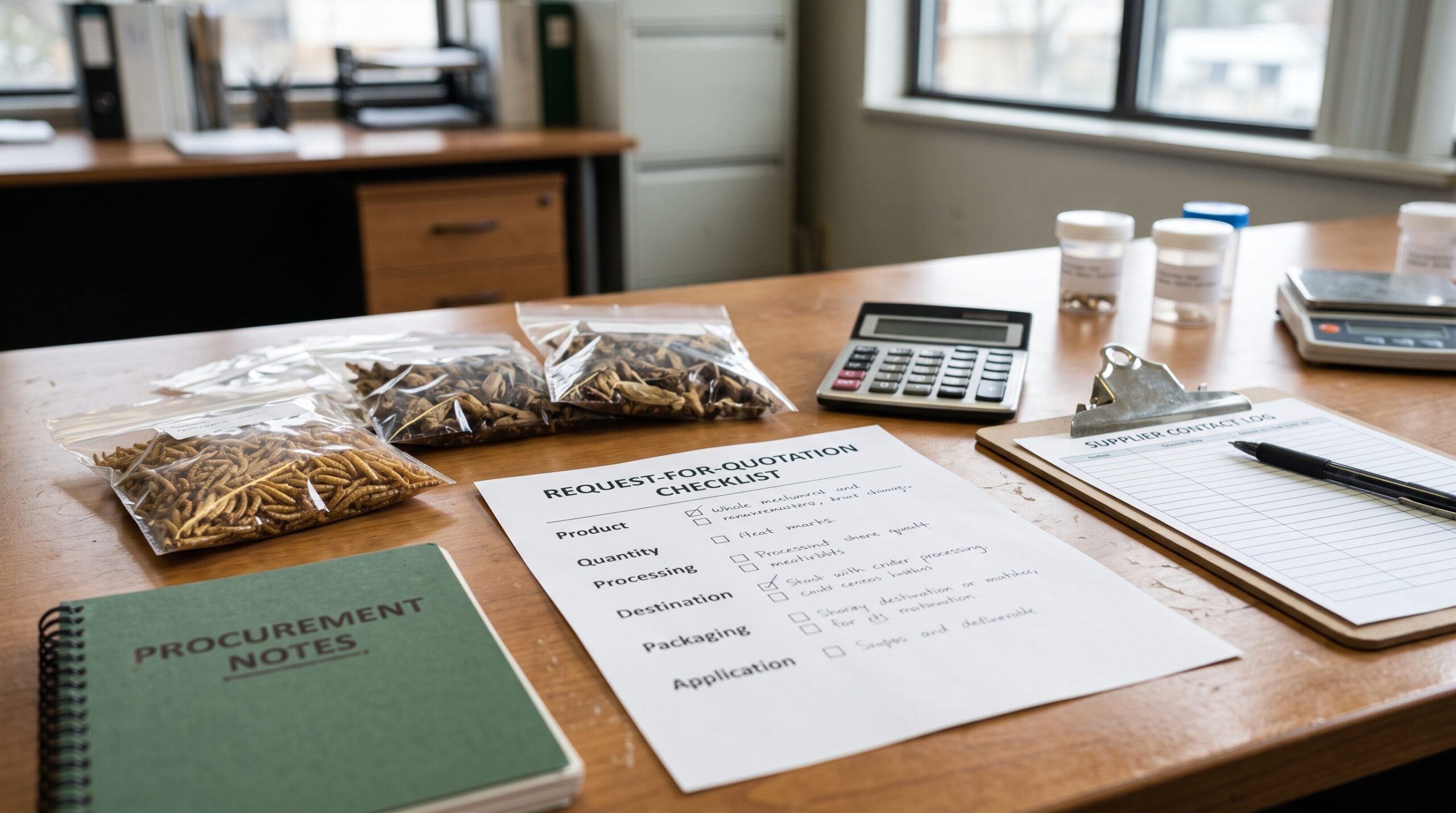

A clear bulk dried insect RFQ helps suppliers understand what you need and prepare a quotation on the correct basis. If important details are missing, two suppliers may quote different products, grades, packaging methods or shipping terms—even when their prices appear comparable.
For wholesalers, distributors, resellers, pet product businesses, farms and feed-related commercial buyers, a useful request for quotation should cover six essential points:
- Product
- Quantity
- Processing
- Destination
- Packaging
- Application
Providing this information does not mean that every technical detail must already be final. It gives the supplier enough context to identify suitable options, ask relevant questions and avoid a quotation based on incorrect assumptions.
Why a Complete RFQ Matters
A message such as “Please send your best price for dried insects” is too broad for an accurate commercial quotation.
Dried insect products can differ by species, whole-product condition, cleaning, drying method, grade, order volume and packaging. Freight and documentation also vary according to destination. Without these details, a supplier may provide only a general price range or quote an option that does not match the buyer’s intended market.
A well-prepared RFQ makes it easier to:
- compare suppliers on the same basis;
- reduce repeated emails;
- select an appropriate commercial grade;
- estimate packing and freight requirements;
- clarify sample and testing needs;
- identify potential import or documentation issues early;
- move from enquiry to trial order more efficiently.
The following sections explain what to include.
1. Product: Specify the Dried Insect You Need
Start with the insect species and product form. “Dried insects” is a category, not a complete product description.
State whether you are looking for:
- whole dried mealworms;
- whole dried earthworms;
- whole dried grasshoppers;
- whole dried crickets;
- whole dried maggots; or
- whole dried black soldier fly larvae (BSFL).
If you are comparing several products, list them separately. Do not combine all quantities into one unspecified total.
Where relevant, add the scientific name, preferred size or other identifying information. This can be particularly useful when common product names vary between markets.
Also describe your main quality priorities. For example:
- recognizable whole-product appearance;
- low level of fragments or dust;
- removal of soil or other impurities;
- particular colour or size range;
- commercial grade for bulk feeding;
- cleaner or more uniform grade for repacking.
You do not need to invent technical limits if you do not yet have them. Instead, explain what matters commercially and ask the supplier which grades are available.
2. Quantity: Give a Realistic Purchase Volume
Quantity affects the product price, packaging, lead time and freight calculation. An RFQ should therefore include more than the word “bulk.”
Provide one of the following:
- required quantity for the current order;
- estimated range, such as 500–1,000 kg;
- number of pallets;
- trial-order quantity;
- expected container volume; or
- approximate monthly, quarterly or annual demand.
If the first order is for evaluation, say so clearly. For example:
We plan to begin with a 500 kg commercial trial. If the product is approved, expected repeat demand is approximately 2–3 metric tons per quarter.
This is more useful than presenting a large annual volume without explaining the immediate purchase plan.
Buyers should also ask about the supplier’s current minimum order quantity rather than assume that the same MOQ applies to every insect species, grade or processing method.
3. Processing: Describe the Required Product Condition
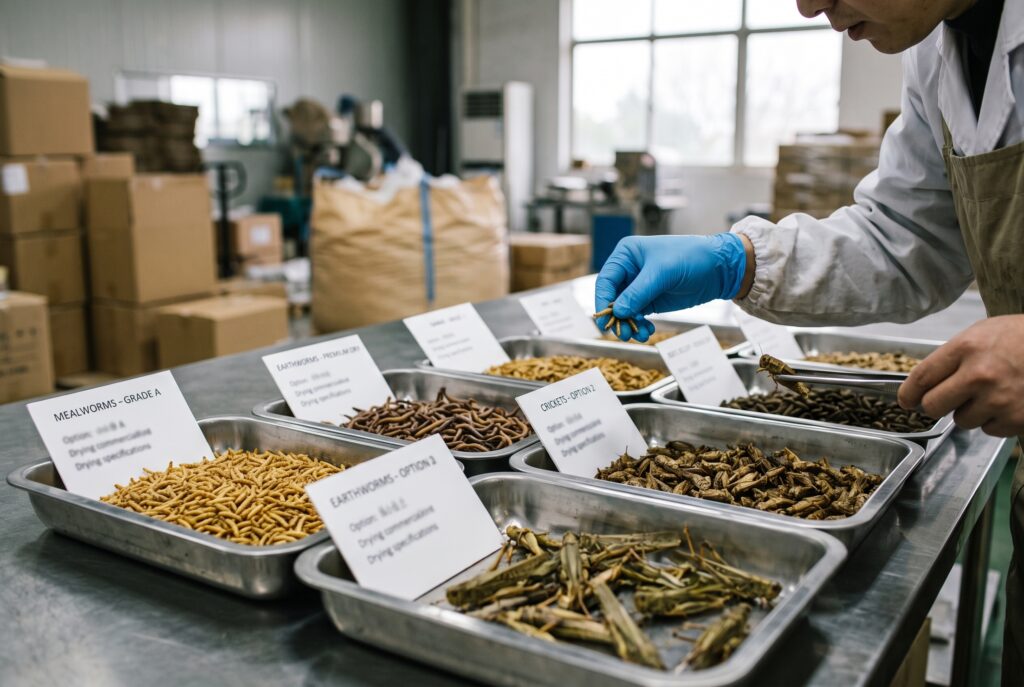
Processing can affect appearance, cost, moisture, storage and suitability for the buyer’s commercial purpose. Available options may vary by product and batch.
In your RFQ, state whether you prefer or want to compare:
- sun-dried;
- hot-air or heat-dried;
- microwave-dried;
- freeze-dried; or
- another available commercial drying option.
If you do not know which method is suitable, describe the outcome you need. For example:
- “We need whole dried mealworms with good colour and low breakage for retail repacking.”
- “We need a commercial grade for direct use by a poultry farm.”
- “Please quote available dried earthworm options with attention to cleaning and soil removal.”
Also mention whether you require whole insects. BulkInsects focuses on whole dried insect products rather than live insects or insect powder.
Processing requirements should not be confused with guaranteed final specifications. Nutritional, moisture, microbiological and other parameters should be confirmed using the relevant batch information and testing arrangements.
4. Destination: State the Country and Delivery Point
The destination is essential even when you initially request only a product price.
Include:
- destination country;
- destination port, city or postal code if known;
- preferred shipping method;
- requested Incoterm, such as FOB or CIF, if already decided;
- whether you will arrange freight through your own forwarder.
Destination information helps the supplier evaluate packing, freight basis, export documentation and possible import considerations. A CIF quotation cannot be prepared accurately without a named destination port. Door-delivery options generally require a complete location or postal code.
Buyers should verify the import requirements and permitted use of dried insect products in their own market. Requirements can depend on the insect species, origin, intended use and current local rules.
If you are still comparing markets, request an FOB quotation first and explain that the final destination has not yet been selected.
5. Packaging: Explain How the Product Will Be Handled
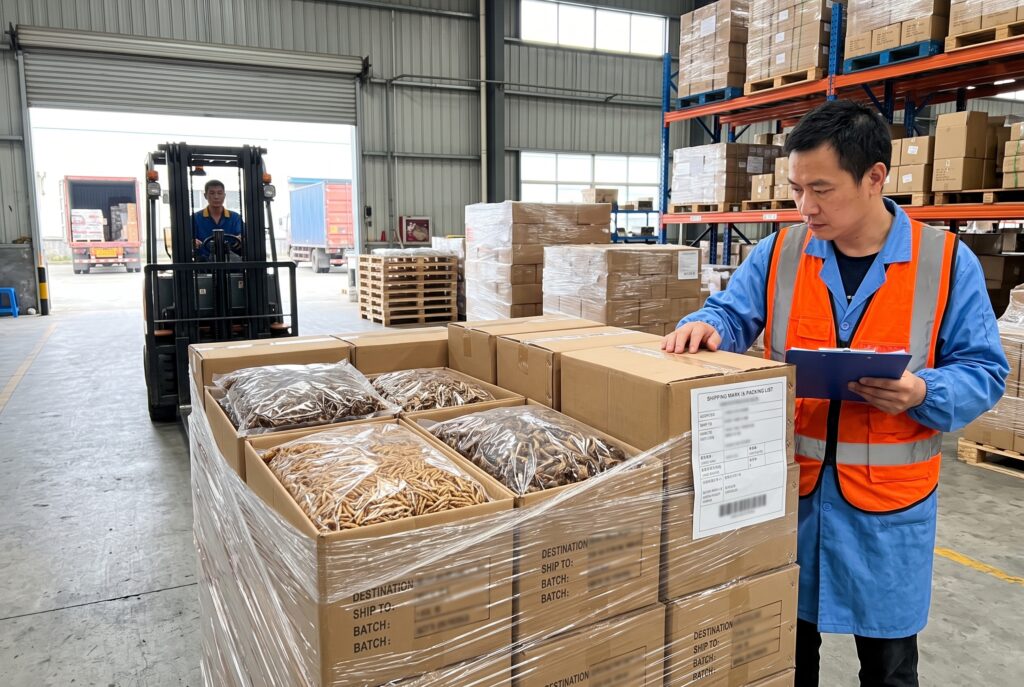
Packaging requirements depend on the order size, transport conditions and what happens after delivery.
Tell the supplier whether the product will be:
- stored in a warehouse;
- sold in original bulk packaging;
- divided into smaller packs;
- used directly by a farm;
- transferred into production or blending equipment; or
- repacked under the buyer’s own brand.
Then specify any known packaging preferences:
- target net weight per bag or carton;
- inner moisture-proof liner;
- outer bag or export carton;
- palletized or floor-loaded shipment;
- stretch wrapping;
- batch labels;
- shipping marks;
- neutral or customized outer packaging.
If you are unsure, ask the supplier to recommend a standard bulk packing option and provide the approximate package dimensions and weight.
For buyers who care about whole-product appearance, packaging should be discussed together with breakage risk. Larger bags may reduce packaging cost but can increase compression during handling. The preferred balance depends on the product and resale requirements.
6. Application: Tell the Supplier How the Product Will Be Used
Application is one of the most useful details in a bulk dried insect RFQ. It helps the supplier understand which commercial characteristics deserve priority.
Common applications include:
- wholesale distribution;
- retail repacking;
- pet product manufacturing;
- bird food;
- reptile food;
- poultry feeding;
- aquaculture;
- farm use; and
- feed-related processing.
A reseller may prioritize appearance, size uniformity and low fragments. A large farm may place more emphasis on delivered cost and manageable bulk packaging. A pet product business may require a cleaner, more uniform product and additional documentation for its internal approval process.
Avoid describing the application only as “feed” if you can provide more detail. The animal category, buyer type and next processing step can all influence the recommended product option.
Application information is used to improve product selection. It does not replace the buyer’s responsibility to confirm local regulatory suitability and formulation requirements.
Additional Information That Can Improve the Quotation
After the six essential items, include any purchasing conditions that may affect the offer.
Quality and testing requirements
State whether you need:
- a current product specification;
- a representative sample;
- a batch-related Certificate of Analysis;
- specified laboratory test items;
- pre-shipment inspection; or
- photographs or video of the commercial batch.
Testing requirements should be confirmed before the order because the required items may depend on the product and destination. Final parameters should be based on the relevant export, inspection or batch-testing results rather than treated as universal fixed values.
Required documents
List documents that your importer, customs broker or internal purchasing team has requested. These may include a commercial invoice, packing list, certificate of origin or other applicable documents.
Do not simply request “all certificates.” Tell the supplier which document names or information your market requires so availability can be checked accurately.
Target schedule
Include:
- preferred sample date;
- expected order date;
- required shipment window; and
- any fixed arrival deadline.
If the schedule is flexible, say so. This may make it easier to coordinate product availability, testing and freight.
Trade and payment terms
If your company has mandatory purchasing conditions, include them at the RFQ stage. Examples include preferred Incoterm, payment method, inspection condition or document approval process.
Bulk Dried Insect RFQ Checklist
Before sending your enquiry, check that it answers the following questions:
| RFQ item | Information to provide | Example |
|---|---|---|
| Product | Species, whole-product form and quality priority | Whole dried mealworms with good colour and low fragments |
| Quantity | Trial order, current order or repeat demand | 500 kg trial order; 2 MT quarterly if approved |
| Processing | Preferred drying option or required outcome | Microwave-dried preferred; quote available alternatives |
| Destination | Country, port/city and delivery basis | Rotterdam, Netherlands; CIF quotation requested |
| Packaging | Weight, materials, pallet and label needs | 10 kg lined bags in export cartons, palletized |
| Application | Buyer type and intended commercial use | Repacking for a pet product distributor |
| Testing | Required reports, samples or inspection | Representative sample and batch-related COA |
| Timing | Target order and shipment dates | Order planned in October; shipment within four weeks |
Example of a Complete Bulk Dried Insect RFQ
The following template can be copied and adapted:
Subject: RFQ – Whole Dried Mealworms for Wholesale Repacking
Hello,
We are a pet product distributor looking for whole dried mealworms for repacking. Please provide a quotation based on the following information:
Product: Whole dried mealworms
Quantity: 500 kg commercial trial order
Processing: Microwave-dried preferred; please advise available options
Quality priority: Good colour, recognizable whole appearance and low fragments
Destination: Rotterdam, Netherlands
Trade term: Please quote FOB and CIF Rotterdam separately
Packaging: Please recommend standard moisture-protected bulk packaging suitable for repacking
Application: Wholesale distribution and retail repacking
Testing: Please advise available batch testing and sample options
Timing: Purchase planned within the next four weeksPlease also provide current product photos, MOQ, lead time, payment terms and quotation validity.
Thank you.
This format gives the supplier enough information to prepare a relevant first response without making the RFQ unnecessarily complicated.
Common RFQ Mistakes to Avoid
Asking only for the lowest price
The lowest number may refer to a different grade, packaging basis, quantity or Incoterm. Define the product before comparing prices.
Hiding the intended application
Application helps the supplier recommend a suitable option. It does not weaken the buyer’s negotiating position.
Requesting CIF pricing without naming a port
Always identify the destination port for an ocean-freight quotation.
Combining several products into one quantity
State the required quantity for each insect species. MOQ and availability may differ.
Treating sample quality as an automatic shipment guarantee
Confirm how the commercial batch will be evaluated and whether the final shipment comes from the same batch as the approved sample.
Requesting fixed specifications before discussing the actual product
Use available specifications and batch testing to confirm what can be supplied. Avoid assuming that every natural product batch is identical.
Send a Clear RFQ and Receive a More Relevant Offer
A useful bulk dried insect RFQ does not need to be long. It needs to be specific about product, quantity, processing, destination, packaging and application.
These six details allow suppliers to understand the commercial requirement, recommend appropriate options and quote on a clearer basis. Adding testing, documentation and timing requirements further reduces uncertainty before a sample or trial order.
BulkInsects supports B2B buyers sourcing whole dried mealworms, earthworms, grasshoppers, crickets, maggots and black soldier fly larvae. Product availability, processing, packaging and batch testing are discussed according to each enquiry.
Preparing an RFQ? Send the six essential details above through our enquiry form, and we will review the requirement before providing product and quotation information.
Frequently Asked Questions
What does RFQ mean in dried insect sourcing?
RFQ means request for quotation. It is a purchasing enquiry that describes the product, quantity, processing, destination, packaging, application and other commercial requirements a supplier needs to prepare an offer.
What is the most important information in a bulk dried insect RFQ?
The six essential items are product, quantity, processing, destination, packaging and application. Testing, documentation, trade terms and required timing can then be added where relevant.
Can I request a quotation if I do not know the exact specification?
Yes. Explain the intended application and your main quality priorities, then ask which commercial grades and processing options are available. Do not invent specification limits simply to complete the enquiry.
Should I include my destination when asking for an FOB price?
Yes. The destination helps the supplier understand documentation and market considerations, even when the initial quotation is FOB. A named port is required if you also request CIF pricing.
Should a trial-order RFQ include expected future demand?
It can be helpful to state both the immediate trial quantity and a realistic estimate of repeat demand. The quotation should still be based on the actual current order unless another volume basis is clearly agreed.