As global aquaculture operations and premium poultry feed manufacturers scale their reliance on sustainable alternative proteins, securing an uninterrupted supply chain becomes the primary commercial objective. The global demand for insect biomass is accelerating, making the procurement of Wholesale Dried Crickets a highly strategic endeavor for international B2B buyers. However, transitioning from small-scale pilot formulations to massive Full Container Load (FCL) continuous processing exposes severe vulnerabilities in overseas manufacturing infrastructure. Many international procurement directors fail to rigorously evaluate the true industrial production capacity of their potential suppliers. Understanding the critical difference between verified factory throughput and dangerous agricultural aggregation is essential for protecting downstream extrusion schedules and maintaining a profitable Feed Conversion Ratio (FCR) on the farm.
The Bottleneck of Aggregation and Batch Consistency
When evaluating a potential supplier for Wholesale Dried Crickets, procurement teams must look beyond raw agricultural breeding capacity and focus entirely on the factory’s industrial dehydration throughput. The fundamental flaw in global insect procurement occurs when a supplier lacks the in-house processing machinery to fill a 40ft HQ container within a specified lead time. To meet massive volume demands under strict FOB or CIF shipping terms, unverified suppliers act as brokers, aggressively aggregating wet insect biomass from dozens of disparate, localized farming operations.
This fragmented sourcing strategy creates a catastrophic logistical phenomenon known as mixed-batch degradation. Because each small farm utilizes vastly different processing methodologies—ranging from cheap thermal oven-roasting to unpredictable open-air sun-drying—the broker mechanically blends conflicting biochemical profiles into a single commercial shipment.
The resulting cargo is dangerously volatile. Thermally roasted insects suffer from a severe Maillard reaction, locking heat-sensitive amino acids and rendering the protein biologically unavailable to commercial livestock. Meanwhile, the sun-dried portions harbor high residual moisture. When packed together in woven bulk bags, this moisture migrates throughout the container during ocean transit, inevitably triggering massive aflatoxin proliferation. Furthermore, this aggressive aggregation destroys all supply chain traceability. When destination border authorities, such as the Food and Drug Administration (FDA) in the United States, require rigorous origin documentation, brokers cannot provide accurate paperwork. This lack of transparency leads directly to mandatory cargo incineration and astronomical port demurrage fees.
Resolving Capacity with Microwave Dehydration
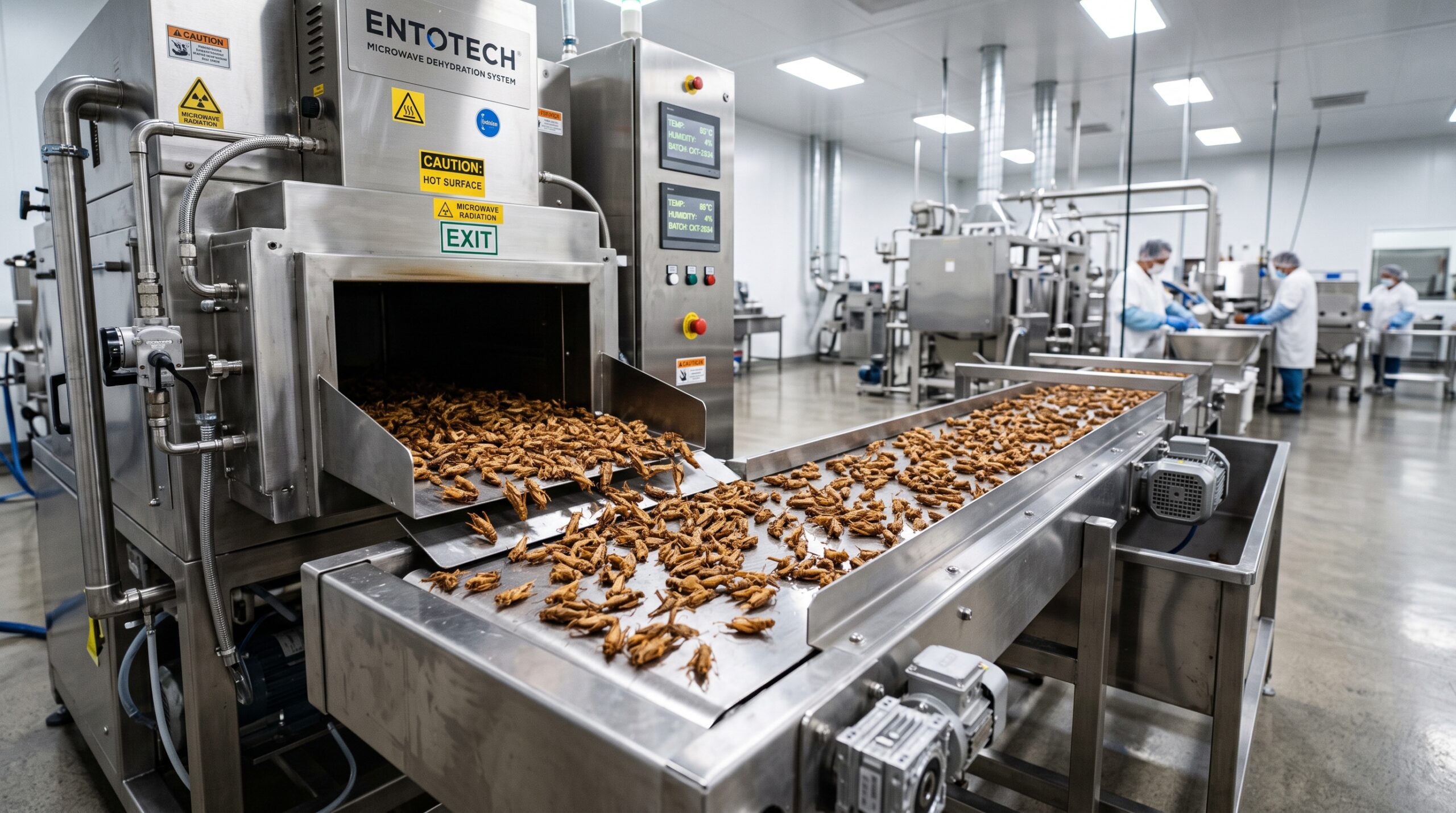
To systematically eliminate these supply chain blind spots and guarantee absolute batch uniformity across multi-ton contracts, industry-leading feed mills mandate direct partnerships with technologically equipped factories. A verified manufacturer ensures genuine production capacity by processing their entire output of Wholesale Dried Crickets through advanced industrial microwave dehydration technology. This state-of-the-art volumetric heating method serves as the ultimate industrial solution to the dehydration bottleneck.
Unlike traditional roasting ovens that require prolonged baking cycles, microwave technology generates heat directly from the water molecules within the biomass itself. This ensures rapid, highly uniform moisture evaporation from the inside out, allowing the factory to process massive daily tonnages continuously. Because the facility processes every single batch in-house using the exact same controlled electromagnetic exposure, the buyer receives a pristine, unblended cargo. Similar to the rigorous throughput required when scaling the supply of premium Dried Grasshoppers, this advanced technology ensures that the internal moisture content remains strictly below the 5% threshold across the entire FCL shipment, securing an 18-month shelf life without artificial preservatives.
Moreover, because this rapid volumetric processing successfully bypasses the thermal degradation zone, the structural elasticity of the exoskeleton remains intact, preventing wasteful dust accumulation during automated feed extrusion. Most importantly, the rapid processing preserves the pristine amino acid profile, securing a highly digestible ≥60% Crude Protein yield that maximizes biological performance on the farm.
Strategic Procurement and Risk Mitigation
Ultimately, executing a successful international procurement strategy requires physical verification of production capacity before assuming massive financial risk. Smart international buyers do not jump blindly into multimillion-dollar FCL contracts with untested facilities. Instead, they demand technological transparency and leverage a strategic 1000kg Minimum Order Quantity (MOQ) trial batch. This initial phase allows procurement directors to physically test the biological performance and structural resilience of Wholesale Dried Crickets on their own extrusion lines, validating the supplier’s actual delivery capabilities and SGS compliance.
Looking for a reliable manufacturer with verified industrial capacity? BulkInsects uses advanced microwave dehydration technology to deliver premium insect ingredients with guaranteed batch uniformity. Start your market test with our 1000kg MOQ. Contact us today for CIF pricing and free samples.